
A rise in air-purifier sales tells us that more devices are being bought. It does not tell us how much cleaner buyers’ rooms become, or whether those purchases will turn into regular use.
That distinction matters as Indian retailers and appliance makers report stronger demand. The business opportunity extends beyond selling a machine during a pollution episode: it includes explaining its limits and keeping it usable afterwards.
The Breakdown
In reporting published on November 15, Croma operator Infiniti Retail said its air-purifier volumes had more than doubled in 2026. The reported statement did not specify the exact comparison dates or base volume. It should not be read as a measured doubling of India’s entire market.
Amazon has also reported a doubling over a week, but that description appeared in coverage earlier in November. Without dated underlying sales data, repeating it today does not establish another week of doubling.
Manufacturers describe demand spreading beyond traditional markets and more advance purchases before seasonal pollution peaks. These are sellers’ observations, not a representative household survey demonstrating year-round adoption.
The evidence supports a narrower conclusion: businesses are reporting stronger interest, while the size, timing and durability of the wider shift remain harder to measure.
What performance actually means
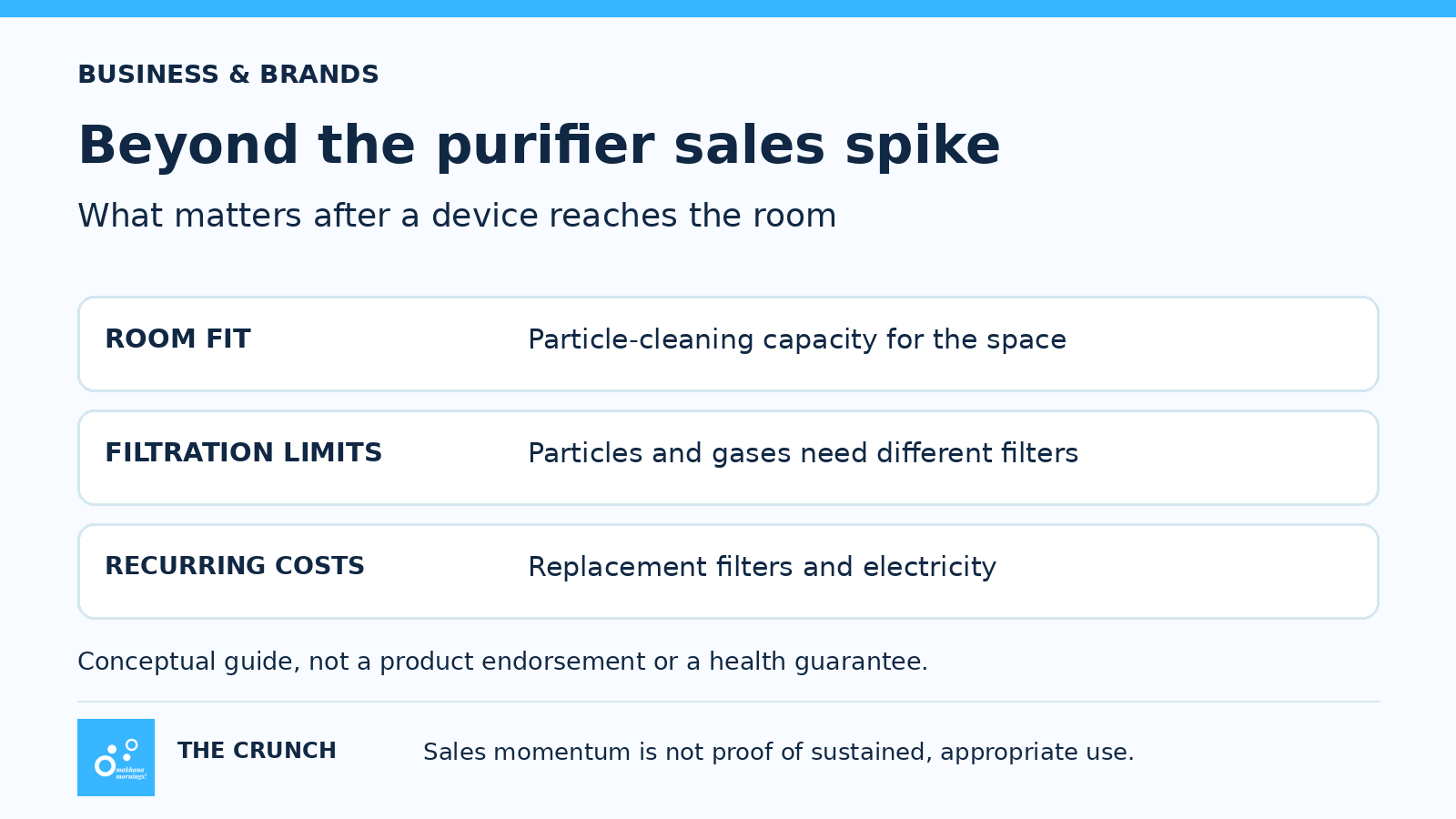
A room purifier is designed for a particular space, not automatically for an entire home. Clean air delivery rate, or CADR, measures the volume of filtered air delivered over time and helps relate particle-removal performance to room size. It is usually rated at the highest fan speed.
A quieter setting can filter less air. Filters also need replacement, and airflow must not be obstructed. A particle filter is not a guarantee of gas removal; those pollutants require suitable additional filtration. No purifier removes every pollutant.
Filtration complements control of indoor pollution sources and ventilation with clean outdoor air. Devices that deliberately produce ozone should be avoided.
Those limits make the recurring cost relevant. The purchase price is only one part of ownership: filter replacements and electricity also matter. For a brand, reliable availability of the correct replacement filter can be as important to continued use as a strong launch offer.
A pollution number is not a product guarantee
India’s ambient-air standards set PM2.5 concentrations at 40 micrograms per cubic metre as an annual average and 60 over 24 hours. WHO’s 2021 guideline values are lower: 5 and 15 respectively.
These use specified averaging periods. They are not instant appliance pass marks, and WHO guidance is not the same as India’s regulatory standard. A brief reading on a device cannot establish compliance with an annual average.
The Crunch
The stronger long-term proposition is not simply a purifier sold quickly. It is a device whose tested performance suits the room, whose running costs are understood and whose replacement parts remain available. Sales momentum is the opening signal; sustained, appropriate use is the harder consumer-business test.


Leave your thoughts