
Electric cars gained ground during India’s festive buying season even as registrations across the wider passenger-vehicle market declined. For manufacturers, the next opportunity depends partly on how quickly they can turn demand into completed deliveries.
JATO Dynamics India president Ravi G Bhatia’s published summary puts electric passenger-vehicle registrations at 40,122 over the 32-day festive period, up 69% from a year earlier. Overall passenger-vehicle registrations fell 7.2% to about 5.81 lakh. Electric vehicles’ share rose from 3.8% to 6.9%.
The Breakdown
Those figures describe registrations, rather than shipments from a factory to its dealers. The Economic Times identifies the comparison window as the Navratri-to-Bhaidooj period ending November 11. It spans parts of October and November, so it should not be treated as an October monthly sales result.
The distinction matters in a season when the festival calendar shifted between years. It also matters for the business question: a vehicle dispatched into the dealer network has not necessarily reached its eventual buyer.
Bhatia’s summary confirms the aggregate figures and argues that production capacity, variant availability and delivery speed could increasingly shape competition. It does not quantify how many additional vehicles would have been registered without supply constraints. Sources: JATO India president’s summary and The Economic Times.
What manufacturers have disclosed
Mahindra’s November 5 analyst-call transcript provides a concrete capacity example. Executive director Rajesh Jejurikar said the company had been unable to fully capture the EV opportunity because capacity was constrained at 8,000 vehicles a month. He said another 4,000 of EV capacity was on track to be added by February–March 2027, taking the total to 12,000.
That is a planned expansion, not capacity already operating throughout the festive period. Nor does a higher production ceiling guarantee an equal increase in registrations. Source: Mahindra’s November 5 transcript.
Tata Motors Passenger Vehicles’ November 13 investor presentation likewise flags EV supply-side constraints. Its discussion of the Sierra and Sierra.ev says volumes will scale as capacity is added to serve demand. This supports the broader delivery challenge without establishing a common bottleneck or timetable across manufacturers. Source: Tata Motors Passenger Vehicles Q2 FY27 presentation.
Why This Matters
Production capacity is only part of a completed sale. A buyer needs the right model and variant available in the right location, at a workable price and delivery date. For a manufacturer, the relevant follow-through is whether additional output reaches those customers rather than merely building stock elsewhere in the network.
The business opportunity is therefore more specific than a rising EV market share. Firms must decide which products to make, where to allocate them and how to coordinate suppliers and dealers. Aggregate registrations show what reached the market; they do not reveal every order still waiting.
The Crunch
Electric cars have increased their share of festive registrations. The next useful evidence will be completed capacity additions, model availability and deliveries after the seasonal peak. The growth opportunity is visible; how much each manufacturer captures remains an execution question.
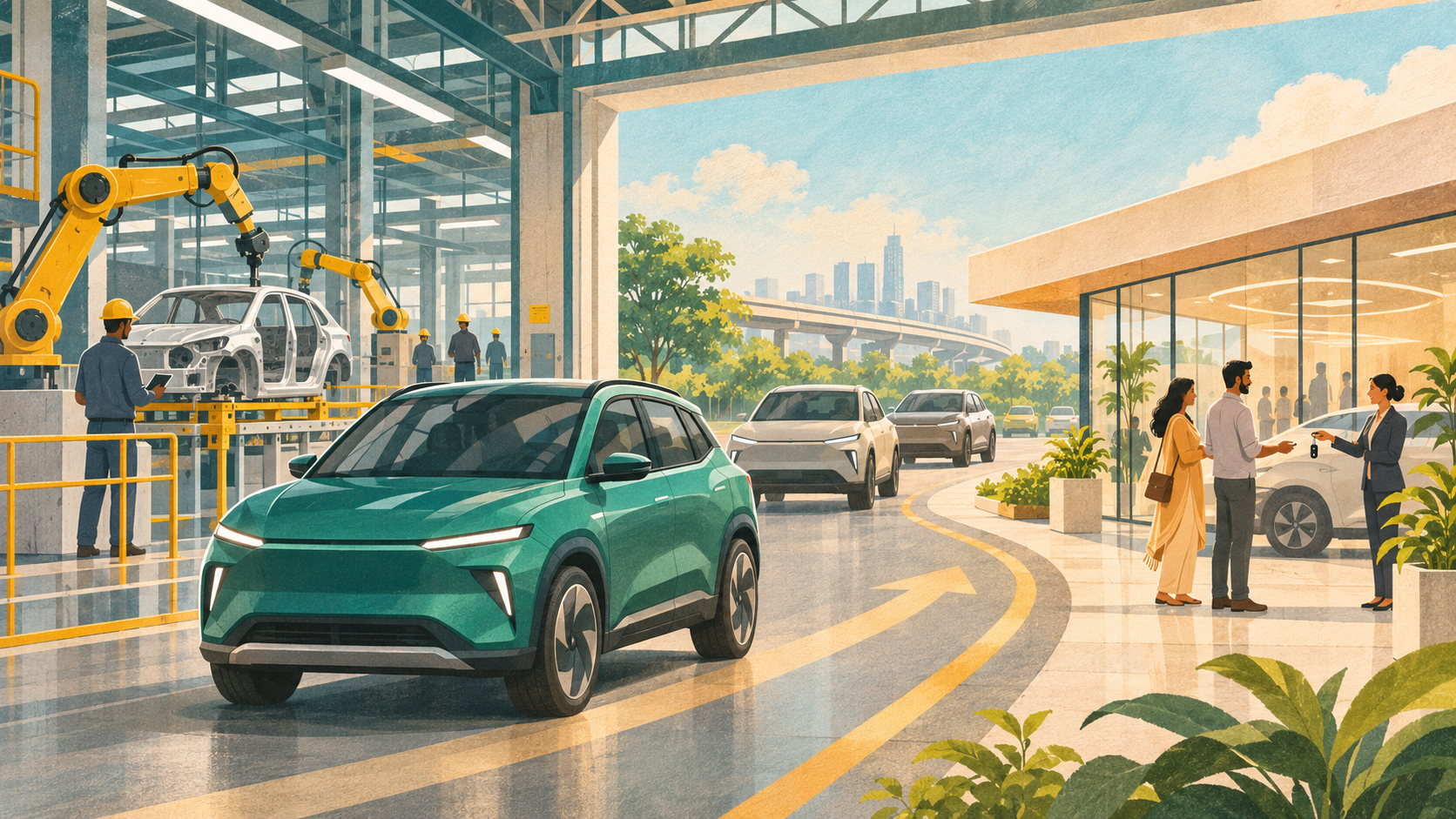
Cover: original AI-generated editorial illustration for Makhana Mornings.

Leave your thoughts