
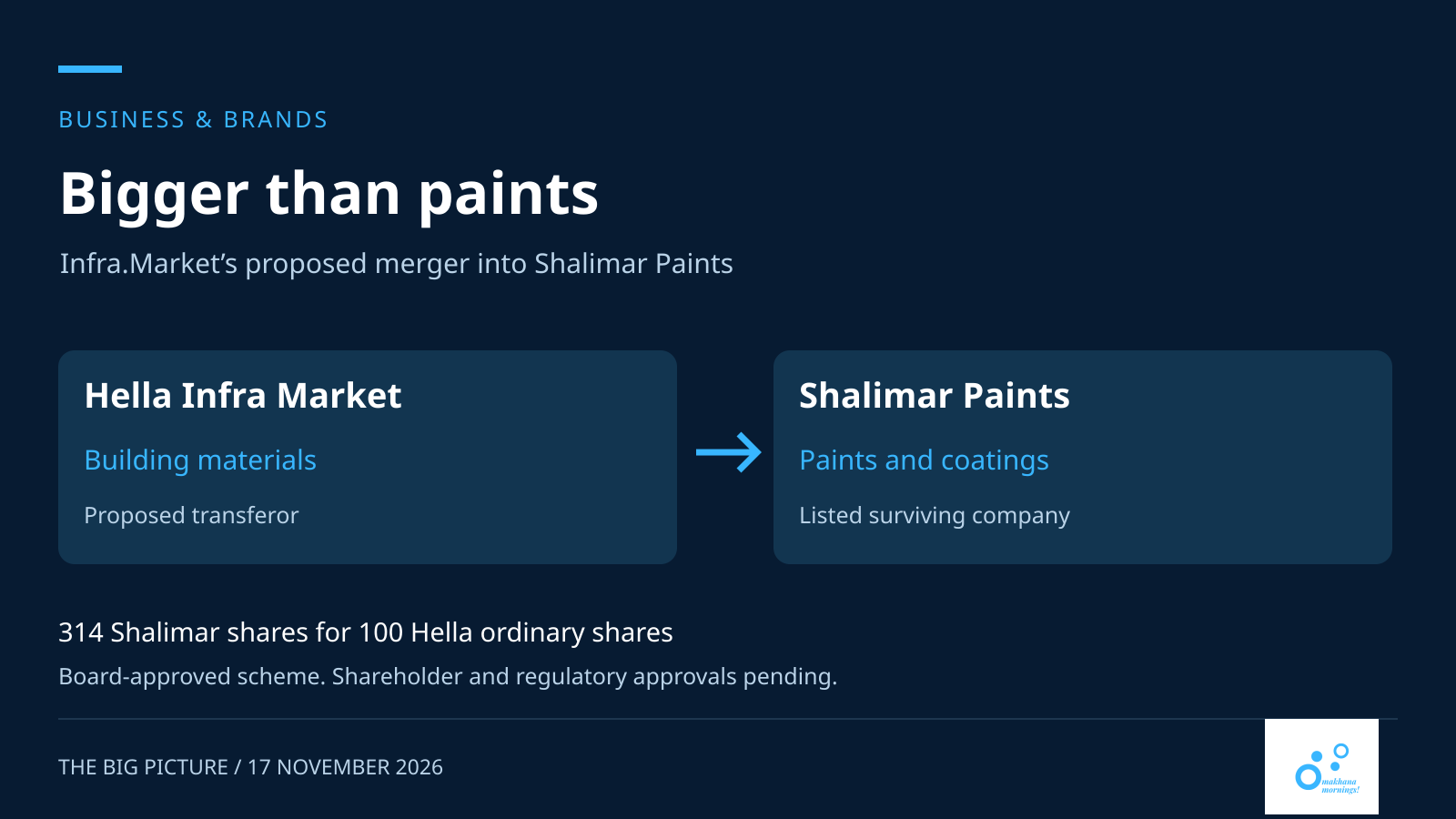
Shalimar Paints could become a very different business under a merger scheme its board approved on 16 November. Hella Infra Market, the building-materials company behind Infra.Market, would merge into the listed paints company, bringing a much wider construction-products portfolio into the same corporate entity.
The scheme still needs shareholder, creditor and regulatory approvals. For now, the announcement sets out a proposed transaction, not a completed merger.
What is moving into Shalimar?
Hella supplies products across the construction chain, including ready-mix concrete, steel products, tiles, plumbing and wood panels. Shalimar’s existing business centres on decorative paints and industrial coatings. The proposed combination would therefore change the breadth of the listed company’s operations, rather than simply expand its paint capacity.
The size difference is substantial. The filing reports consolidated turnover for the year ended March 2026 of ₹19,838.99 crore for Hella and ₹575.63 crore for Shalimar. Those are like-for-like consolidated figures, not a comparison of one company’s group revenue with the other’s standalone sales.
They should not simply be added to estimate the merged company’s revenue. Hella already holds 52.85% of Shalimar’s equity, according to the filing. Consolidation and intra-group eliminations matter.
How would the exchange work?
The scheme proposes 314 Shalimar equity shares for every 100 ordinary equity shares in Hella. It does not propose cash consideration.
That headline ratio applies to ordinary equity only. Hella’s compulsorily convertible preference shares have separate exchange ratios, with Series D6 and D7 treated separately from the other preference shares. Listed non-convertible debentures would be exchanged one for one for Shalimar debentures with equivalent face value and specified terms, including coupon, tenure and security.
Hella’s existing shares in Shalimar would be cancelled under the scheme once it becomes effective. The filing also describes an ongoing institutional placement, a proposed preferential issue and contemplated share swaps. A simple calculation from today’s share counts would therefore be a poor guide to any investor’s final ownership.
Why combine the businesses?
The boards’ stated rationale includes using manufacturing and distribution networks together, sharing procurement and logistics resources, and selling a broader product range through existing customer relationships. Those are expected benefits, not results already achieved.
The practical question is whether a combined group can turn that broader catalogue into better execution. More product categories bring opportunities to sell across the same construction project, but also make working capital, integration and operating performance important to follow.
What happens next?
The filing lists approvals from shareholders, creditors, the stock exchanges, the National Company Law Tribunal, SEBI and other authorities where required. The scheme names 1 April 2027 as its appointed date. That is the date from which the scheme is intended to operate, not a promise that every approval will be secured or the merger completed that day.
For readers tracking the business, the next useful checkpoints are the approval process, the eventual capital structure and how the enlarged company reports its different businesses. The board decision is a significant step towards a broader building-materials group. Its economics will become clearer as the transaction moves through those stages.


Leave your thoughts