
Raising money from investors is not just a question of finding buyers. A company must qualify for the route it chooses, explain what investors are buying, work through pricing and allotment, and meet the obligations attached to the issue.
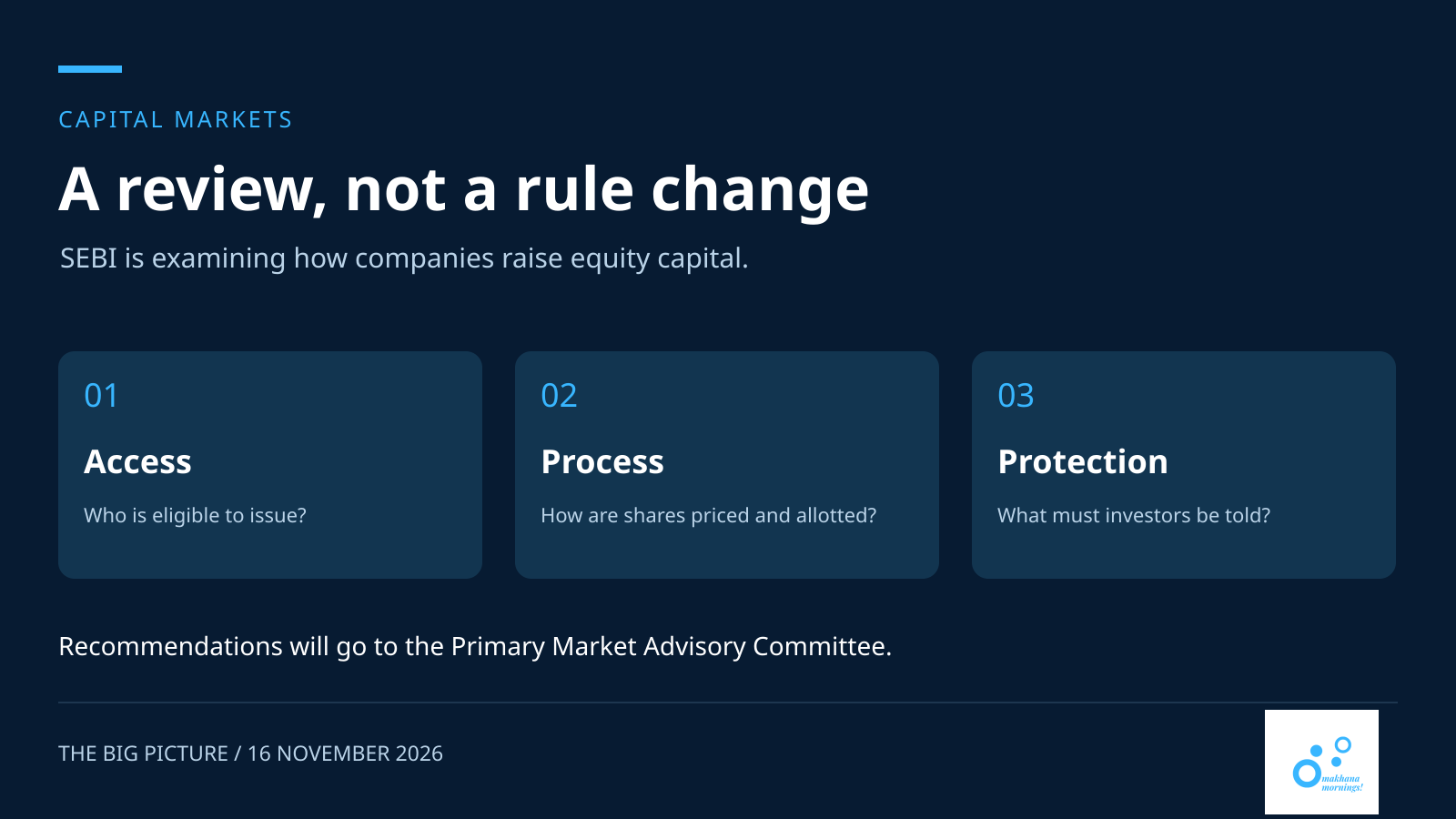
SEBI has now started a review of that machinery. On November 16, the regulator constituted a subgroup of its Primary Market Advisory Committee, or PMAC, to examine specified provisions of the Issue of Capital and Disclosure Requirements regulations.
The important distinction: this is a review mandate, not an announcement of new capital-raising rules.
The Breakdown
The scope includes eligibility, lock-ins, applications and allotment, disclosure, pricing and intermediary due diligence across IPOs, follow-on public offers, preferential issues and qualified institutional placements. Related directions and procedural inconsistencies are also in scope.
These routes serve different situations. An initial public offering brings a company to public investors for the first time. A follow-on public offer is a subsequent public issue by an already listed company. Preferential issues target selected investors, while qualified institutional placements are a route for listed companies to raise capital from eligible institutional investors.
A lock-in restricts when specified holders can sell securities. Price-discovery rules govern how an issue price is arrived at. Due diligence is the checking that supports the information placed before investors. These are different safeguards, so reviewing them does not necessarily mean relaxing them together.
Why This Matters
SEBI’s stated aim is to simplify access for eligible issuers and remove duplication while retaining adequate disclosure, investor protection and market integrity. The subgroup’s recommendations will go to PMAC for consideration.
The practical tension is familiar: repeated paperwork can consume time without adding useful information, but missing information can leave investors unable to judge a deal properly. A better process would distinguish between the two.
Consider an established listed company raising funds from institutions and a first-time issuer approaching public investors. The transaction histories, investor audiences and information needs are not identical. The relevant question is which requirements serve a clear purpose for each route, rather than whether every route can be made equally light.
The Big Picture
For companies and advisers, the announcement identifies the subjects to watch. It does not establish shorter timelines, lower costs, different eligibility thresholds or an effective date for revised rules. Existing requirements should not be treated as displaced by a committee’s terms of reference.
This is also distinct from SEBI’s separate review of the startup-listing platform. A review can open a policy discussion without settling its outcome.
The next meaningful evidence will be the recommendations and any subsequent regulatory decisions, particularly how they separate avoidable duplication from disclosures and checks that investors still need.
The Crunch
SEBI is reviewing the path to raising equity, not opening a shortcut today. The test will be whether any eventual changes make the process clearer without making the investment harder to understand.


Leave your thoughts