
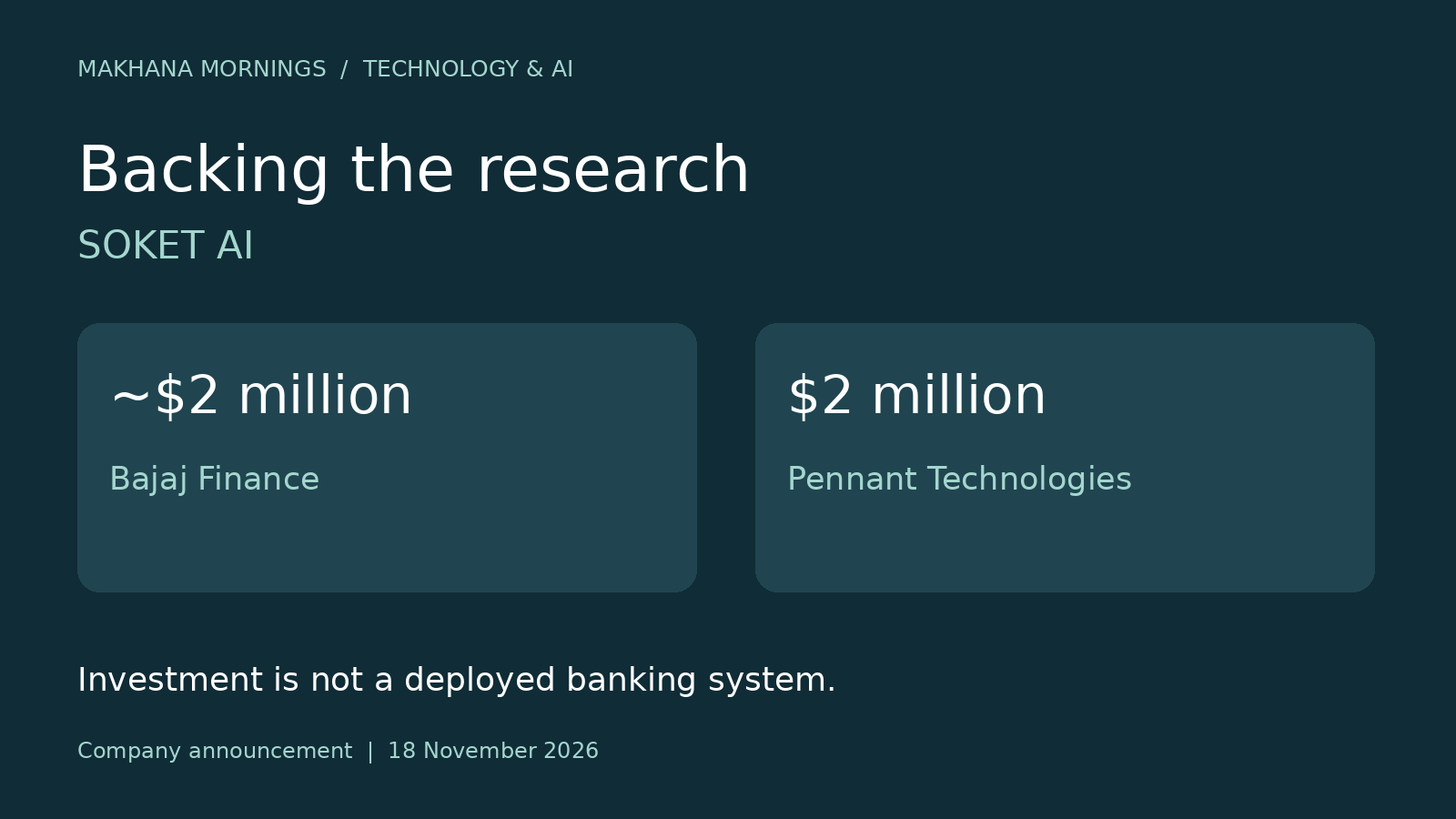
Soket AI’s next step has attracted capital from two businesses close to financial-services technology. Bajaj Finance and Pennant Technologies have invested about $4 million between them, according to a November 18 company announcement. The news is funding for research and potential applications, not evidence that a new AI system is already making banking decisions.
The Breakdown
The Bajaj Finserv release identifies approximately $2 million invested through Bajaj Finance under Finserv Intelligence, the group’s applied-research initiative. Pennant Technologies, itself a Bajaj Finance investee company, invested a further $2 million in the same round. These are separate contributions, not a $4 million investment by Bajaj Finance alone.
The companies describe a research relationship combining financial-services experience with Soket’s foundation-model work. Pennant says it wants locally developed models that regulated institutions can run on their own infrastructure. The release does not disclose a valuation or the investors’ ownership percentages.
A funding milestone, not a deployment result
Soket’s EKA-1 model is not being launched for the first time in this announcement. Our earlier coverage of India’s new AI models examined its release alongside ZenteiQ’s smaller models. The new development is the financial backing and intended research collaboration.
The release describes EKA-1 as a 26-billion-parameter model and separately sets out Project EKA’s ambitions for larger models and more than 100 languages. That roadmap should not be read as a statement that every planned capability is already available in the released model.
Why This Matters
For a financial institution, running software inside its own infrastructure addresses one part of the deployment question: where the system operates. It does not automatically establish answer quality, suitable access controls or reliable handling of exceptions.
The practical questions are therefore separate from the funding headline. What task would the model perform? Which records could it access? Who would review an uncertain result? What testing would show that it improves a particular workflow rather than simply adding another system to maintain?
Those are evaluation questions, not claims that this partnership has already answered them. The announcement does not provide measured savings, independently verified performance or evidence of a completed banking rollout.
The Crunch
The money creates room to develop and test. A credible next milestone would be a defined use case with documented results, deployment safeguards and clear responsibility for decisions. Investment and operating proof belong on different lines of the story.



Leave your thoughts