
A seed bank can be a village institution, a farmer group or a locally managed collection. Counting these organisations is useful. It is not the same as counting every seed variety available to farmers.
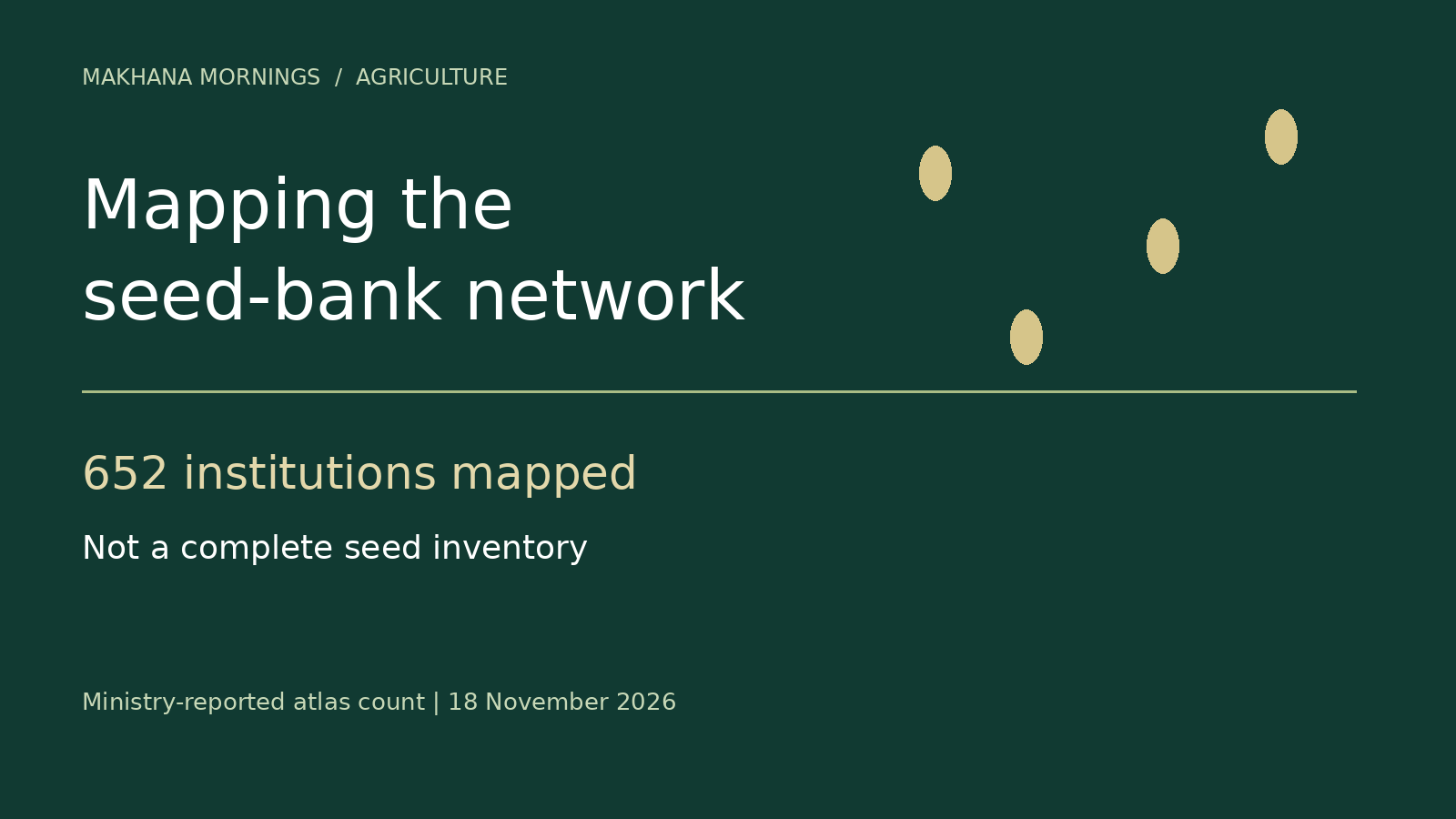
On November 18, the Agriculture Ministry reported that DIVERSIFARM-India’s digital atlas had mapped 652 community seed banks. The project’s survey identified at least 1,000 nationally. The findings were presented at a November 17–18 seminar in New Delhi, alongside a capacity-building manual and policy resources. These are the ministry’s dated figures, not a complete national census. Source: Agriculture Ministry.
The Breakdown
The project’s platform describes an ongoing survey. Researchers first identified roughly 300 organisations that promoted community seed banks through literature, reports and online searches. They then contacted organisations by email, telephone and online meetings. Information came from supporting organisations or seed-bank representatives, with consent for its use.
That approach helps locate a dispersed network. It also sets limits on what the map can establish: visibility through participating organisations is not proof of exhaustive coverage. The platform says seed mothers and family seed banks were excluded from the mapping because of their numbers and the difficulty of establishing how they serve communities. It also notes difficulty reaching traditional village-council banks.
An institution is not an inventory
The atlas groups banks by governance, including individual custodians, village councils, elected member committees, self-help groups, civil-society organisations and business-oriented farmer organisations. Different managers can mean different decisions about access, resources and continuity.
For a farmer organisation or potential supporter, the next questions are operational: who manages the bank, what material is available, when was it checked, and how do members obtain or replenish it? An institutional listing alone cannot answer all of those questions. Nor does the number of mapped banks demonstrate seed quality, higher yields or improved farmer incomes.
Support proposals are not funding commitments
The ministry says the new manual draws on Odisha case studies. A separate roadmap recommends a secretariat under the state’s agriculture department. Those are guidance and recommendations, not evidence that a new secretariat or funding programme has been approved.
DIVERSIFARM-India is a research collaboration involving the M.S. Swaminathan Research Foundation and Norway’s Fridtjof Nansen Institute, funded by the Royal Norwegian Embassy. Its stated work includes mapping institutions and examining how to strengthen them. Source: MSSRF project description.
This is distinct from allocating payments linked to crop biodiversity. A map identifies institutions; a payment record tracks money; evidence of conservation requires observing what happens to the material and knowledge being maintained.
The Crunch
The atlas makes a dispersed seed-conservation network easier to find. Its value grows when listings connect to current records and durable local management. The useful headline is better visibility, not a completed inventory or a demonstrated agricultural outcome.


Leave your thoughts