
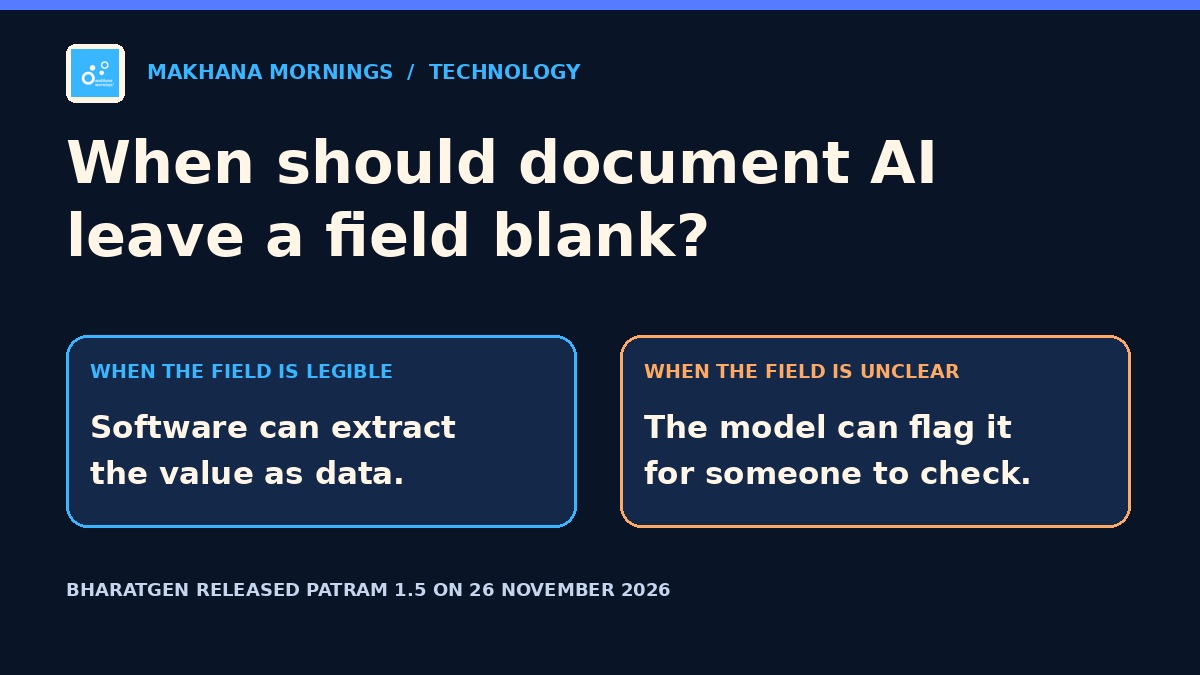
A scanned invoice may have a clear total but a blank purchase-order number. If software invents the missing number, it can send the invoice to the wrong approval queue. If it flags the blank, someone can check the original instead. BharatGen’s Patram 1.5, released on 26 November, is designed to do the latter when the page cannot support an answer.
Reading a page is not the same as copying its text
Optical character recognition, or OCR, converts text in an image into text a computer can use. Patram 1.5 takes the image directly and can be asked for a specific field, table or section rather than a full transcription. It can return the result in a structured format such as JSON, which lets business software pick up a field without someone copying it by hand.
That matters on forms where position conveys meaning. A number beside ‘amount paid’ is not necessarily the same as one beside ‘amount due’. The model is designed to flag missing, unreadable or contradictory information rather than always supplying an answer. A flag can trigger manual review. Its absence does not prove the extraction was right.
What its launch tests establish
BharatGen’s model card reports 7.8 billion parameters and weights released under Apache 2.0, with sign-in and access conditions on Hugging Face. The developer tested the model across 34 public benchmarks and 15 tasks from its own PatramBench, weighting the public and in-house results equally in its overall score. The public benchmark runs used English test items. The results are developer-run and do not establish accuracy for every Indian language or every document workflow.
The Crunch
Before automating an approval, test two things separately: how often the model copies the right number when it is visible, and how often it refuses to guess when the field is blank or illegible. A correct refusal keeps an uncertain value out of a business system. The useful test is whether the software can do that on the forms the business actually receives.

Leave your thoughts