
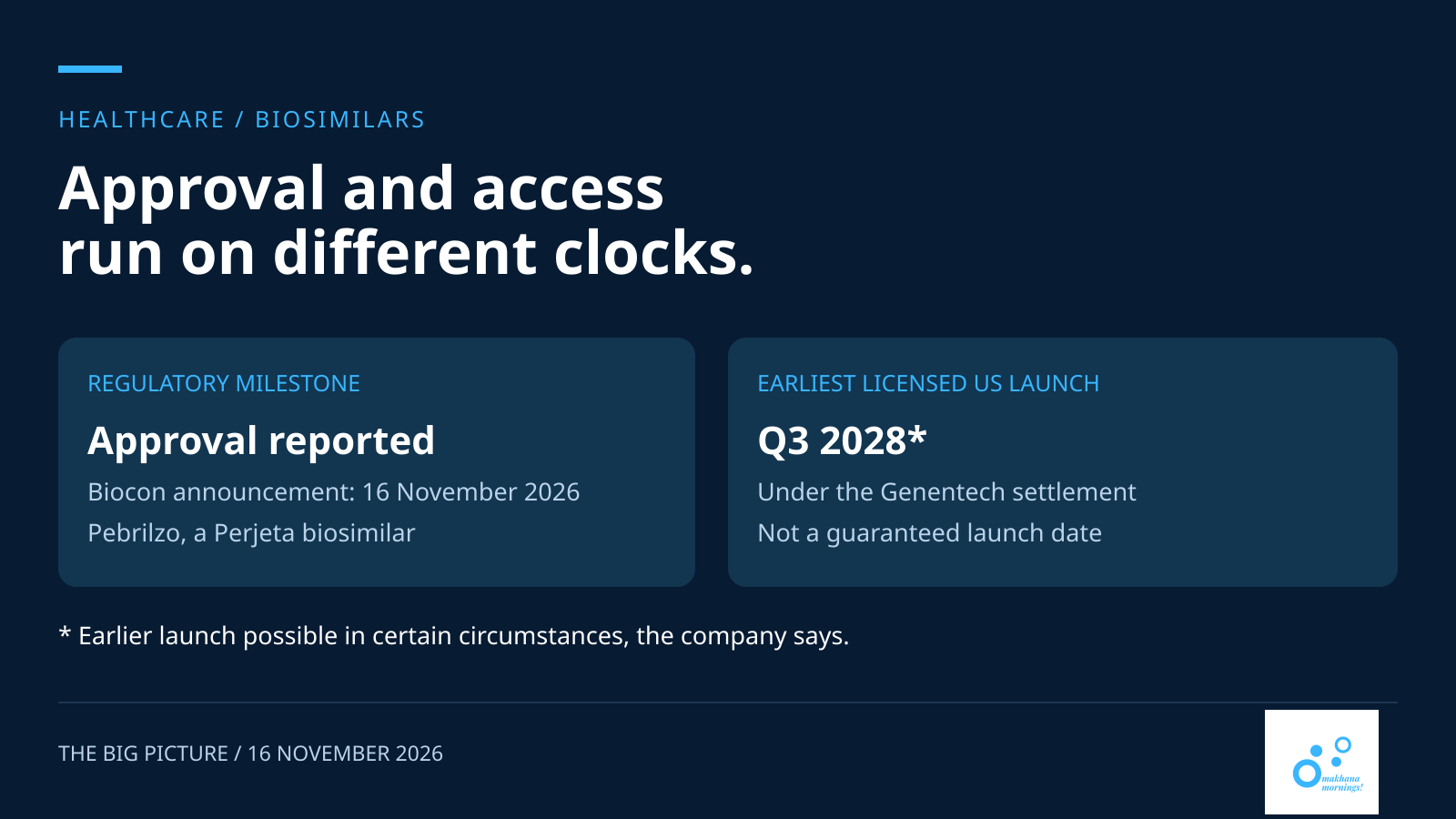
Biocon has reported a US regulatory milestone for Pebrilzo, its biosimilar to the breast-cancer medicine Perjeta. The commercial timetable is a different matter.
In a November 16 announcement, the company said the US Food and Drug Administration had approved Pebrilzo, also named pertuzumab-qcay. Its settlement with Genentech sets the earliest licensed US launch in the third quarter of calendar 2028, with earlier launch possible in certain circumstances.
That gap explains why an approval headline should not be read as immediate availability, an announced selling price or a promise of savings.
The Breakdown: two milestones, two different questions
A regulatory review assesses whether a medicine meets the standards for approval. A patent settlement can separately determine when a company is licensed to bring that product to market. In this case, Biocon’s October 14 settlement announcement and its November approval announcement describe those distinct steps.
The settlement also named earlier licensed launch windows for other regions, subject to regulatory approval. Its remaining terms are confidential. The stated US window is therefore the relevant reference point, not a guaranteed launch appointment or evidence that sales have begun.
What makes it a biosimilar?
Biologic medicines are made using living sources, such as cells. A biosimilar is developed against an existing biologic, known as the reference product. The FDA requires high similarity and no clinically meaningful differences in safety and effectiveness. This is a different regulatory pathway from that used for conventional generic medicines.
Pebrilzo’s reference product is Perjeta. Biocon describes its use in specified HER2-positive breast-cancer settings, alongside other medicines. It should not be understood as a treatment for every breast cancer or as a standalone substitute chosen without clinical supervision.
The European Medicines Agency’s published record supports the Pebrilzo name and records a positive recommendation on September 17. That recommendation is a separate European process, not evidence of US launch or of availability in India.
Why This Matters: access comes after the headline
Biosimilar competition can widen treatment choices and may reduce costs. But the FDA’s general explanation of that potential does not establish what any particular product will cost. Biocon’s announcement does not provide a US launch price or a patient-level savings figure.
For an Indian pharmaceutical business selling overseas, the practical distinction is important. Scientific development, regulatory clearance and the ability to commercialise a product are connected, but they need not happen on the same date. Treating an approval as immediate revenue would skip the launch conditions that the company itself has disclosed.
Our Morepen US-market explainer similarly separates a launched medicine from a filing under review. The broader lesson is to identify which milestone a company has actually reached before judging the commercial outcome.
The Crunch
Biocon’s reported approval moves Pebrilzo’s US story forward. The next meaningful evidence is a confirmed launch, actual supply and commercial terms. Until then, the earliest licensed window remains a condition on the access story, not proof that patients can obtain the medicine today.
Related categories: Business & Brands



Leave your thoughts