
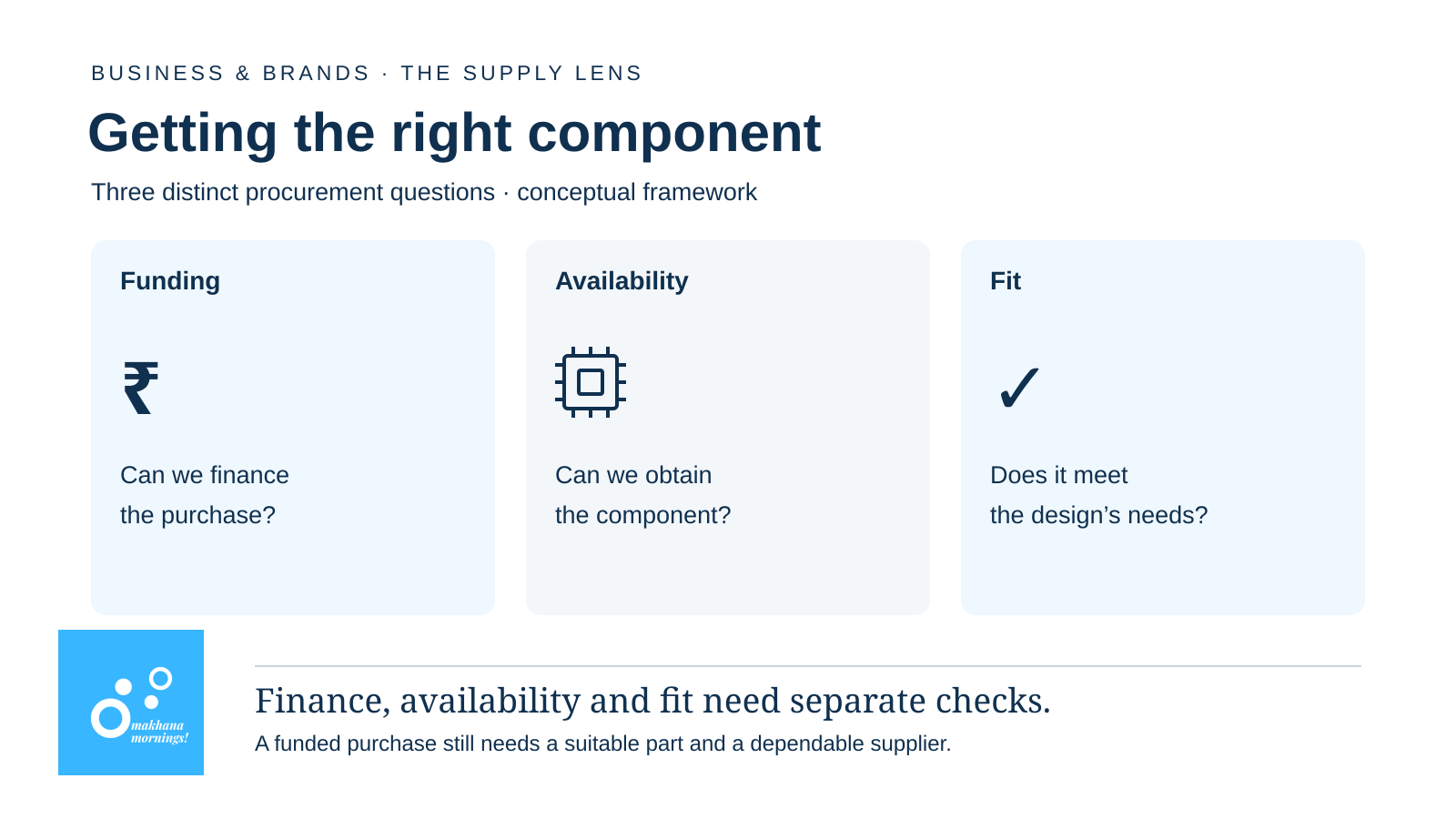
A bigger parts inventory can help a drone maker cope with unpredictable deliveries. It works only if the company can obtain the component in the first place.
That distinction makes India’s deeptech import problem more specific than a shortage of investment. Financing the purchase, finding an available supplier and securing a component suitable for the product are different jobs.
The Breakdown
Equipment for thermal imaging offers a concrete example. In its June 4, 2026 assessment of ideaForge, India Ratings cited the company’s indication that thermal imagers remained constrained across the drone industry and could affect delivery schedules. The agency also identified dependence on imported high-precision sensors, semiconductors and lithium-ion batteries.
Those categories are not interchangeable. A supply of battery cells cannot fill a gap in imaging equipment. Nor does a general announcement of semiconductor capacity establish that a particular sensor or camera system is available.
India Ratings said supplier diversification and inventory planning could partly mitigate the risk. It nevertheless identified uninterrupted access to constrained components as a continuing sensitivity. That is a credit assessment specific to that company, not a measured shortage rate for every Indian deeptech business.
Buying a buffer has a cost
Crisil’s May 27 assessment of the same company explains the financial response. It linked inventory requirements to import lead times and the breadth of ideaForge’s products, and said geopolitical and supply-chain uncertainty encouraged larger buffers.
Holding more components can reduce exposure to a late shipment. It also commits money before those components become a delivered product and a customer payment. In this setting, more capital can support resilience without removing the underlying availability risk.
The reports do not justify a distress narrative. Both agencies assessed liquidity as adequate at the time. India Ratings also attributed much of ideaForge’s longer FY26 working capital cycle to the timing of order buildup and execution, rather than solely to imports.
What a domestic alternative involves
An older ISRO example shows the technical work behind developing a domestic component. In March 2025, the agency described VIKRAM3201, a processor developed with the Semiconductor Laboratory, fabricated at its Chandigarh facility and qualified for conditions encountered by launch vehicles. ISRO also developed the associated software tools, and the processor’s initial lot was validated in space on POEM-4.
The example combines design, fabrication, software and validation. It illustrates a specific capability built over time; it does not establish that this processor is a commercial replacement for a startup’s chosen chip, or a solution to a shortage of imaging equipment.
Why This Matters
For founders and investors, the useful question is which input can interrupt the product’s schedule. Then ask what the available response actually does: buys more time through inventory, adds another suitable supplier, or develops a replacement that still needs validation.
The distinction also helps assess announcements about domestic manufacturing. The relevant evidence is a usable component with the required performance, supply volume and delivery schedule. A broad investment total leaves those questions about individual products open.
The Crunch
India’s deeptech companies need money to build. They also need dependable access to the specific parts their designs require. Funding a buffer and creating an alternative supply are complementary tasks, with different costs and timelines.



Leave your thoughts