
A capability built to serve one business group can become a business in its own right. But that does not make every shared-services operation the same kind of Global Capability Centre.
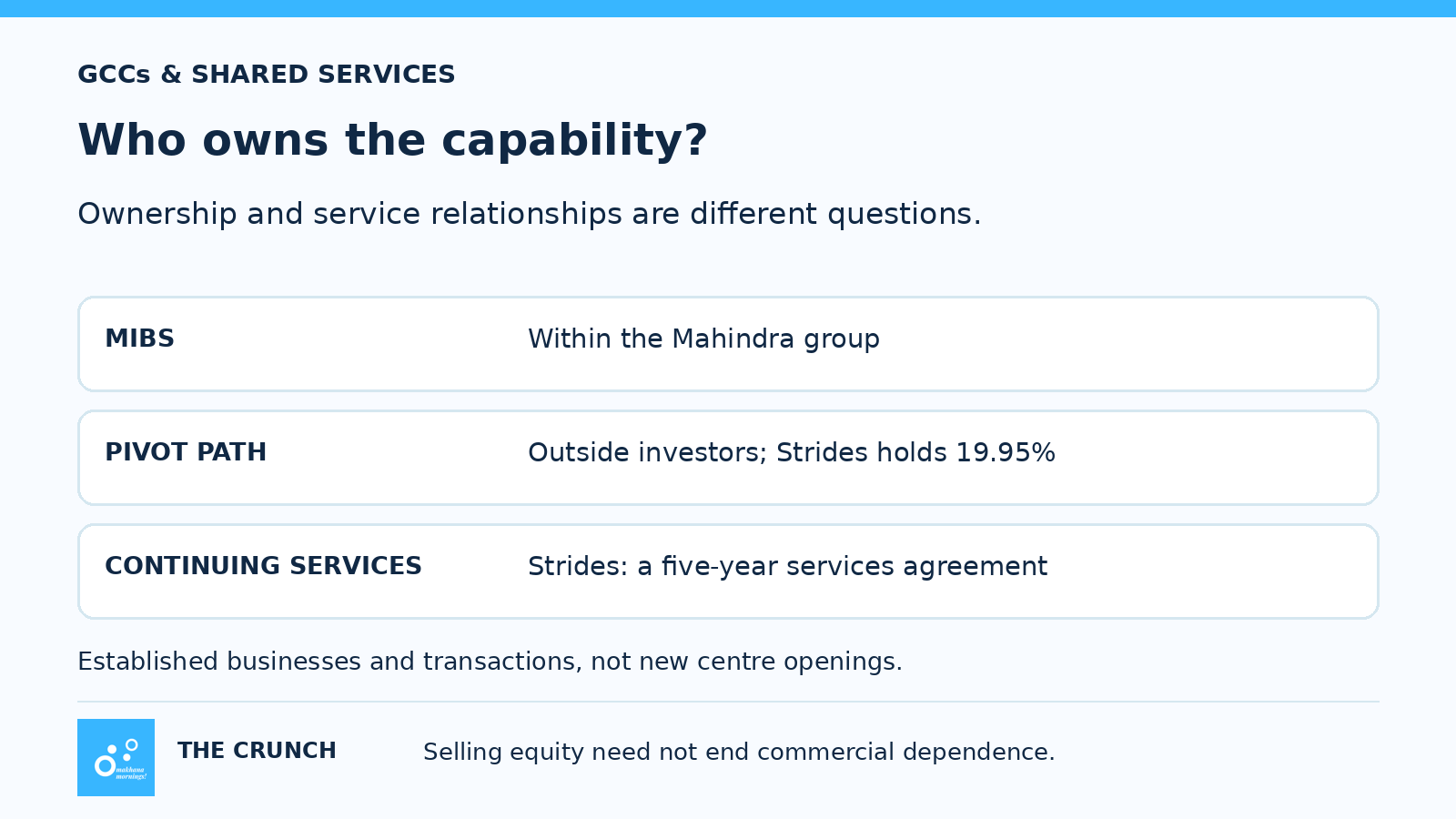
Mahindra Integrated Business Solutions and Strides Pharma’s former subsidiary Pivot Path illustrate the distinction. One sits within an Indian business group while marketing services to a wider customer base. The other has brought in outside investors, leaving its original parent with a minority stake and a long-term services contract.
These are established businesses and transactions, not two new centre openings. Their value is in showing what changes when a company decides to own a capability, sell its services or share its ownership.
The Breakdown
Mahindra Integrated Business Solutions, or MIBS, was incorporated in January 2011 and began operations that May. Its FY2025 annual report identifies Mahindra & Mahindra as its immediate and ultimate parent. Its services include accounting and payroll; its website also markets broader business solutions.
The public material does not establish how much of MIBS’s revenue comes from outside the group. An external-facing service offering should not be confused with proof that external customers dominate its business.
Pivot Path followed a different route. Strides carved the Life Sciences and Digital Innovation capabilities business out of Arco Lab into Pivot Path. This was a business demerger, not simply a renaming of the whole of Arco Lab.
In June 2026, Strides announced an investment by a consortium led by Ascent Capital, with Vintage Classic. By July, the majority-stake sale was complete. Strides’ September-quarter results record a retained holding of 19.95% and classify Pivot Path as an associate rather than a controlled subsidiary.
Strides remained a customer. The transaction included a five-year Master Services Agreement with minimum revenue commitments and annual price escalation.
Why This Matters
The ownership decision changes the relationship. A group-owned centre can be directed through the parent’s management structure. A separately controlled service provider needs contractual arrangements for the work the former parent still depends on.
For an Indian company considering either model, the practical questions therefore go beyond where to hire. Who sets priorities? Which capabilities must remain under direct control? How will service quality, confidential information and competing customer demands be managed?
A long-term customer commitment can support a newly independent business, but it also creates an obligation for the buyer of those services. Selling equity does not necessarily end commercial dependence.
The Crunch
These examples do not establish how quickly Indian companies are adopting the GCC model. They show why the label alone is insufficient: the important distinction is who owns the operation, who buys its services and what obligations connect them.

Leave your thoughts