
Shield’s new Bengaluru office adds a software-engineering role to its India presence. It is a different investment from the aircraft-manufacturing partnership already being developed with JSW Defence.
The US defence-technology company announced the office opening on November 13. Indian engineers will develop and test autonomy software for Indian aircraft and defence systems, working on its Hivemind platform. The company listed roles in software, simulation, integration and testing, but did not disclose a hiring target or an office investment amount.
The Breakdown
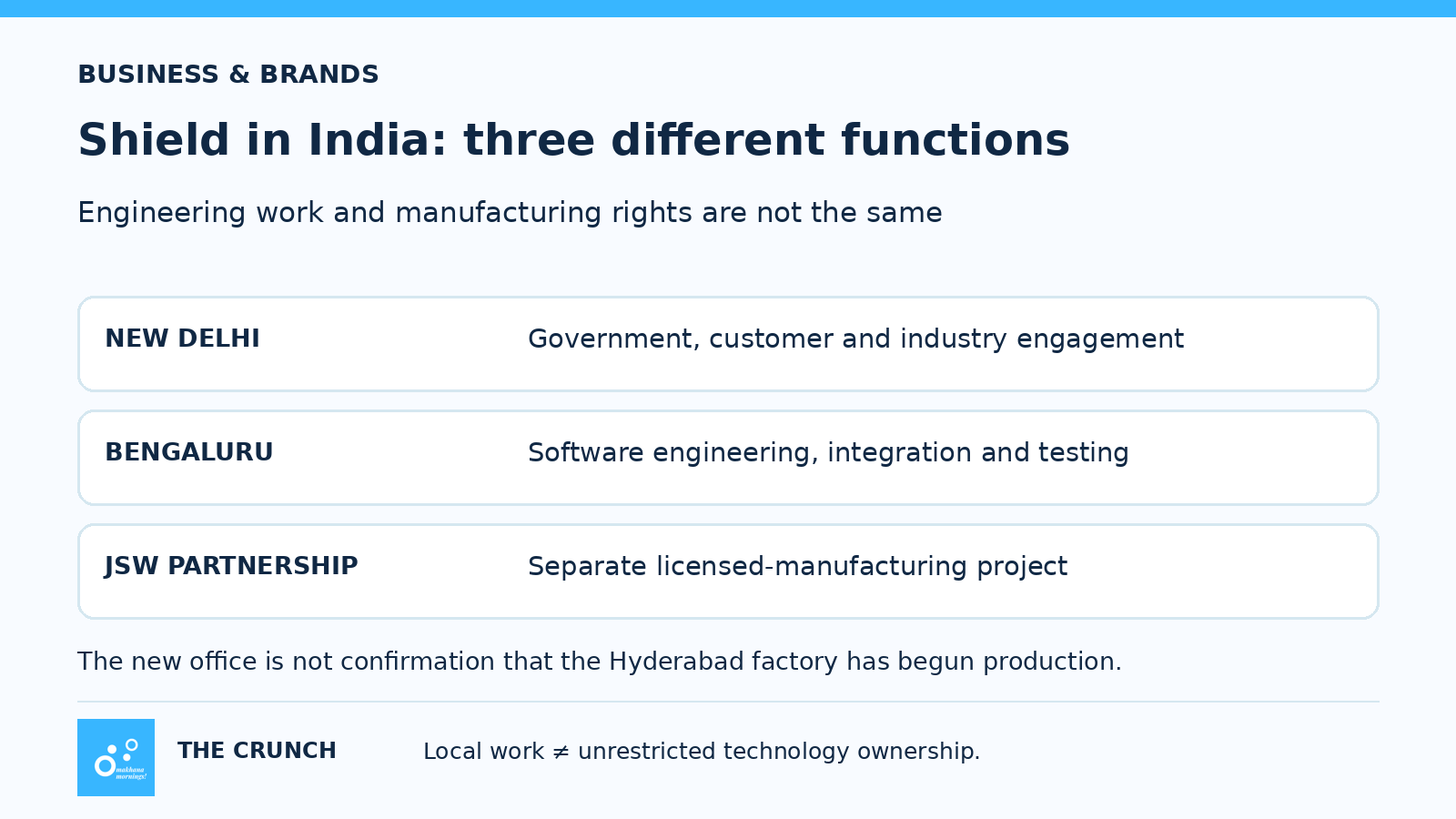
Shield’s India footprint has three distinct functions.
Its New Delhi office, opened in April, leads engagement with government, the armed forces and industry. Bengaluru adds engineering and testing. Separately, JSW is developing manufacturing capacity for Shield’s V-BAT unmanned aircraft under a licensing arrangement.
The Bengaluru opening follows the expansion plan announced in April. It is not a fresh announcement of the JSW partnership, nor does it establish that aircraft production has begun at the Hyderabad project.
What localisation actually covers
The manufacturing arrangement illustrates why the scope of an agreement matters more than a broad claim of localisation.
In its May assessment of JSW UAV, ICRA described acquired rights to manufacture, market, sell and provide after-sales support for V-BAT in India. It also said export sales would go directly to Shield under an offtake agreement, rather than to any overseas buyer JSW might choose.
Those are specific commercial rights. They should not be read as unrestricted ownership of every underlying technology. Nor can the terms of a manufacturing licence be assumed to describe ownership of software developed at a separate engineering office.
ICRA also distinguished completing the manufacturing project from validating it and beginning commercial operations. JSW’s November investor presentation still describes infrastructure being set up in Hyderabad. Neither document turns the Bengaluru office opening into a production milestone.
Why This Matters
For India’s engineering workforce, the stated Bengaluru mandate is more specific than customer support: software development, integration and evaluation are part of the proposed work. Its eventual scale will depend on hiring and the responsibilities actually assigned to the team.
For the wider industry, three questions need separate answers. What work is performed locally? What contractual rights accompany that work? And what products or services have been validated and delivered?
An office address answers only part of the first question. It does not settle the other two. The distinction allows local engineering to be recognised without converting an expansion announcement into proof of complete technological independence.
The Crunch
Shield is adding an engineering base alongside customer engagement and a separate licensed-manufacturing partnership. The useful next evidence is the work and responsibility that move into India, not an assumption that all three activities confer the same capabilities or rights.

Leave your thoughts