
A ship can be delivered before it is ready to carry a full commercial load. Transport Corporation of India’s fleet expansion makes that distinction unusually concrete.
TCI expects two new vessels, involving about ₹350 crore of investment, to lift shipping capacity by roughly 20%, according to management’s latest comments. That is an expectation for the pair, not evidence that both are already operating.
The Breakdown
The completed milestone is TCI SETU’s delivery on October 29. The company disclosed investment of about ₹178.82 crore in the 500-TEU container carrier, financed through internal accruals. It is the first of two vessels covered by an agreement announced in July 2024.
The delivery filing describes the existing fleet as six ships with 78,120 deadweight tonnes of capacity. Deadweight measures the weight a vessel can carry, including cargo, fuel and stores. TEU measures container capacity in units equivalent to a standard 20-foot container. Neither number tells us how much cargo actually moved during a quarter.
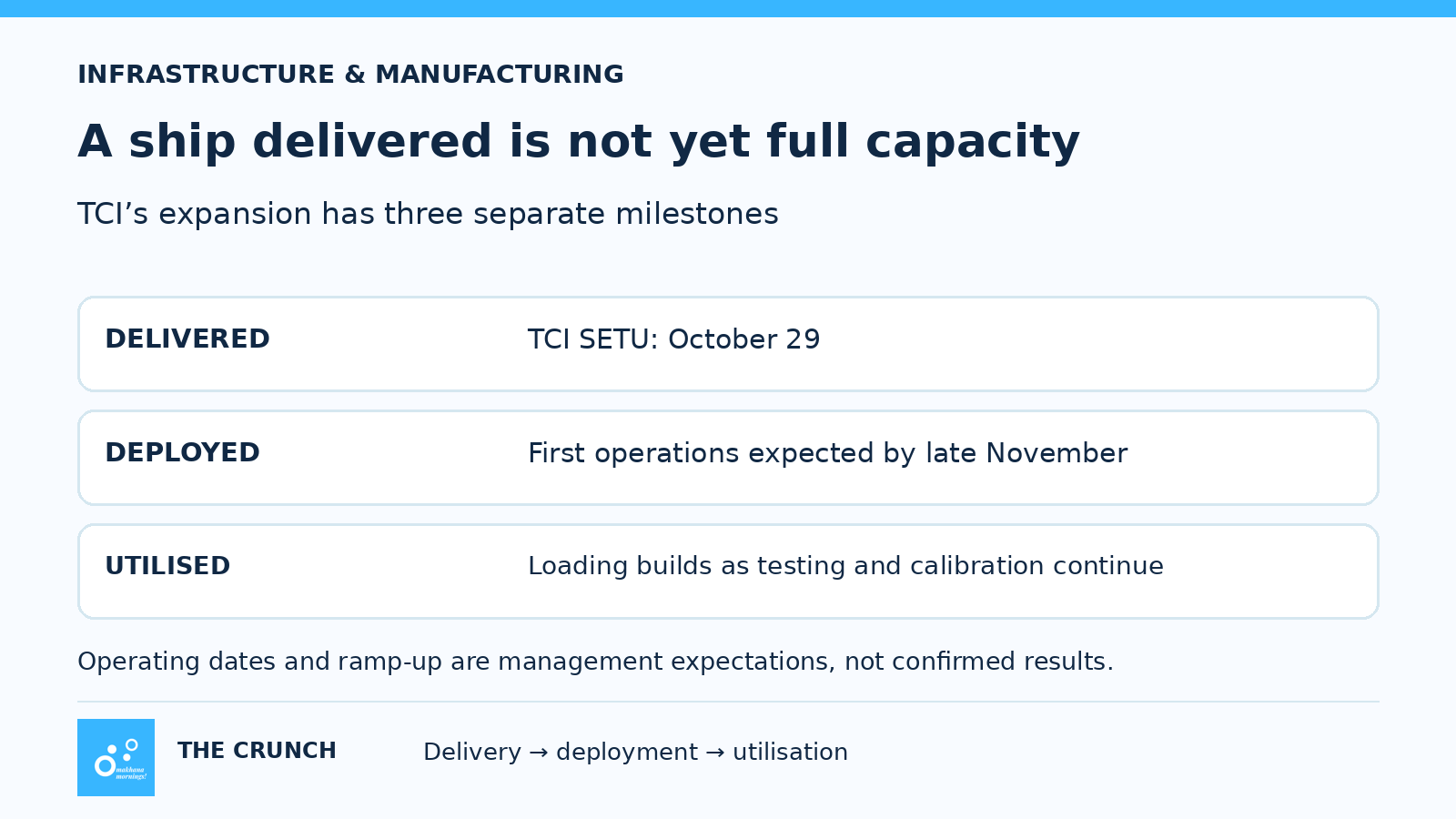
Getting a ship into service takes another step
On its October 30 earnings call, management expected the first vessel to begin operations towards the end of November, after reaching India and completing formalities. The second was expected in early January 2027. Those are company timelines, not verified operating milestones.
More revealing was the explanation of loading. Management said a new vessel would initially carry less than its full container capacity while testing and calibration continued. It expected several months before the ships were fully in service, with the fuller benefit coming in FY28.
That gives the expansion three separate measures: capacity delivered, capacity deployed and capacity used.
Why This Matters
TCI already serves routes linking mainland ports with the Andaman Islands, as well as western coastal routes. Management’s stated focus for the additions is largely domestic, with regional opportunities also under consideration.
For a manufacturer or distributor, the relevant question is whether the extra capacity appears on the route and sailing schedule its supply chain needs. A fleet-wide percentage does not by itself establish that a particular shipment will leave sooner or cost less.
There is also a distinction between carrying more cargo and earning more revenue. Management noted that freight prices could fall if vessel-fuel costs eased. More volume would therefore not necessarily translate into the same percentage increase in sales.
The Crunch
Watch the first commercial sailings, subsequent loading and the second delivery separately. TCI has a verified new vessel and an expansion plan; the operating and financial contribution will emerge as those ships enter service and build up their loads.
Leave your thoughts