
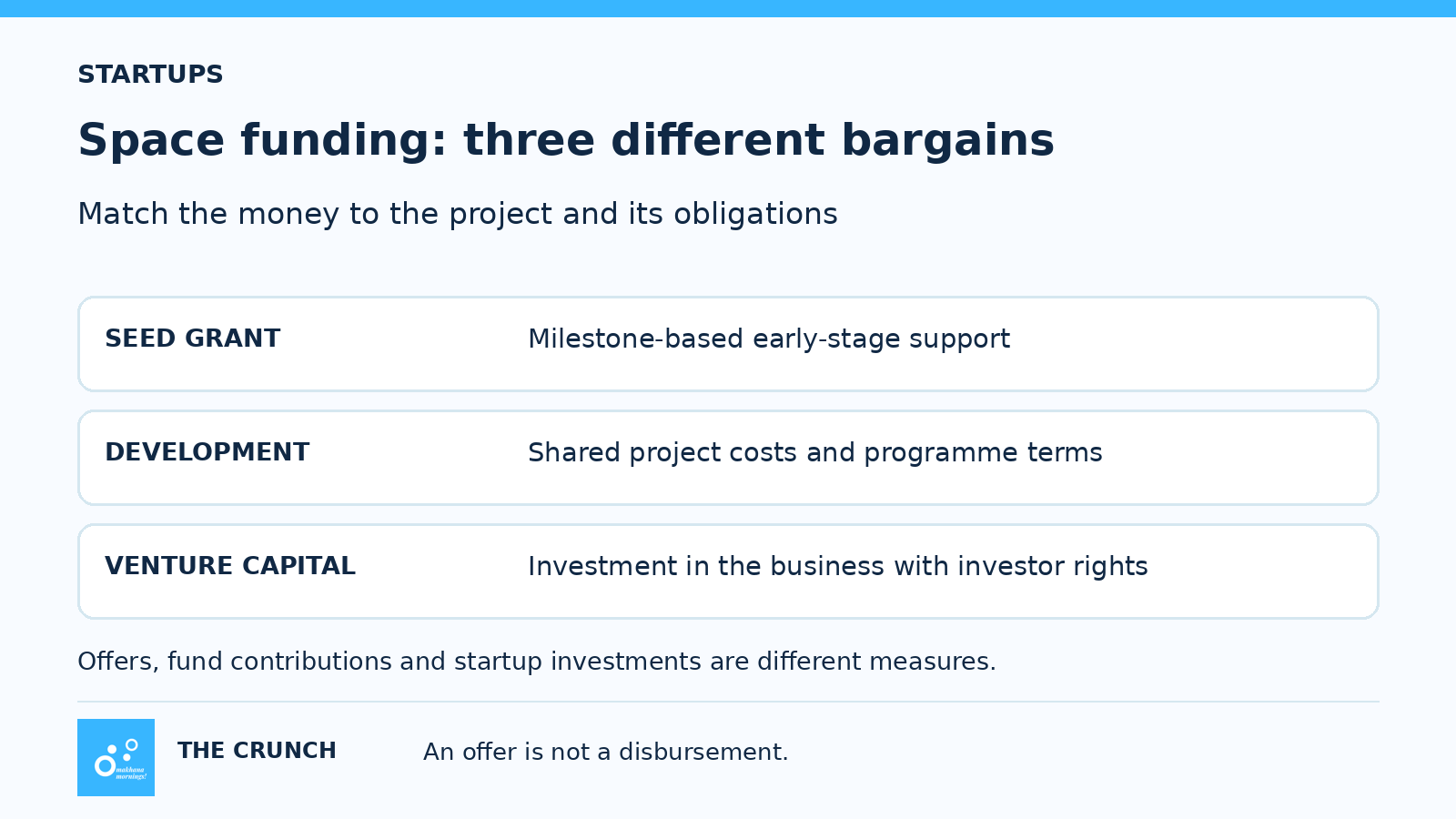
A grant to demonstrate an idea, support for developing a product and an investment in a company are not interchangeable sources of money. India’s space-financing programmes make that distinction particularly important for founders planning the journey from a prototype to paying customers.
A government overview published on November 15 brings these existing programmes together. It is not the announcement of a new funding package. Recent selections and an earlier company investment show how the different instruments work in practice.
The Breakdown
Seed funding supports a defined early-stage project. IN-SPACe’s scheme provides selected startups with grants of up to ₹1 crore, released against milestones in three or more instalments. The published guidelines require evidence of progress and audited utilisation records. The headline amount is therefore neither an automatic entitlement nor necessarily cash available on day one.
The Technology Adoption Fund shares development costs. Its ₹500 crore programme can support up to 60% of project costs for startups and MSMEs, or 40% for large industry, with a ₹25 crore project ceiling. The remaining funding still needs to be arranged.
This is also not unconditional free money. The scheme’s published terms say the participating entity owns the intellectual property it develops, but licensing requires IN-SPACe’s prior approval and revenue must be shared under the guidelines. Those conditions belong in the commercial plan alongside the initial support.
Venture capital invests in the business. The Antariksh Venture Capital Fund’s manager describes investments through negotiated equity, convertible instruments and other permitted instruments in unlisted Indian space companies. It seeks standard investor rights and a credible route to growth and an eventual exit. That is a different relationship from receiving a project grant.
What the examples show
On October 29, IN-SPACe announced funding offers totalling ₹67.15 crore for four technology projects. They include ₹22.08 crore for Manastu Space’s iodine-based satellite thruster and ₹11.34 crore for MumbaiSemi’s NavIC and GPS receiver chip. These are development offers linked to milestones, not proof that the products are commercially ready or that the full amounts have been paid.
The venture-capital example is different. Dhruva Space announced a ₹60 crore investment from Antariksh in July, with capital intended for manufacturing, infrastructure and customer programmes. It was a company investment, not another ₹60 crore grant under the seed scheme.
Why This Matters
A founder needs to match the financing instrument to the next task. Demonstrating an idea, completing product development and expanding a business involve different costs, evidence and obligations. A company may encounter more than one instrument, but there is no automatic progression between them.
There is also a reporting distinction. The government said IN-SPACe had contributed ₹188.93 crore to Antariksh by July 24. Money contributed to a fund is not the same measure as money invested by that fund in startups. Adding the two would risk counting the same financing twice.
The Crunch
For India’s space businesses, the useful question is not simply how large a fund is. It is what the money pays for, when it arrives, what the company must contribute and which obligations remain after it accepts the support.

Leave your thoughts