
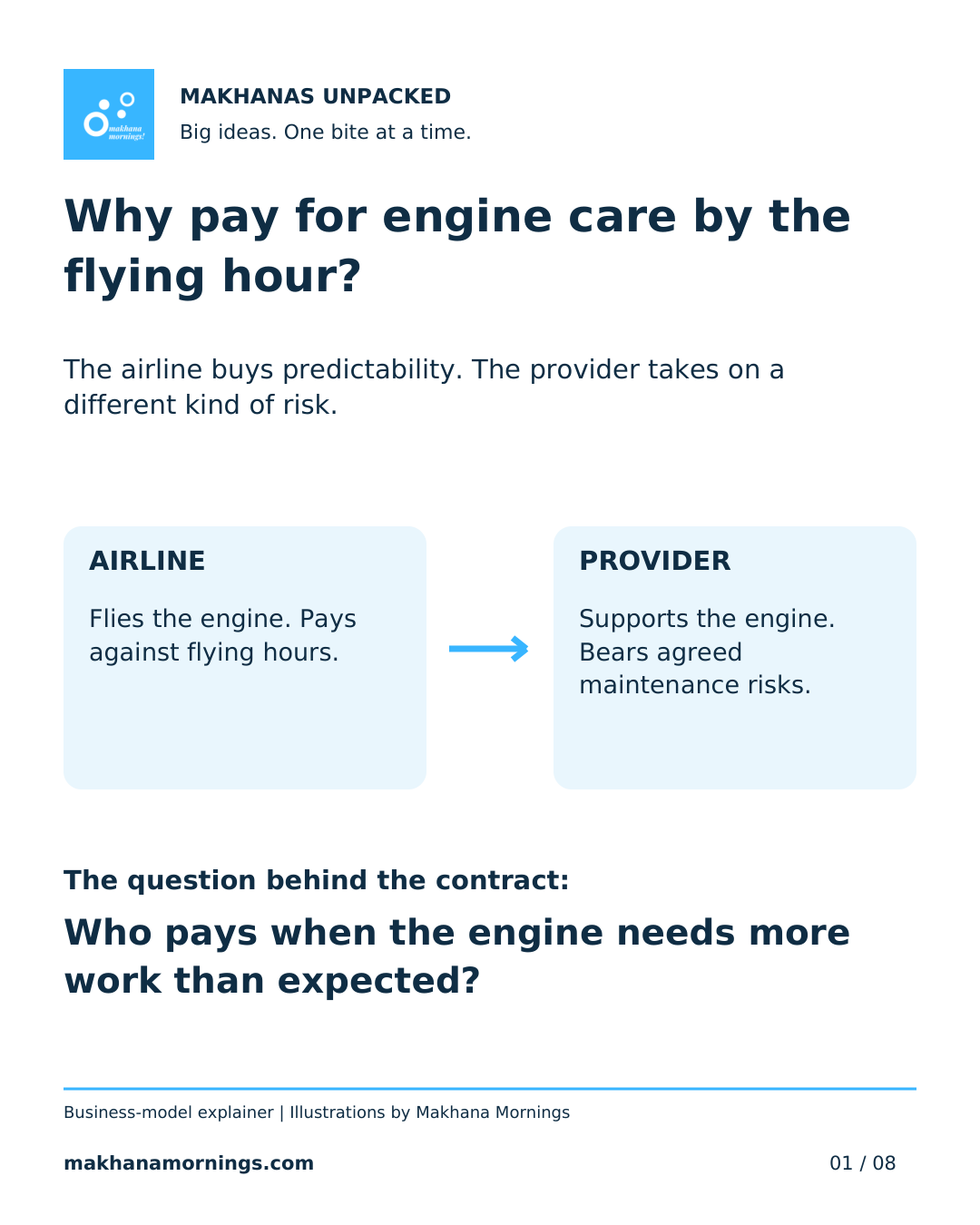
An airline buys an engine to fly passengers, not to become better at handling repair bills. The manufacturer knows how the machine was designed. The airline knows where it needs to go. A long-term maintenance contract connects those two businesses through a surprisingly simple unit: the engine flying hour.
The interesting part is not the hourly invoice. It is what happens to the risk behind it. If an engine needs expensive work sooner than expected, who absorbs the bill? And if better engineering keeps it flying longer, who benefits?
The Breakdown: two risks inside one rate

Rolls-Royce describes TotalCare as a service that transfers two risks back to the manufacturer. The first is time on wing: how long an engine remains installed before it needs a shop visit. The second is the cost of that visit, including planned and unplanned work. Customers pay in dollars per engine flying hour, while retaining operational control. Source: Rolls-Royce TotalCare

The supplier undertakes to deliver agreed maintenance. This is more than a savings pot from which the airline later pays its own repair bills. Source: Rolls-Royce TotalCare
CFM offers a similar rate-per-flight-hour model, but also sells event-based overhaul programmes with different pricing and scope choices. An airline therefore has a choice about how much maintenance-cost risk to transfer and how much control to retain over individual jobs. Hourly cover is a business arrangement, not the only way to maintain an engine. Source: CFM maintenance programmes
What an hourly invoice actually means

Take a deliberately hypothetical contract charging $250 per engine flying hour. This is an invented rate, not a quote from Rolls-Royce, CFM or an airline.
One engine flying 300 hours would generate a $75,000 usage charge. At 200 hours, it would generate $50,000. The example isolates the usage calculation, before escalation, adjustments or other contract terms. A twin-engine aircraft accumulates hours on both engines: a five-hour flight means ten engine flying hours.
This is only the chosen maintenance charge. Fuel, crew, aircraft ownership and other expenses remain outside the example. A lower payment caused by fewer flying hours does not prove the airline is better off: it may also have fewer flights earning revenue. The useful comparison is an alternative with equivalent coverage and operating activity.
Why This Matters: reliability changes the supplier’s economics

Our business interpretation is straightforward. Under an agreed hourly rate, avoiding unnecessary maintenance can leave the supplier with more of the contract’s receipts after costs. Keeping engines available also supports the airline’s ability to operate its schedule. The supplier has a reason to invest in durability, monitoring and well-planned repairs rather than treating every shop visit as a separate sale.
That does not make maintenance optional. The economic aim is to reduce avoidable work and disruption while meeting the required maintenance standard. It is not to fly a machine beyond its permitted limits.
There is also a cash-timing issue. Rolls-Royce’s investor FAQ illustrates regular receipts beginning before major shop visits. Cash collected early must support work that comes later; it cannot all be treated as profit. Source: Rolls-Royce LTSA FAQ
Consider another invented example: a provider receives $1 million a year for four years, then spends $3 million on covered work in year four. The earlier $3 million was not a windfall. Ignoring other costs, the four-year surplus is $1 million, not the $3 million accumulated before the repair. Real contracts are more complex, but the timing lesson survives.
Predictable does not mean identical or unlimited

The hourly rate is not necessarily one unchanging number for every operating pattern. Rolls-Royce says its contracts use a rate matrix reflecting engine use, and include inflation-linked escalation. Spare engines and certain other services can be optional. Source: Rolls-Royce LTSA FAQ
For a buyer, the useful questions are therefore practical: what is included, which events fall outside coverage, what changes the rate, and what support is available while an engine is in the shop? A quoted hourly price without those answers is an incomplete comparison.
The India connection

This is relevant to Indian aviation without assuming undisclosed airline contract terms. Safran’s February 2023 announcement of Air India’s LEAP engine order explicitly included a CFM services contract. It did not disclose an hourly price or establish that particular contract’s payment structure. Source: Safran / CFM announcement, February 2023
Our inference: an aircraft order creates a continuing support requirement, not just a delivery milestone. India’s maintenance opportunity includes the physical repair work, but also planning, dependable turnaround and coordination with the organisation responsible for the service agreement. Building a workshop and carrying the commercial risk are different roles.
The Crunch

Charging by the hour does not make an engine cheap or a service contract automatically profitable. It changes who must make reliability pay. The business works when the supplier can price the obligation sensibly, deliver the promised support and manage the gap between today’s receipts and tomorrow’s repairs.
Related: India’s airlines want more control over the work between flights and Collins’ Bengaluru repair centre targets the downtime behind regional flying.
Reporting note: the Air India example is dated February 2023, not a claim about current deliveries or undisclosed contract terms. Rolls-Royce’s older investor FAQ is used for contract mechanics, not current financial figures. All dollar calculations are invented illustrations.

Leave your thoughts