
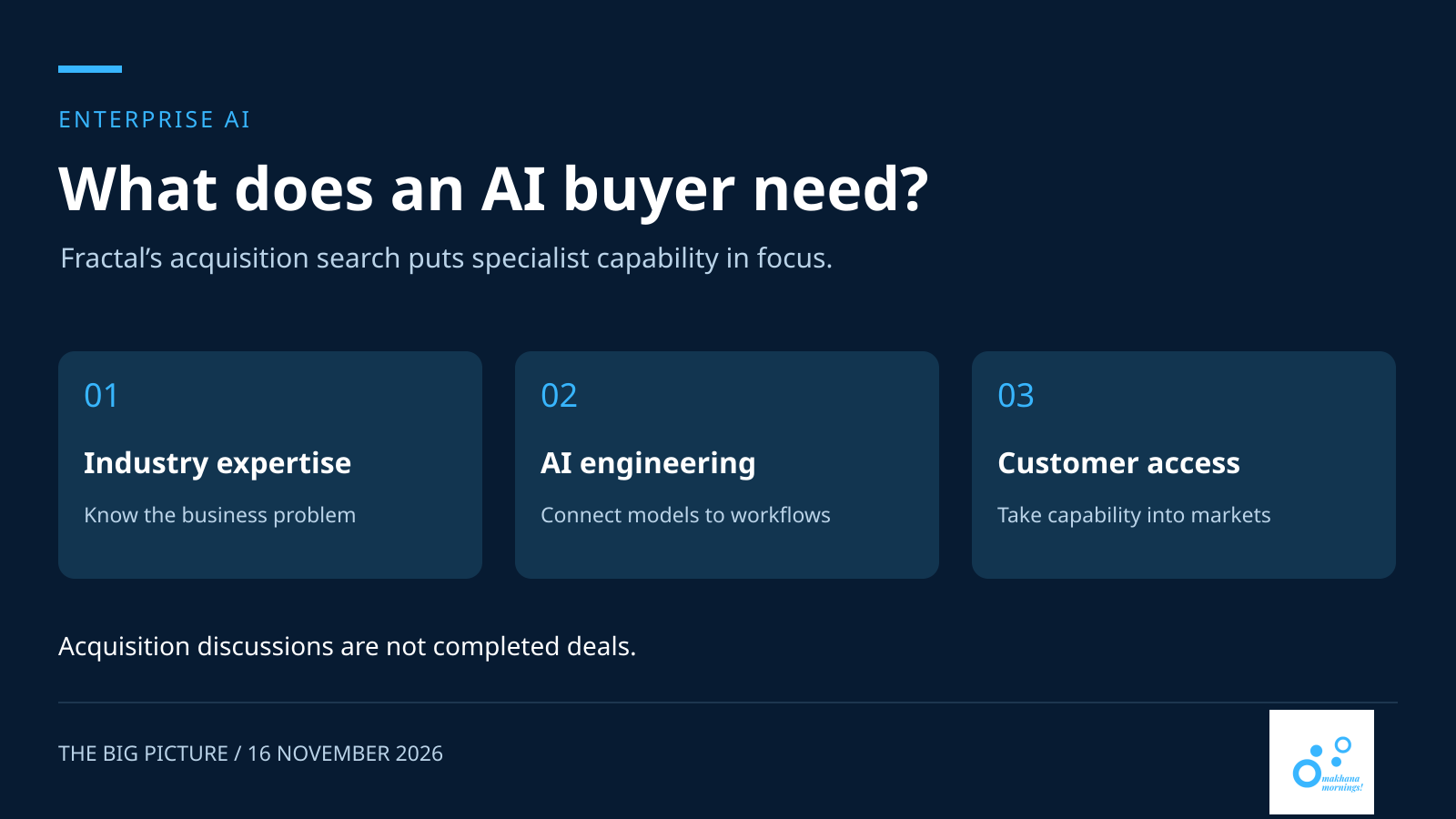
Fractal’s next acquisition could be valuable for what its people know, not simply for the revenue it adds.
The enterprise AI company is in discussions with 20–25 startups about possible acquisitions, its chief executive said in a November 16 interview. The stated aims include deeper industry-specific expertise and access to advanced AI capabilities. These are discussions, not a list of agreed purchases.
The Breakdown: what is actually being bought?
A completed transaction offers a more concrete example. Fractal’s step-down subsidiary Asper acquired selected assets and took on specified liabilities of Switzerland’s Pricing One, while contracting with key employees. It did not acquire shares or an equity interest in Pricing One.
The transaction closed on November 2. The filing puts the approximate aggregate transfer price at CHF1.319 million, including CHF0.997 million of liabilities. That distinction matters: the headline value is not simply a cash payment for an entire company.
The assets include intellectual property and know-how behind a platform used for pricing strategy, revenue optimisation and consumer testing. Fractal says the purpose is to add revenue-growth-management capability, talent and a stronger European presence.
Why This Matters: a model is not a business process
On its November 4 earnings call, Fractal’s management argued that general AI models need company-specific knowledge and context to work effectively inside an organisation. It described investment in engineers who work closely with clients to understand and solve their operational problems.
Consider a pricing decision. Producing an answer is only one step. A business also needs to know which products and customers the decision covers, what restrictions apply, how the recommendation reaches a working system and who checks the result. This is an illustrative way to understand the implementation challenge, not a claim about a particular Fractal customer.
Specialist acquisitions can shorten the path to that knowledge. They may bring an experienced team, useful software or access to a market. But buying those ingredients does not automatically produce a working combined business. Retaining people and integrating systems remain part of the job.
The Big Picture: capability still needs to pay
Fractal reported product revenue of ₹38 crore for Q2 FY27, representing 4% of total revenue. Management also linked pressure on gross margin to investment in AI engineering talent. Those disclosures show a business still investing in how it delivers AI, rather than one already transformed into a predominantly product-led company.
The useful question for Indian AI founders is therefore not just whether a larger buyer wants AI exposure. It is what capability the startup can demonstrate, how that capability fits the buyer’s clients and whether the combined offering can be delivered profitably.
Our earlier Fractal results explainer separates reported growth, exchange-rate effects and cash performance. This acquisition search adds a different test: whether specialist expertise can become repeatable business value.
The Crunch
Fractal’s discussions point to an acquisition strategy built around capability. The evidence to watch is not the number of conversations, but the terms of completed deals and what they subsequently contribute. Until then, an acquisition pipeline is a set of possibilities, not an earnings outcome.
Related categories: Business & Brands



Leave your thoughts