
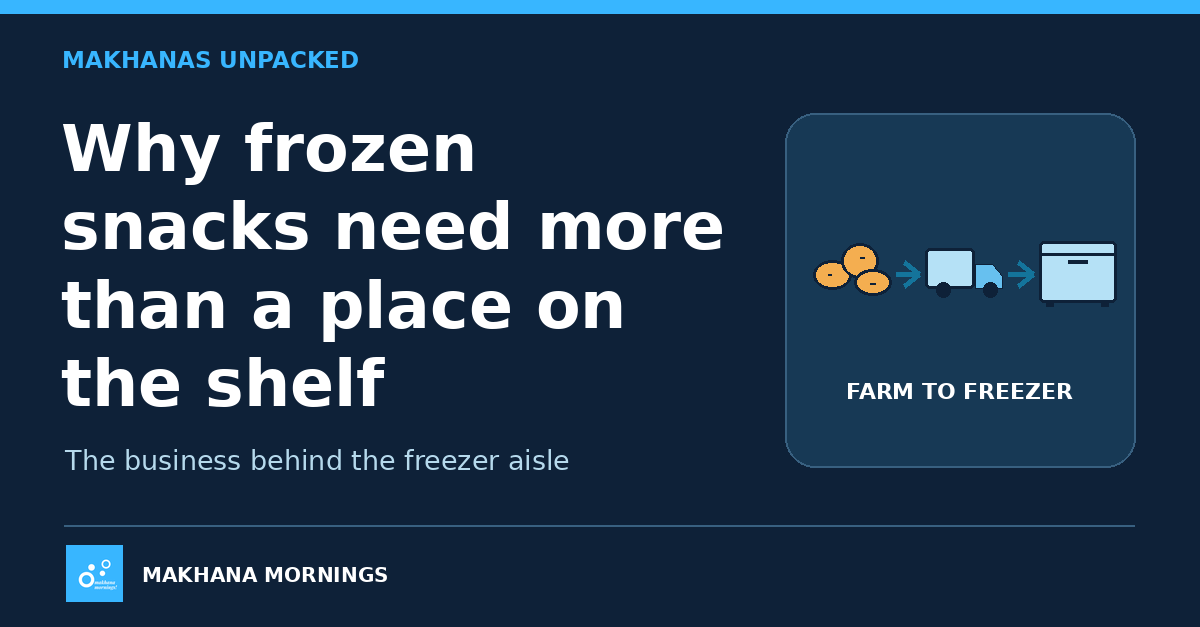
A bag of frozen fries can win a place in the supermarket freezer and still be difficult to keep there. The manufacturer has to line up the next batch of potatoes; the distributor has to fit another delivery into a refrigerated route; and the retailer has to decide whether the bag sells fast enough to keep its place. None of those decisions is visible when you pull the bag out of the freezer.

HyFun, the Indian frozen-food maker, offers a useful example. The company describes a chain that starts with contracted potato growers, stores raw crop before processing and sends finished food through refrigerated distribution. It serves foodservice buyers as well as selling household packs. The interesting part is not how many places it can list a product. It is what the business has to do to keep those places supplied.

Two stocks, two different jobs
A processor does not buy a generic potato and turn it into a standard fry by cutting it. It needs tubers that suit its process and can produce the size, colour and texture buyers expect. HyFun says it works with growers on propagation and sourcing, and stores raw potatoes near the processing stage. Raw stock bridges the gap between a seasonal harvest and a plant that needs inputs over a much longer period.
The finished stock does something different. Once the potatoes have been cut and processed, fries are quick-frozen and held until orders call for them. For quick-frozen fries, the Codex standard uses minus 18°C at the product’s thermal centre after the temperature has stabilised as the benchmark for completing quick freezing. That is not a setting for a raw-potato store. Cold storage before processing and frozen storage after processing protect different things.

Holding both stocks costs money. Cash can be tied up in the crop before a finished bag has been made, and then again in bags waiting to sell. Infomerics, in a January 2025 rating report on HyFun’s parent group, flagged working-capital intensity and agricultural procurement risk. That is an independent observation about the business at the time, not a current estimate of HyFun’s inventory days or margins. For more on what can go wrong at a cold-chain handover, see our earlier story.
One factory, two delivery patterns
A restaurant can use a standard cut of fries over and over. The kitchen cares that portions behave consistently and the next order arrives in time for service. A grocer needs something else as well: packs sized and labelled for shoppers, enough of each product to meet demand and a way to refill stock without overloading the freezer. HyFun’s retail brochure lists 425 g and 1 kg packs of French fries; the company describes its foodservice offering in bulk quantities. Those are two ways to sell from a processing operation, not necessarily one way to distribute.

The balance is different at each stop. A kitchen might take a larger order, while a shop might order a wider mix in smaller quantities. A dense route may make smaller drops workable; a long detour for one small order may not. None of that tells us which HyFun channel earns more. It tells us what we would need to know before deciding: delivered volume, number of stops, journey time, and the frequency of repeat orders.
Do the route maths
Imagine the fixed portion of a refrigerated trip costs ₹3,000. If it delivers 300 kg, that portion works out to ₹10 per delivered kilogram. At 600 kg on the same route, it is ₹5. This is made-up arithmetic, not an industry freight rate or an all-in delivery cost. It holds route, stops and time constant and leaves out any costs that change with load or handling. If finding the extra 300 kg means adding several distant stops, the same calculation no longer applies.

The retailer has a different denominator: how many cases sell per week for the space they occupy. A new flavour might look attractive on the day it launches, but if it moves slowly, the freezer space is unavailable to faster sellers. The distributor’s incentive to carry a bigger drop and the shop’s incentive to carry just enough stock can pull in opposite directions.


The Crunch
A listing tells you a bag has a place to sit. It does not tell you how often it sells, whether a refrigerated route can refill it economically, or how much cash the maker has tied up in stock. The harder test is whether all three businesses can keep saying yes after the first order.



Leave your thoughts