
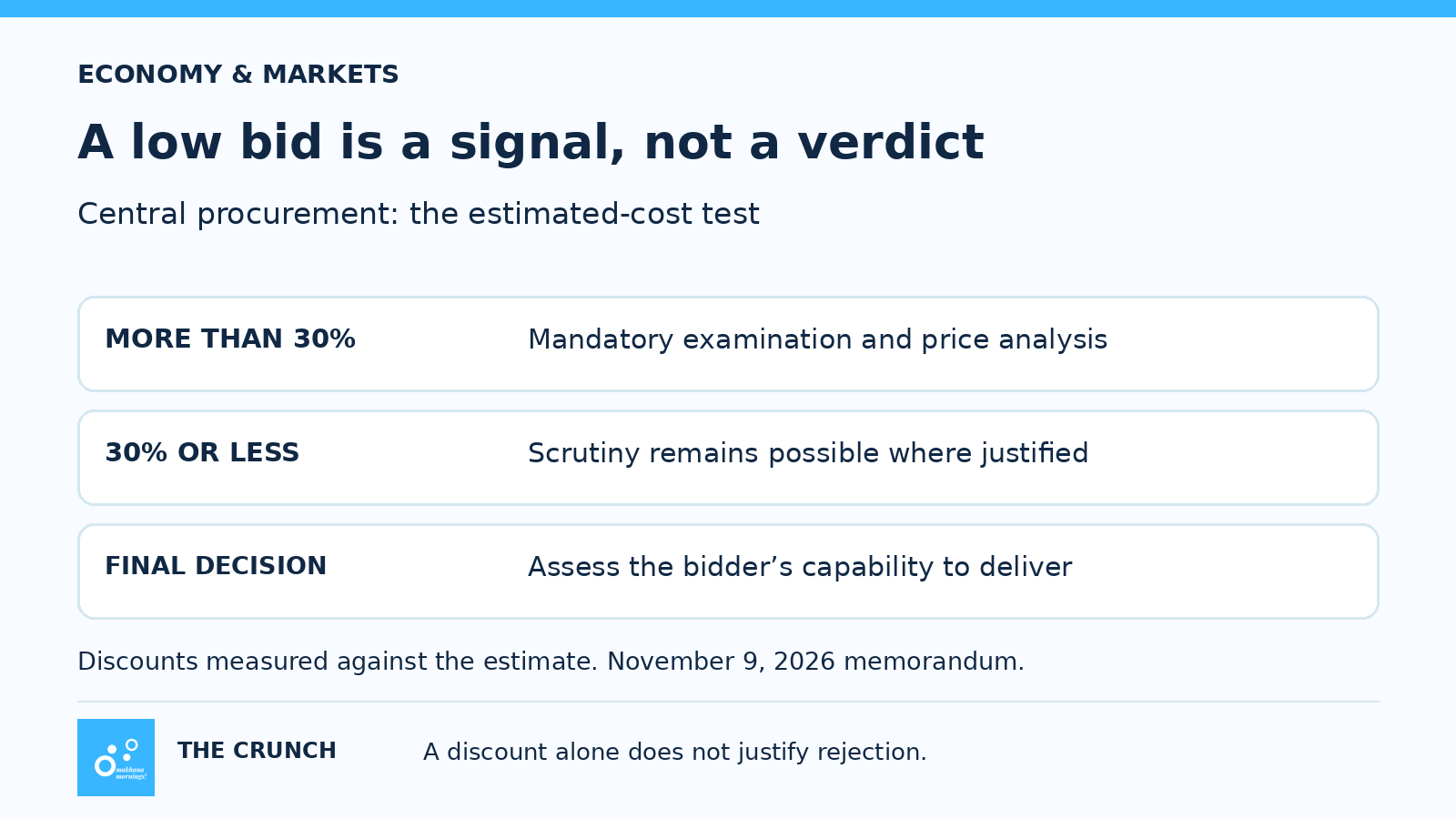
A price far below a government buyer’s estimate can be a saving or a warning. India’s Department of Expenditure has introduced a numerical trigger for examining that difference: a bid more than 30% below the estimated cost must be checked as potentially abnormally low.
The important word is potentially. The November 9 memorandum does not make a large discount an automatic reason to reject a supplier.
The Breakdown
The amendment covers the central procurement manuals for goods, consultancy services, non-consultancy services and works. It requires written clarification and detailed price analysis when the mandatory trigger applies, including how the price relates to the scope, schedule and allocation of risks and responsibilities.
The comparison is with the estimated cost, not with another bidder’s offer.
Take a hypothetical contract estimated at ₹100 lakh. A ₹69 lakh bid is 31% lower and crosses the mandatory-examination threshold. A ₹70 lakh bid is exactly 30% lower and does not cross that particular trigger.
But ₹70 lakh is not a safe harbour. Even when the discount is no more than 30%, the buyer may seek clarification if the price, together with other parts of the bid, raises material concerns about the bidder’s ability to perform.
Why This Matters
The rule separates a screening signal from a decision. The percentage identifies bids that must be examined; the explanation helps establish whether delivery at that price is credible.
If, after evaluating the clarification and price analysis, the buyer determines that the bidder has substantially failed to demonstrate that capability, it may reject the bid. The next higher bidder can then be evaluated at its own quoted rate, if reasonable. The rejected low price is not a counter-offer for the next bidder to match.
For a supplier, this makes the account behind the quote important. A lower price could reflect a different production method, available capacity or a misunderstanding of the work. These are illustrative possibilities, not findings about any bidder. A percentage alone cannot distinguish them.
The Big Picture
The estimate also matters because it is the denominator of the test. For an unchanged ₹69 lakh offer, a ₹100 lakh estimate produces a 31% discount; a ₹90 lakh estimate produces a discount of about 23.3%. Those hypothetical calculations show why a numerical screen does not replace judgement about the tender and the proposed delivery plan.
The memorandum retains the existing provisions on additional security deposits and bank guarantees. It does not introduce a routine extra-guarantee requirement for every deeply discounted bid.
This is a change to the specified central-government procurement manuals, not evidence that every state tender or private purchase has acquired the same rule.
The Crunch
A cheap bid should neither win unquestioned nor lose simply for being cheap. The amendment makes examination mandatory beyond a defined discount while preserving the need to judge whether the bidder can actually fulfil the contract.

Leave your thoughts