
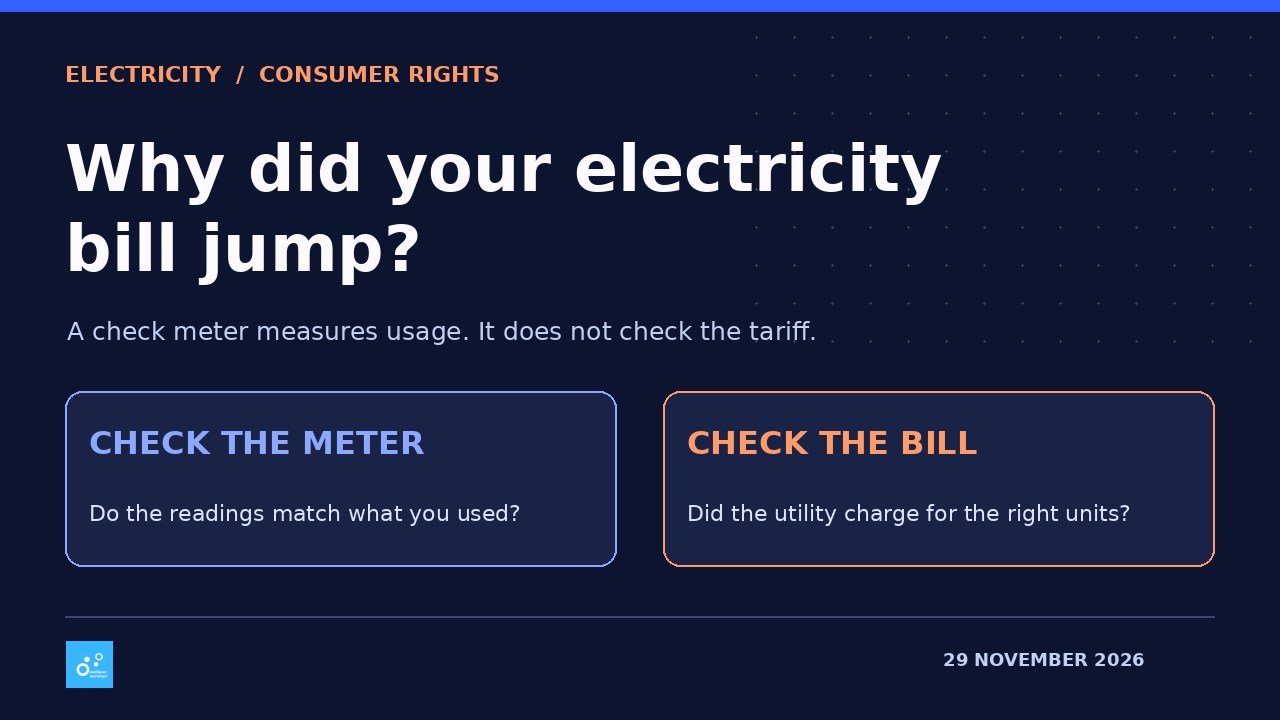
Start with the units, not the rupee total. If a shop’s bill jumps, it could be because the meter recorded more electricity, because the bill used more units than the reading supports, or because the same units were charged differently. Each problem calls for a different check.
The Ministry of Power highlighted check meters at this weekend’s meeting with state power ministers. The right to a second meter in certain disputes already exists under the Electricity (Rights of Consumers) Rules. It was not created at the conference.
When the meter reading seems wrong
Compare the billing dates and meter number with your account. Look at the opening and closing readings and, if available, the consumption history in your utility’s app. Check whether your opening hours or equipment changed. Keep copies of the bills, dated readings and the complaint acknowledgement.
If your complaint is that the meter reading itself does not match your consumption, Rule 5(7) requires the distribution company to install an additional meter within five days of receiving the complaint and use it to verify consumption for at least three months. The same rule gives the company 30 days from receipt to test the meter for the complaints it covers, including a suspected inaccurate reading, a stopped meter or damage. Five days is the deadline to install the additional meter, not to resolve the bill.
When the reading looks right but the bill does not
Check whether the bill applied the right tariff, fixed charges, arrears or credits. Some business connections also have a multiplier: a number the utility applies to the change in the meter reading to calculate the billed units. For example, a reading difference of 100 billed at a multiplier of 10 would count as 1,000 units. If that meter’s correct multiplier is 1, it should count as 100 units before any other adjustments.
That distinction came up in a Haryana Electricity Ombudsman case. A telecom site’s meter had been replaced, but the account applied a multiplier of 10 instead of 1. The Ombudsman ordered a reconciliation and an adjustment in the bills. Another meter would not, on its own, have fixed the account calculation.
How to raise the right complaint
Tell your electricity distributor what does not match. For a reading dispute, identify the periods in question and request a check meter. For a disputed calculation, ask for the written breakdown, including the readings and any multiplier, tariff, arrear or credit in question. Keep the complaint number. If it is not resolved, check your state’s process for escalating to the utility’s Consumer Grievance Redressal Forum and then the Electricity Ombudsman. Ask separately how the disputed bill is handled while the complaint is pending.
The Crunch
A check meter answers one question: how much electricity did you use? A billing review answers another: did the utility charge you correctly for it? Start by deciding which answer you need.




Leave your thoughts