
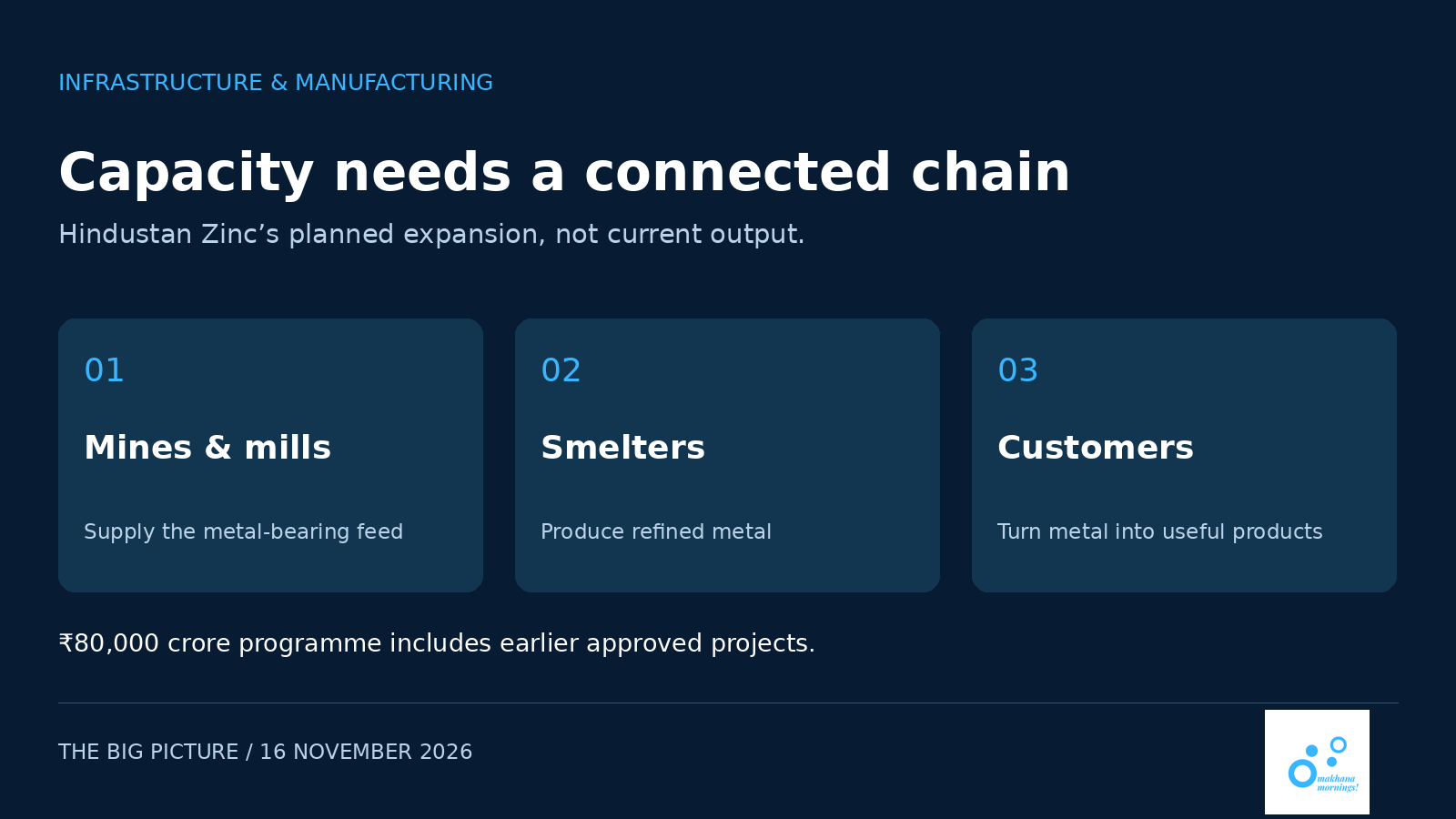
A bigger smelter only works if enough material reaches it. That is the useful way to read Hindustan Zinc’s latest expansion plan: as a chain of connected investments, rather than a single factory announcement.
The Breakdown
On 16 November, the board approved a programme targeting annual metal capacity of 2 million tonnes, compared with the existing 1.1 million. The envisaged investment is about ₹80,000 crore over three to five years, financed through internal accruals and debt.
That amount includes previously approved Debari smelter, exploration and related infrastructure budgets. It should not be added wholesale to earlier announcements. Debari’s planned capacity rises from 250,000 to 265,000 tonnes a year within its existing budget.
The presentation also sets out mine and milling expansion, new zinc and lead smelters, and a silver refinery. It separately notes an additional ₹3,823 crore tailings-reprocessing investment. These are proposed capacities and investment plans, not metal already being produced.
Why the chain matters
Mining supplies ore containing useful metals. Milling prepares that material for further processing; smelting and refining produce metal that customers can use. Adding capacity at one stage does not automatically increase output at every other stage.
This creates a practical coordination problem. If downstream equipment is ready before sufficient feed arrives, it may be underused. If feed expands first, processing can become the bottleneck. Construction schedules therefore matter alongside the final capacity figure.
Why steel demand matters
The company links its rationale to zinc demand from steel and infrastructure. Galvanising applies a zinc coating to steel to help protect it against corrosion. The coating acts as a barrier and can also provide sacrificial protection, with zinc corroding in preference to the underlying steel.
That connection explains why a metal used as a coating can matter to the life of a much larger structure. It does not mean every tonne of new steel needs the same amount of zinc. Product specifications, coating choices and the mix of end uses all affect demand.
The Big Picture
For readers tracking industrial investment, three questions are more useful than the headline budget alone: how much of the spending is genuinely new, which production stages must expand together, and when completed assets become usable capacity.
Internal accruals mean cash generated within the business; debt adds financing obligations. The eventual result will depend on delivery, costs, operating performance and the market in which the extra metal is sold. A board approval cannot settle those outcomes in advance.
The Crunch
Hindustan Zinc has laid out a larger industrial system. The next test is whether its parts can be built and brought into production together.



Leave your thoughts