
Getting a consumer brand onto more shelves is only part of distribution. The harder question is what happens to stock between the company, its distributors and the retailer, and whether the next order reflects products moving out, rather than inventory building up.
Two companies’ FY2025–26 disclosures illustrate why there is no single winning network design. Honasa Consumer describes moving away from a super-stockist layer towards a more direct distributor model. Tata Consumer Products reports expanding its super-stockist base by 37%.
What Honasa changed
Honasa’s revised chain still runs through distributors and retailers. “Direct” does not mean every sale goes straight from the brand to a household; it describes the relationship within the trade network.
For FY26, Honasa reports approximately 1.2 lakh outlets billed directly through distributors and about 80% of general-trade billing handled by direct distributors. It says distributor inventory settled at around 30 days, supported by systems showing stock by product and tracking sales further down the channel.
These are company-reported operating measures. Distributor inventory is not the same as inventory on the company’s own balance sheet. Nor does an outlet count show how frequently each retailer reorders.
A transition has an accounting trail
The earlier restructuring was not just a redraw of the distribution map. Honasa’s audited standalone accounts for FY25 say Project Neev discontinued the super-stockist layer and replaced certain distributors in its top-50-city transition.
The revenue note records ₹635.18 million (about ₹63.52 crore) of sales returns associated with that change, with a resulting inventory or right-to-return asset.
That is a channel-restructuring sales-return adjustment. It is not a ₹63.52 crore inventory write-off, and it says nothing about consumers misusing online return policies. Keeping those distinctions intact is essential when reading the cost of changing a distribution network.
Why another company can expand that layer
Tata Consumer’s FY26 report describes expanding super-stockist capacity to support availability and regional servicing. Alongside that expansion, it says its automated replenishment system operates across urban and rural distributors, using secondary-sales information to guide replenishment and reduce distributor inventory days.
The two approaches are therefore not a clean contest between “old” and “new” distribution. Their portfolios, territories and servicing requirements differ. Neither company’s disclosure establishes that its architecture is the right one for every brand.
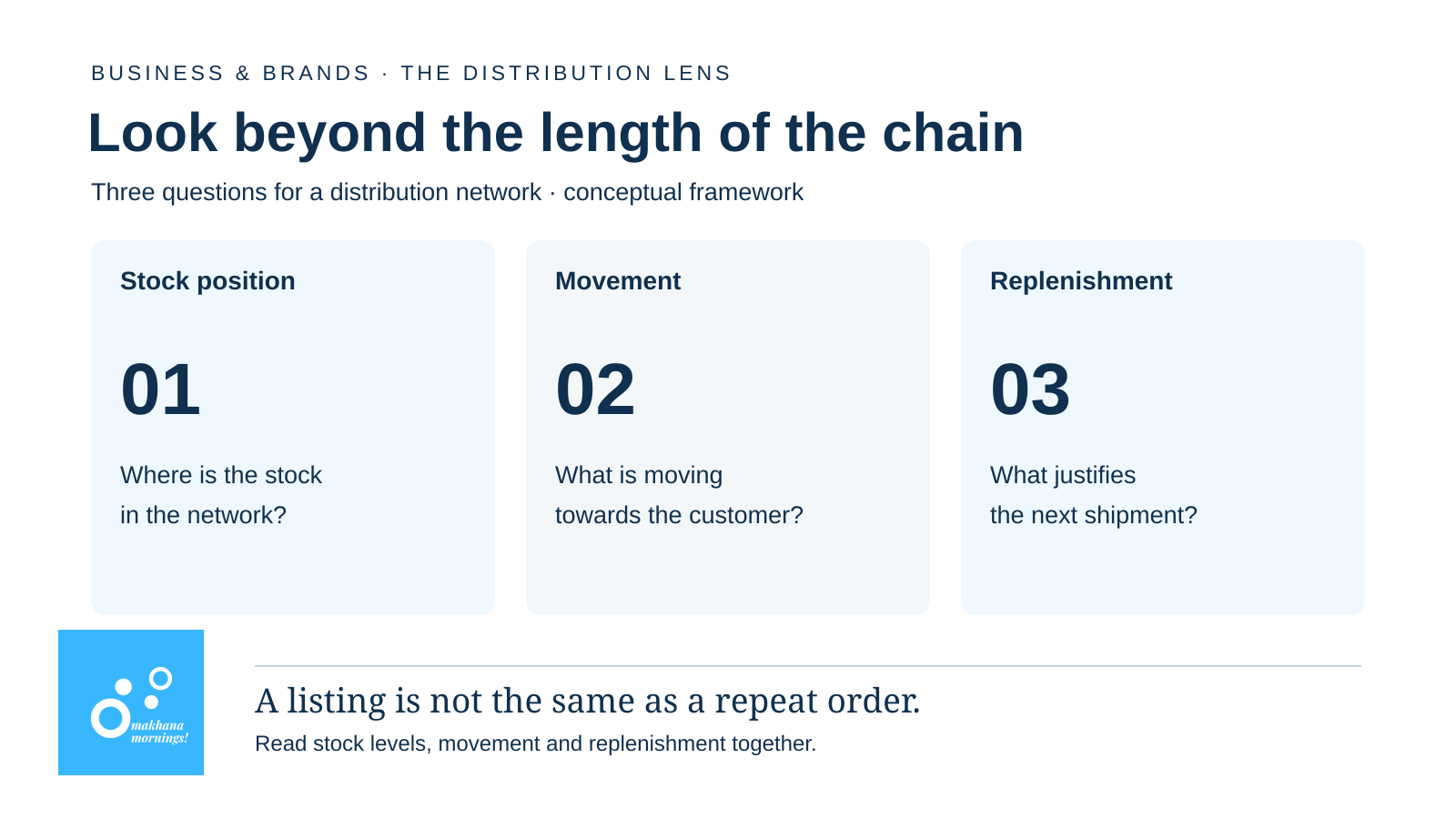
The common question is visibility: how much stock is already in the network, where is it moving, and what justifies the next shipment? Removing an intermediary cannot answer that on its own. Keeping or expanding one does not necessarily mean the company has stopped tracking it.
The Crunch
A listing, a shipment to a distributor and a repeat retailer order are different milestones. For brands expanding beyond online sales, the useful test is whether broader reach comes with explainable stock levels, replenishment and cash collection, not simply whether the distribution chain has become shorter.




Leave your thoughts