
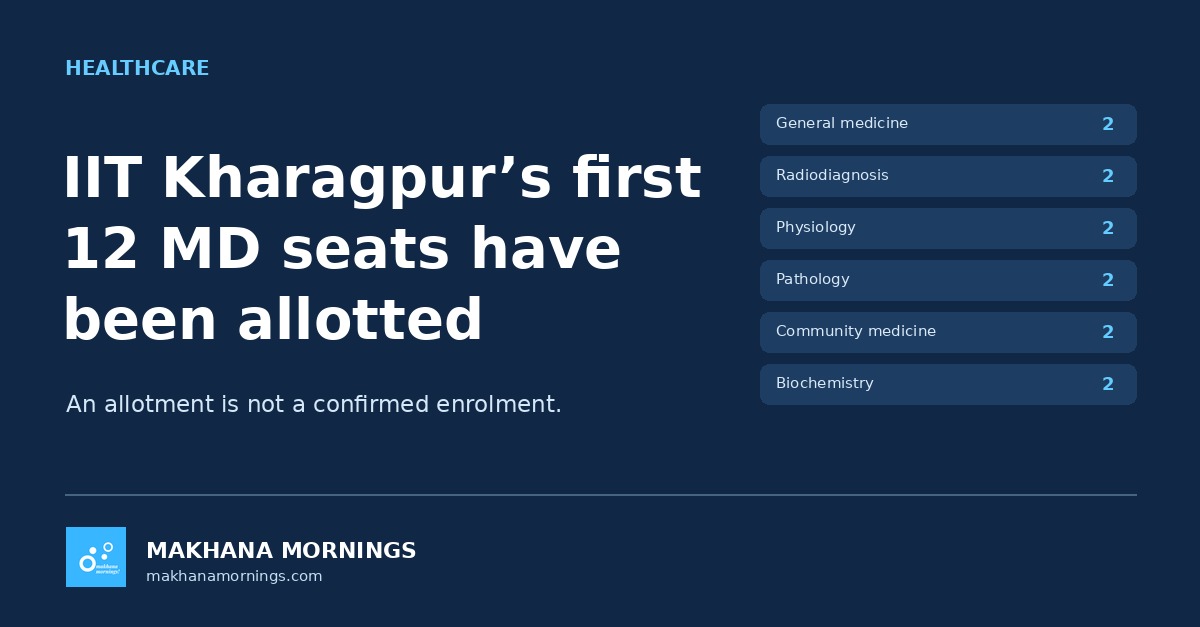
The Medical Counselling Committee’s final Round 2 list marks a step beyond approval for IIT Kharagpur’s new postgraduate medical programmes. All 12 seats in its first MD intake appear as allotments. That tells us the seats have been offered to candidates, not that 12 doctors have joined the programme.
Six disciplines have two seats each
The 12 allotments are under the All India quota at the Dr B. C. Roy Multi-Speciality Medical Research Centre. There are two each in General Medicine, Radiodiagnosis, Physiology, Pathology, Community Medicine and Biochemistry. The committee recorded seven as fresh allotments in the round and five as upgrades from an earlier allotment.
The committee declared the Round 2 result on 20 November and set 25 November at 10 p.m. as the reporting deadline. The next measure for the institute is how many candidates complete admission, not how many names appear on the allotment list.
IIT Kharagpur wants clinical training and engineering research to meet
The Ministry of Education describes IIT Kharagpur as the first IIT to introduce National Medical Commission-accredited postgraduate medical degrees. Medical research is not new to the institute. What changes is that it can now train medical graduates for specialist qualifications at its own centre, alongside existing engineering and biomedical research teams.
An August faculty advertisement gives a more concrete idea of the model: clinical faculty were expected to teach postgraduate students, provide specialist patient care and do research with other IIT units. An imaging challenge, for example, could give a clinical team and an engineering group a problem to investigate together. The announcement does not say how much time the first residents will spend in joint research or what they will be required to produce.
Twelve seats make this a small start, not a major increase in India’s specialist training capacity. Once the first students join, the useful evidence will be how clinical training is organised and which collaborations turn into projects that doctors and engineers can test together.




Leave your thoughts