
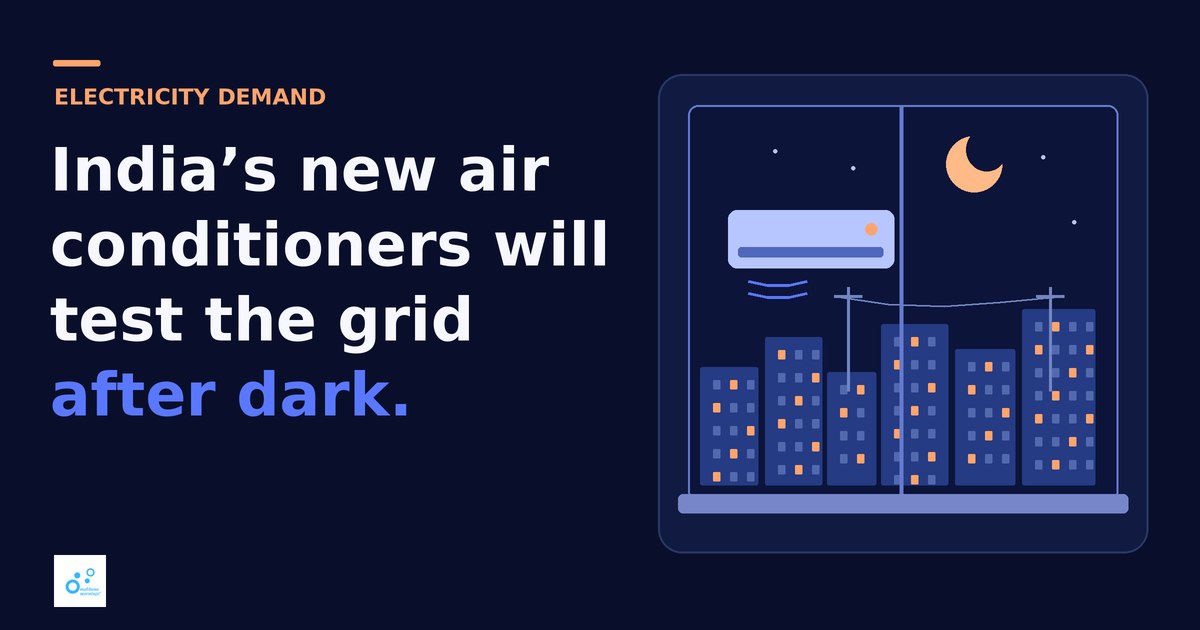
At 4 a.m. on a hot night, plenty of air conditioners are still running. The grid is long past sunset, but the amount of demand left for other power sources to meet has barely come down from its evening peak.
India could add about 200 million air conditioners to its homes by 2035, according to the International Energy Agency’s November World Energy Outlook. That is an increase in installed units over a decade, not annual sales or a count of new households with cooling. The IEA separately estimates that fewer than one in five Indian households own an air conditioner today.
The grid’s hardest hours can stretch into the morning
The IEA’s separate June analysis found that India’s summer net load typically peaks around 8 p.m. At 4 a.m. it is still only about 10% below that peak on average. Net load is the demand left after subtracting generation from weather-dependent sources such as wind and solar. That is not necessarily when total electricity demand is highest. It is when the rest of the system has to do the most work.
On hot summer nights, air conditioners can account for as much as a third of electricity consumption, the IEA estimates. That does not mean cooling is a third of annual demand, or that it explains all the load at 4 a.m. It does explain why the number of hours the grid can keep delivering matters, not just its ability to meet one big spike.
A power contract needs a time window, not just a capacity number
Imagine two resources that can each supply 100 megawatts. If one can sustain that output for two hours and the other for six, the second can deliver three times as much energy at that output. The first can still help cover a short spike. Neither number says whether the resource is charged or available when needed. A utility buying evening power has to ask how much can arrive, when it can start, and for how long.
Efficient air conditioners and buildings that need less cooling tackle the other side of the problem: they can lower the demand the grid must meet during those hours. Buying more supply and using less power per room are different decisions, but operators need to plan for both.
The Crunch
Ask what the power system can still deliver at 4 a.m., not just what it can supply at 8 p.m. A grid that covers the peak may still need help covering the night.


Leave your thoughts