
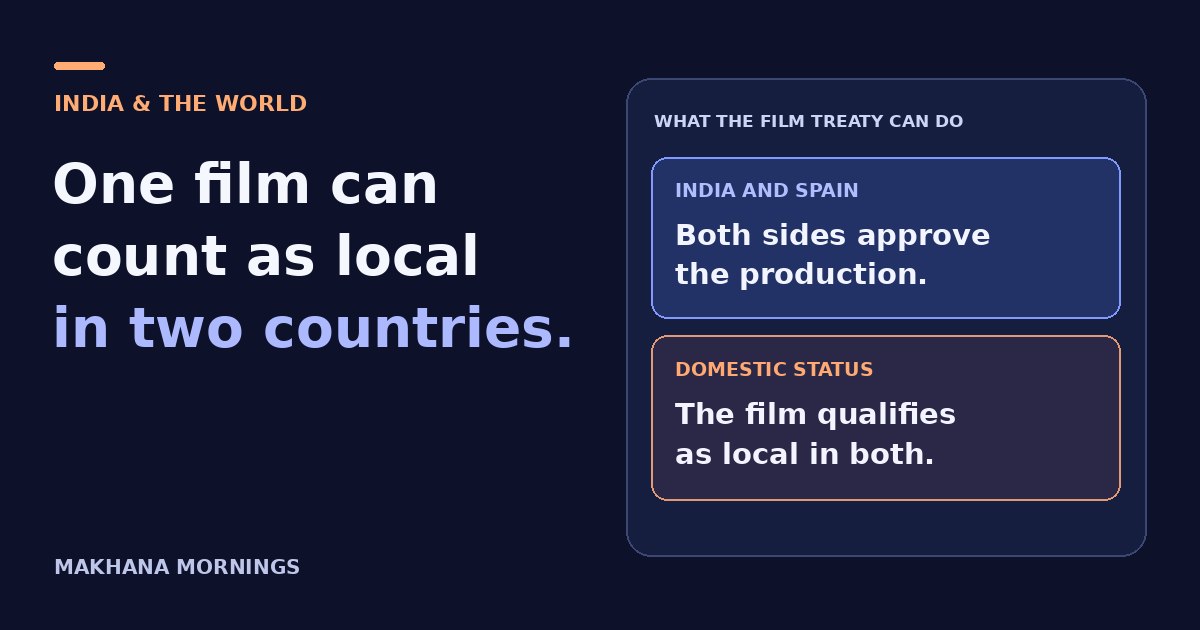
An Indian animation studio can do paid work for a Spanish film without being one of its producers. If the Indian studio and its Spanish partner jointly make the film and qualify under their countries’ co-production agreement, the same film can be treated as a domestic production in both markets. That difference is why talks in Goa about updating a 2012 agreement matter.
At the International Film Festival of India, officials from both countries discussed revising the agreement. The Spanish side proposed a framework spanning fiction, animation, documentaries, television series and films. The talks did not produce a signed revision, and they did not announce funding for any individual project.
The original agreement was written for films that debut in cinemas
The 2012 text already covers features, documentaries and animation, provided the work is intended to be shown first in cinemas and the producers meet the agreement’s conditions. The words “animation” and “documentary” in the new discussions do not mean those formats were previously excluded. The more consequential question is whether a revised text makes room for projects designed to debut on television or other services. The public announcement did not settle that.
A co-producer brings more than a production service
Imagine a Bengaluru studio hired to animate scenes for a Spanish producer. The studio earns a fee for delivering that work. In a co-production, the partners finance and make the project together and agree how to share rights and revenues. The existing treaty normally requires each producer to bring money and meaningful creative or technical participation. A separate exception for finance-only participation requires approval from both sides.
An approved project can be treated as a national film in both countries. That can open the door to domestic benefits under each country’s rules, but it does not put a grant in the budget or guarantee distribution. Under the existing agreement, the two authorities approve a project before filming, and the application includes items such as the script, proof of rights, the budget and the agreement between producers.
The useful test is which projects qualify
For producers, the questions are concrete: what counts as a qualifying first release, what each partner must contribute, and who approves the project before work starts. Until the two countries publish an amended text, a producer can explore a partnership but cannot count on the proposed terms.

Leave your thoughts