
India’s latest energy decisions address two different problems: storing electricity for later use and producing the materials that some energy technologies need.
On November 4, the Cabinet approved ₹14,500 crore of support for grid-scale storage and a separate ₹2,814 crore mineral-processing scheme. Both run from FY2026–27 to FY2030–31. These are approved programmes for future development, not announcements that the facilities are operating.
The Breakdown
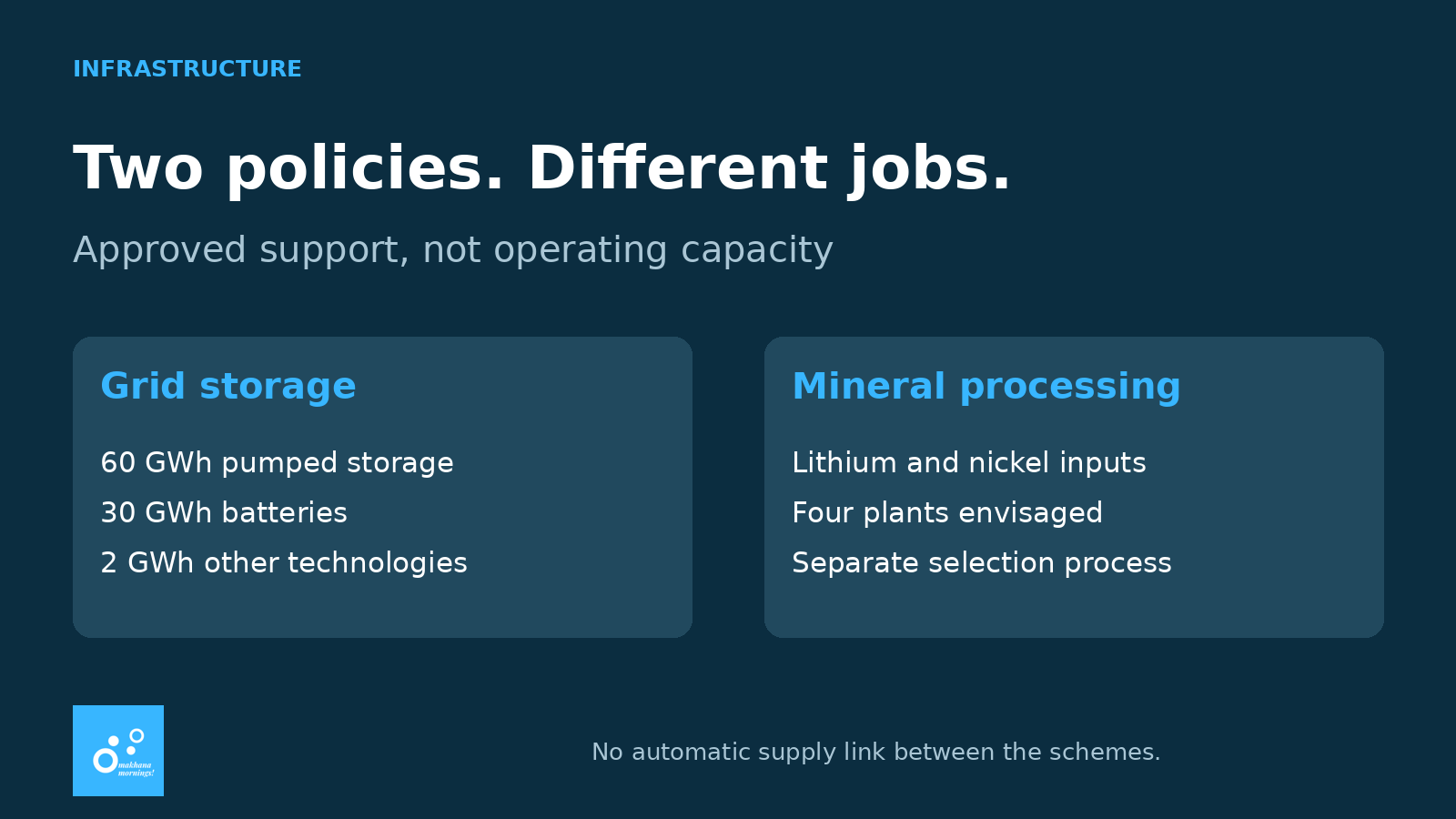
The storage programme targets 92 gigawatt-hours: 60 GWh of pumped storage, 30 GWh of battery systems and 2 GWh of alternative technologies. A gigawatt-hour measures an amount of energy, rather than instantaneous power.
The funding is intended to bridge the gap that can prevent projects from being financially viable. Allocation will use competitive tariff bidding. Battery projects face a minimum domestic-content requirement of 40%.
The mix matters. Most of the targeted capacity is pumped storage, which stores energy by moving water and later using it to generate electricity. The entire programme should not be described as a battery subsidy or a 92 GWh battery order.
The materials question
The processing programme targets lithium and nickel ores or intermediate products that must be converted into high-purity compounds. It envisages four plants: two for lithium, each with a minimum capacity of 30 kilotonnes, and two for nickel, each at least 50 kilotonnes. Cobalt recovery is expected as a by-product of nickel processing.
Eligible investment can receive 30% capital support, capped at ₹500 crore per lithium beneficiary and ₹900 crore per nickel beneficiary. Technical qualification comes before financial bidding, with selection based on the lowest support sought. Payments will be linked to milestones.
That design supports the industrial stage between raw material and a usable factory input. A domestic processing plant can still need imported feedstock, suitable technology and customers willing to accept its output.
Why This Matters
Read together, the decisions combine support for deploying storage with support for part of the materials supply chain. That is a policy connection, not a guarantee that these four plants will supply the supported battery projects.
Battery chemistries differ, and pumped storage has a different equipment chain altogether. The schemes therefore cannot be treated as one closed loop in which every tonne of supported mineral automatically becomes part of a funded storage installation.
For manufacturers and developers, the next decisions will be practical: which projects qualify, how domestic content is measured, what contracts are awarded and when facilities can deliver. Funding approval changes the opportunity; procurement and construction determine the resulting capacity.
The Crunch
The test now moves from announced support to implemented projects. Track awarded contracts, commissioning and reliable output alongside the headline spending and capacity targets. Those milestones will show whether the two programmes create dependable electricity storage and industrial supply.
Related categories: Economy & Markets, Business & Brands


Leave your thoughts