
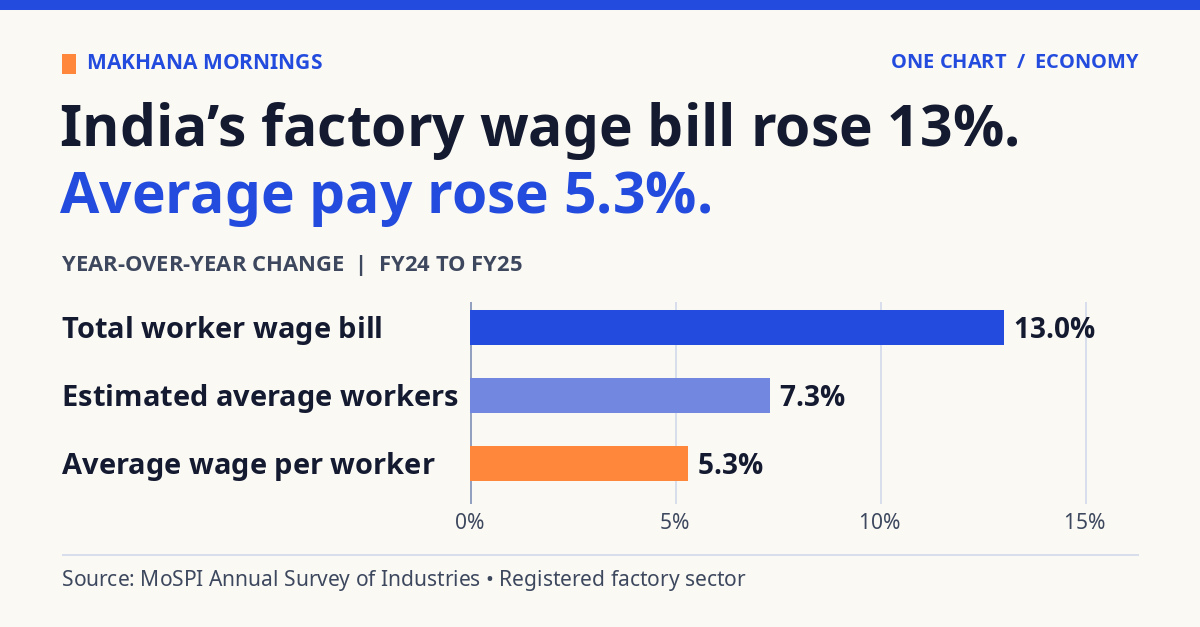
India’s registered factories paid about 13% more in worker wages in FY2024–25 than a year earlier. Average wages per worker rose 5.3%, to ₹2.28 lakh for the year. The gap matters: a bigger wage bill partly reflects more workers, not just higher pay.
Factories paid more wages because they also had more workers
The Annual Survey of Industries put the average number of workers at 1.67 crore, up 7.3% from 1.55 crore. Over the same period, wages per worker rose from ₹2,16,487 to ₹2,28,037. When both the number of workers and the average amount paid rise, total wages grow faster than either one alone.
See the factory wage bill and average pay in One Chart.
Prices absorbed most of the average pay increase
India’s all-India consumer price index rose about 4.6% on a fiscal-year average basis. Using that broad benchmark, average factory wages bought about 0.7% more. This estimate uses national consumer prices, not the spending basket of industrial workers or an individual household.
The survey does not tell us what the same worker earned a year later
The survey compares two averages for registered factories. The mix of plants, industries and workers can change between years. Wages also cover items such as overtime pay and bonuses, so the figure is neither a measure of base salary alone nor the raise given to a typical employee.
The numbers provide useful context for the Prime Minister’s question to industry leaders about pay and hiring at FICCI on 19 November. They describe an earlier year and cannot tell us what firms did after that speech. See how output and employment are distributed across factories.




Leave your thoughts