
India’s healthy-diet affordability gap remains large. But the latest estimate is an improvement, not evidence that the gap has widened.
FAOSTAT’s July 2026 release estimates that 35.5% of Indians (520.1 million people) could not afford a healthy diet in 2025. In the same release, the estimate for 2024 is 40.6%, or 589.2 million people. That is a decline of 5.1 percentage points.
The distinction matters as a new KPMG food-systems report brings the 2025 figure back into discussion. Another striking comparison in that report (food production above requirements alongside consumption below them) comes from 2019. It is not a second measurement of India’s position in 2025.
The affordability test
The FAO–World Bank measure prices the least-cost combination of locally available foods needed to meet a healthy-diet standard. It then compares that cost with the distribution of household resources, allowing for basic non-food needs.
This is an estimate of economic access, not a survey showing exactly what 520 million people ate. Being able to afford the benchmark also does not establish that someone actually follows that diet.
India’s estimated daily benchmark cost was 4.11 international dollars at purchasing-power parity in 2025, against 4.07 in 2024. Those are purchasing-power units for comparison, not US dollars to convert at the market exchange rate.
A slightly higher cost and improved affordability can coexist: affordability depends on resources as well as prices. The national figures alone do not identify which change drove the improvement for particular households or states.
The older production comparison
The production-versus-consumption figures trace to a NITI Aayog working-group report published in February 2024. Its comparison for 2019 puts daily food production at 1,721 grams per person, a population-weighted requirement for moderate physical activity at 1,265 grams, and estimated consumption at 1,000 grams.
On those figures, production was about 36% above the norm and consumption about 21% below it. This is a comparison of aggregate food weights, not a finding that Indians were missing one-fifth of their required nutrients in 2025.
The food groups also move differently. In that older table, estimated cereal consumption exceeded the norm, while milk and fruit consumption fell below it. Adding grams together cannot make those foods nutritionally interchangeable.
What the numbers can tell us
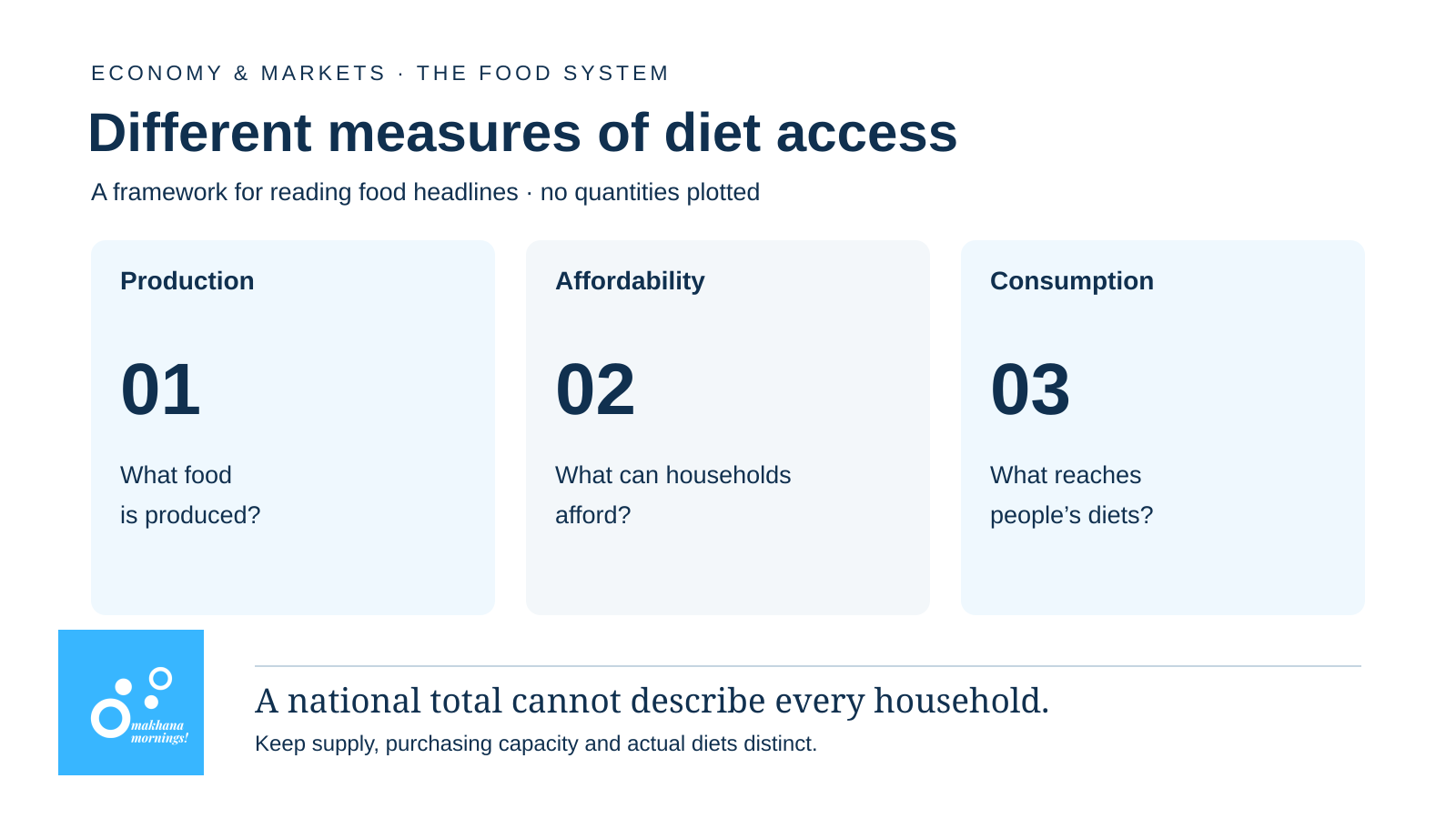
Production, affordability and consumption answer different questions. Production describes supply; affordability tests purchasing capacity; consumption describes what reaches diets. A favourable result on one does not settle the other two.
The year comparison here uses one FAOSTAT release throughout. That matters because the 2026 release updated affordability calculations to use the latest World Bank poverty lines expressed in 2021 purchasing-power-parity terms. Mixing its latest figure with an older release’s estimate can create a misleading trend.
The Crunch
India’s estimated healthy-diet affordability improved in 2025, yet more than a third of the population remained below the benchmark. The useful question is how to widen access to a varied diet, not whether a national production total, by itself, proves that households can afford one.




Leave your thoughts