
India’s wholesale inflation accelerated in October. The sharper warning came from fuel and power, while the annual inflation rates for manufactured products and the broader wholesale food basket eased slightly. That distinction matters more for a business budget than the headline alone.
The Breakdown
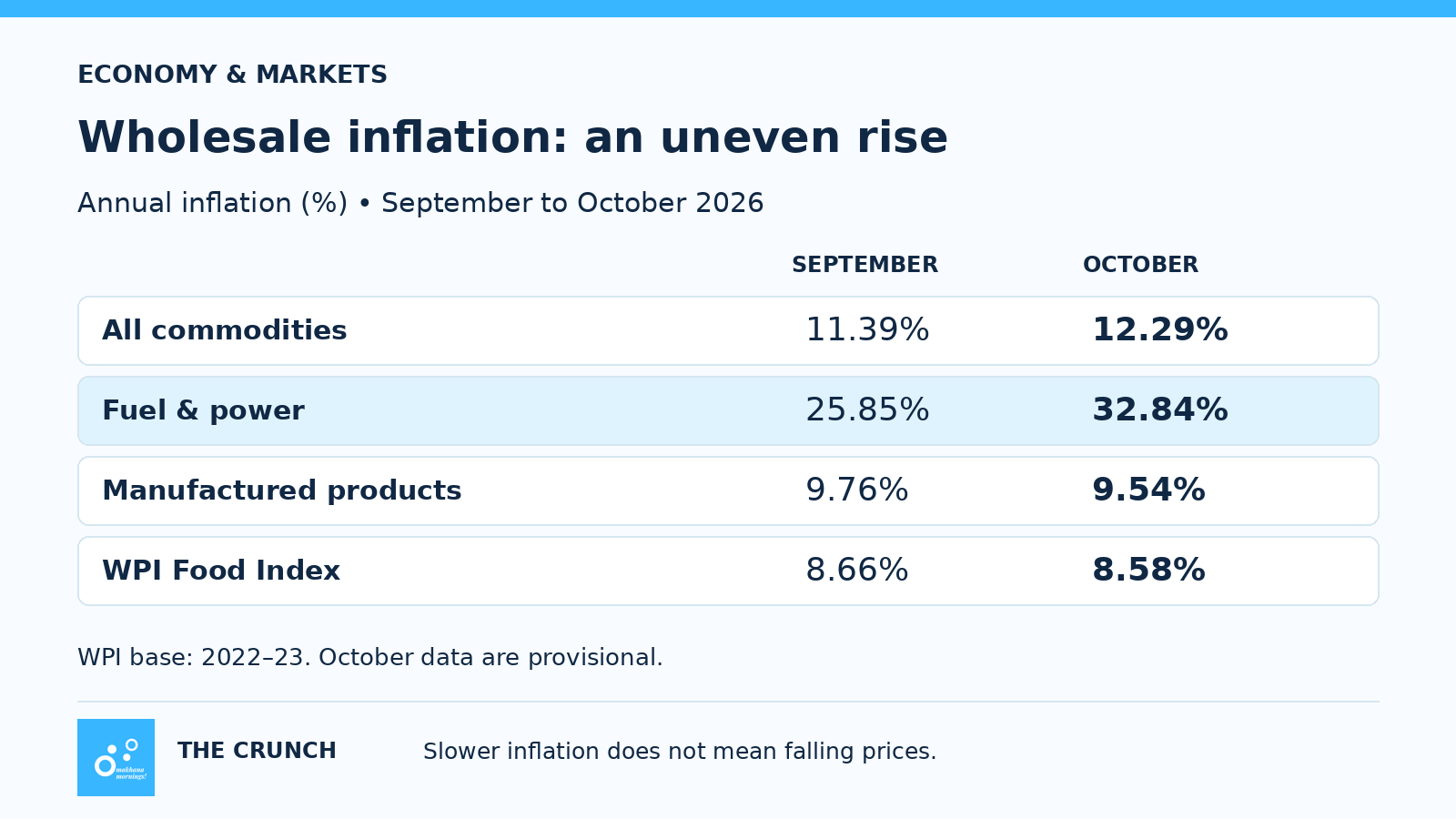
October’s provisional Wholesale Price Index inflation was 12.29% year on year, up from 11.39% in September. Fuel and power inflation climbed from 25.85% to 32.84%, while primary articles rose from 8.67% to 9.24%.
Manufactured-products inflation moved the other way, easing from 9.76% to 9.54%. The WPI Food Index, which combines food articles and manufactured food products, slowed from 8.66% to 8.58%.
Slower inflation does not mean those prices were lower than a year earlier. It means they were rising at a slightly slower annual rate.
The all-commodities index increased from 112.5 in September to 113.3 in October. The figures use the 2022–23 base-year series; October remains provisional, with an 81.1% weighted response rate.
Why This Matters
For a manufacturer, retailer or small supplier, the question is which costs sit inside its own bill. A business with substantial energy exposure may face a different problem from one whose largest costs are staff, rent or purchased components. An economy-wide average cannot substitute for that breakdown.
It also cannot show how quickly a supplier can pass costs on. Existing contracts, stock bought earlier and the willingness of customers to accept a price increase can separate a higher replacement cost from a higher selling price. The practical task is to compare purchase prices, selling prices and inventory together, rather than assuming the headline describes the margin.
The Big Picture
October’s consumer inflation was 6.09%, with consumer food inflation at 8.94%. Those are retail measures, not alternative estimates of WPI. The indices use different baskets, weights and pricing concepts. WPI measures goods at basic prices, excluding net taxes and trade and transport margins; CPI tracks household consumption prices, including services.
The gap between them is therefore not a forecast of how much shop prices must rise next. Nor does one wholesale release determine an interest-rate decision.
The Crunch
Watch the composition of inflation, not just its direction. October’s data warrant closer attention to energy exposure, but they do not show every category accelerating or every company facing the same cost increase.



Leave your thoughts