
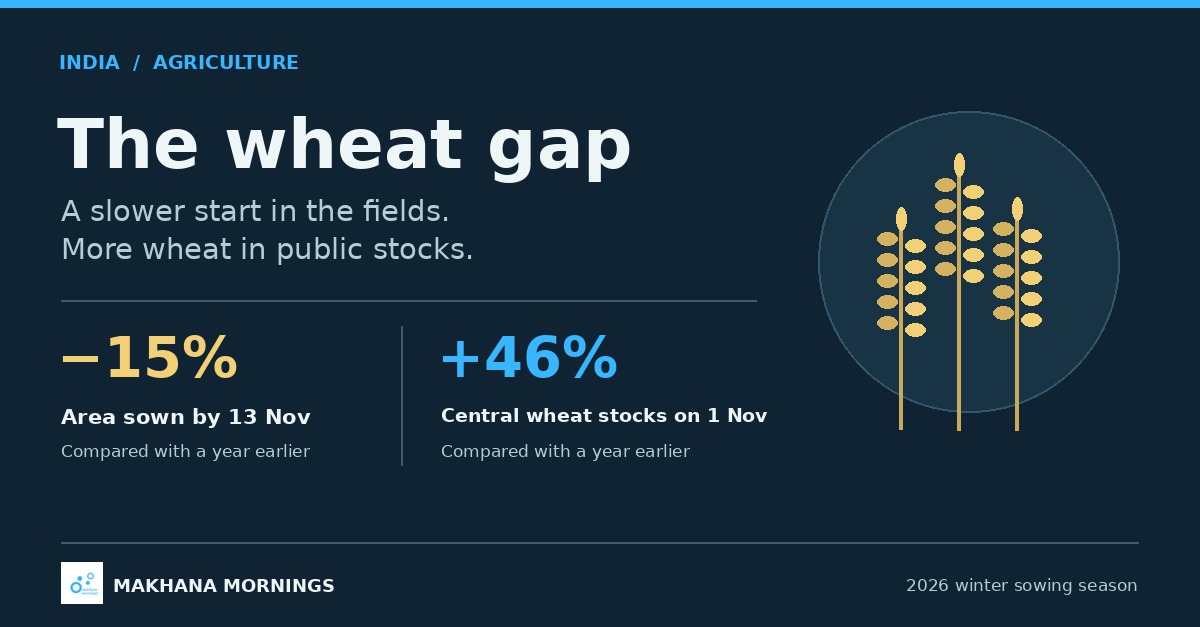
India hasn’t run out of wheat. It has had a slow start planting the next crop. By 13 November, farmers had sown about 50 lakh hectares, down from 59 lakh hectares at the same point last year, according to Agriculture Ministry figures. Yet on 1 November, the government’s central pool held 447.6 lakh tonnes of wheat, up from 307.3 lakh tonnes a year earlier. Those figures are not at odds: one measures land planted this winter, the other grain already in public hands.
See how public wheat stocks changed in One Chart.
Breakdown
Rainfall between 1 October and 18 November was 50% below normal in central India, according to the India Meteorological Department. Northwest India recorded 7% more rain than normal across the same period. Both are regional averages: neither tells a farmer how much moisture is in a particular field or whether irrigation will be available when the crop needs it. For some growers, the decision is whether to wait for better conditions or use the field for a different crop.
The government’s minimum support prices for the coming marketing season also changed by different amounts. Wheat rose by ₹25 to ₹2,610 per quintal, or about 1%. Rapeseed and mustard rose by ₹413 to ₹6,613, or about 6.7%; chickpeas rose only about 1.4%. That does not make another crop automatically more profitable. Yields, irrigation costs, market prices and access to procurement can matter more than the change in the announced price.
Why this matters
A slow start can affect the harvest in two ways. Some fields might never be planted with wheat, leaving less land to harvest. And even if planting catches up later, what farmers harvest per hectare will still depend on when the crop was sown and how it grows. A 15% planting lag at one point in November is not a forecast of a 15% smaller harvest.
The big picture
The 447.6 lakh tonnes in the central pool give the government more room than it had at the same point last year to supply the public distribution system or release grain into the market. They don’t measure private inventories, guarantee stable flour prices or refill warehouses after the next harvest. For mills and buyers, the immediate question is how much wheat reaches the market. For the government, a separate question is how much it can buy when the new crop is harvested.
The Crunch
Watch the next sowing updates and then the spring harvest. More wheat in storage gives India time. It doesn’t tell us how much wheat this winter’s fields will produce.
Related categories: Business & Brands



Leave your thoughts