
Gallup’s October 28 release puts U.S. employee engagement at 29% in the third quarter of 2026, its lowest since 2011. The underlying web survey ran August 5 to 19 among 21,648 employed adults aged 18 or older in its panel recruited using probability sampling.
Engagement concerns people’s involvement in and enthusiasm for their work and workplace. For Indian employers, the useful question is what the evidence says about their own employees, before choosing a response.
The Breakdown
India’s country table puts engagement at 23% for 2023 to 2025, down from 30% for 2022 to 2024. These overlapping averages covering three years are not a quarterly snapshot. South Asia’s 21% is a separate regional figure.
The global study covers people aged 15 or older employed for any number of hours by an employer, rather than the entire labour force. Its latest global fieldwork ran January to December 2025; the public report does not specify India’s employee sample size or exact interview dates.
India’s decline of seven points therefore describes a change between rolling averages. Comparing India’s 23% with the U.S. quarterly 29% does not establish a national gap for the same period.
What leaders think is a different measure
An August 22 report from Gallup and the Institute of Directors adds an Indian leadership perspective. The online survey ran May 14 to June 22 and drew 181 responses from IOD members in board, business and governance leadership roles. Participants could choose up to three of ten explanations for rising “quiet quitting”; 42% selected weak culture or a mismatch in values.
Those are participating leaders’ views, not employees reporting why they disengaged. They suggest questions to investigate; they do not establish a national cause or show that pay and workload are unimportant.
The latest U.S. findings also associate sharper declines with remote and hybrid employees in organisations adopting AI. That pattern does not show that AI caused disengagement, or explain the Indian figures.
Test the response as carefully as the diagnosis
One experiment by Simone Haeckl and Mari Rege, published online in 2024 and in a 2025 issue of Management Science, offers a useful boundary. Brief training in supportive leadership increased the satisfaction and engagement that employees reported during a subsequent meeting. The estimated improvement in team performance was not statistically significant. This was evidence from one corporation, not a finding that a particular meeting script restores engagement across Indian workplaces.
Consider a hypothetical Indian support team whose employees say a new approval process prevents them from resolving customer problems. An appreciative conversation could help surface that frustration. The practical test would also examine the approval process: who can change it, what delay it creates and whether the change improves service without sacrificing safeguards.
That is an example to test, not a remedy established by the surveys. Employee feedback, leaders’ explanations and measured results each answer a different question. Keeping them separate makes it easier to see whether the chosen intervention addresses the actual problem.
The Crunch
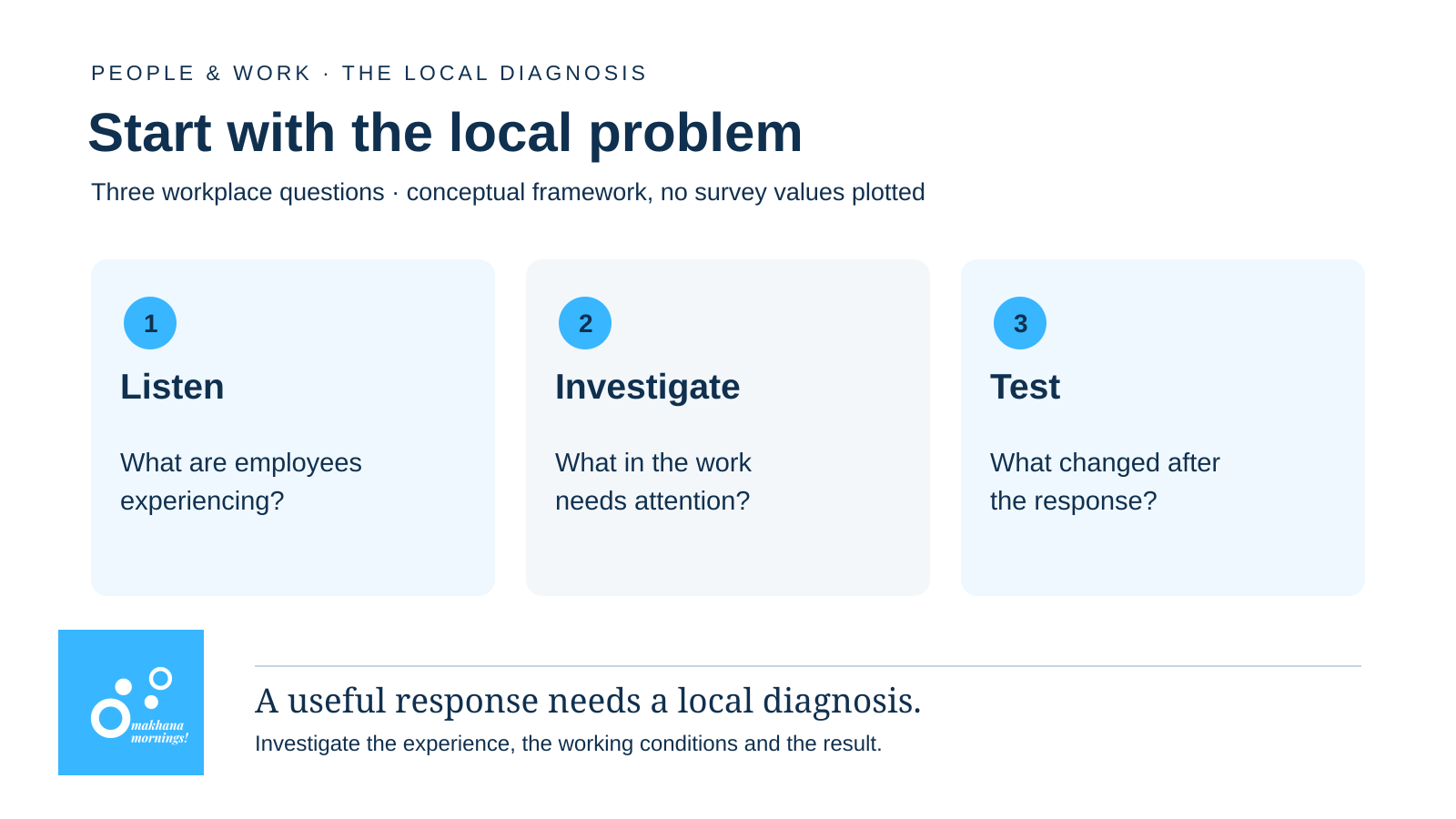
India has an engagement warning of its own. Use it to investigate how work is organised locally, then check whether the response improves both the employee experience and the work. A foreign headline, a leadership opinion and a promising experiment should not be mistaken for the same kind of evidence.




Leave your thoughts