
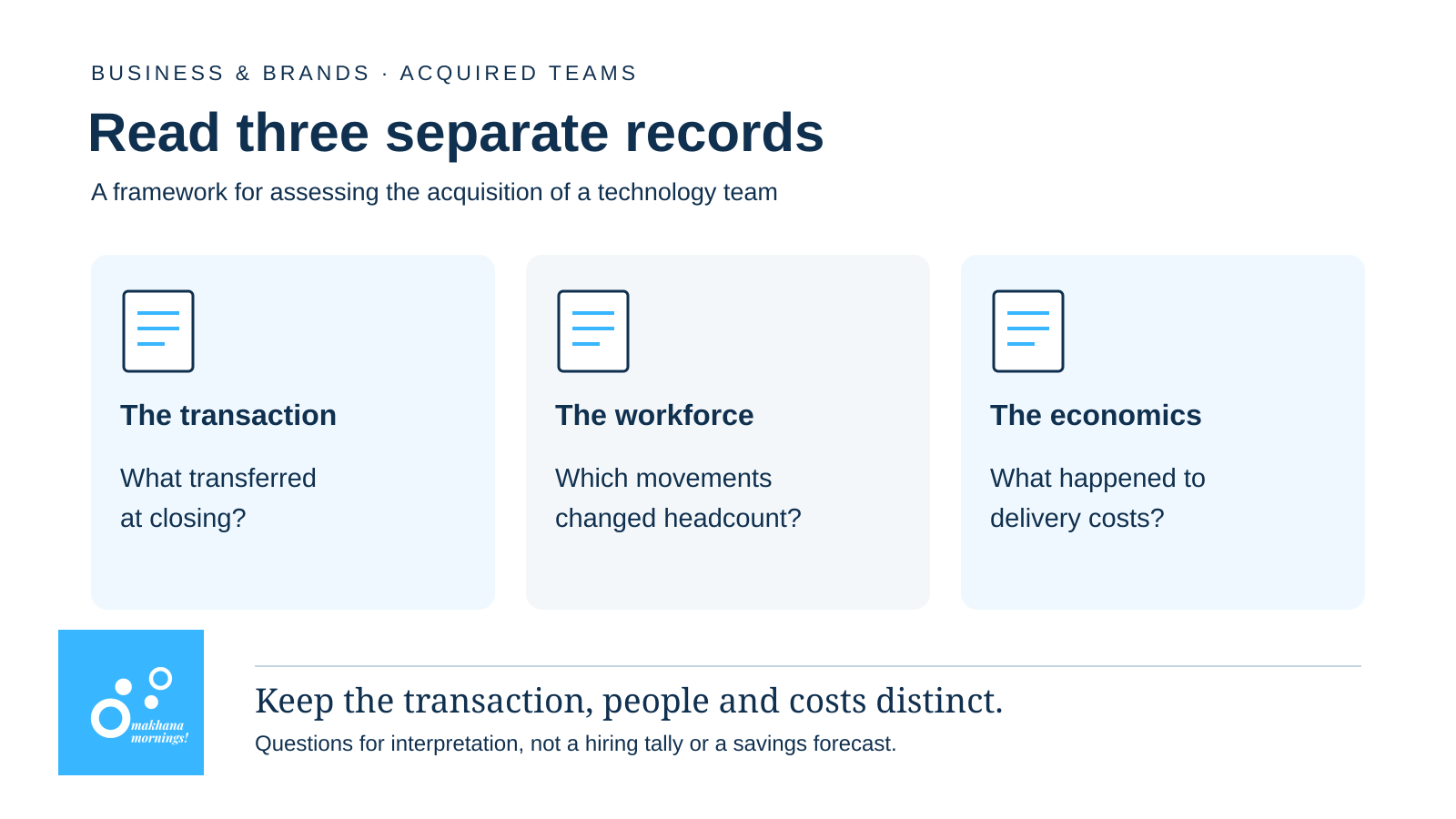
An IT services company can add people by recruiting them or by buying the business that already employs them. Those routes have different implications for jobseekers, clients and shareholders. Recent Indian transactions make the distinction important: a larger workforce does not, by itself, establish new hiring or a lower delivery cost.
What moved with the teams
HCLTech’s July agreement with Guardian paired a services relationship lasting seven years with a planned transfer of nearly 2,000 employees into a dedicated Guardian business unit. Its subsequent exchange filing confirms the Indian operation’s acquisition closed on July 31, 2026.
These transactions have different structures. Wipro completed its Mindsprint acquisition on May 15 alongside an Olam transformation engagement lasting eight years. TCS completed the purchase of all partnership interests in Best Buy’s BBY Services India LLP on October 15. They should not be counted as a single kind of hiring event.
The payroll is only one part of delivery cost
HCLTech ended September with 230,339 people, up 6,450 in the quarter, and reported 6,136 fresher additions. Employee benefits rose from ₹19,692 crore to ₹19,828 crore quarter on quarter, while falling from 56.9% to 55.6% of revenue. Outsourcing costs, including subcontractors and outsourced work, rose from 14.8% to 15.0% of revenue. Its annual measure of revenue per employee was $65,400, calculated using revenue over the preceding twelve months and average headcount at quarter ends across five quarters.
Net headcount change and fresher intake cannot simply be subtracted to calculate experienced hiring. Acquisitions, departures and other workforce movements also matter. Revenue per employee is neither a wage measure nor the margin on an acquired team. A payroll percentage falling while reported expenses rise is also different from an absolute cost cut.
Which acquisition affected the margin?
HCLTech’s earnings call provides a more specific bridge. Management reported an EBIT margin for the September quarter of 18.2%, up 131 basis points sequentially and including 84 basis points of restructuring costs. It attributed a headwind of 25 basis points to the HPE Telco Solutions acquisition, not to Guardian. Management also cited operating efficiencies, Advanced AI services, overhead leverage and currency as positive contributors. These are the company’s explanations of its results, not an independent measurement of AI’s causal effect.
The Guardian purchase note answers a different question. HCLTech’s unaudited IFRS statements show $21 million paid to the seller, comprising $20 million of preliminary purchase consideration and $1 million recoverable from the seller. The company was still finalising the consideration and valuation of acquired working capital. That acquisition accounting does not disclose the operating margin of the services relationship lasting seven years.
The Crunch
For Indian technology workers, the relevant question is what work, responsibilities and career paths transfer with the employer. For investors, it is how the acquired operation contributes after delivery and integration costs. For clients, continuity still needs to be maintained. Reading the closing document, workforce movement and margin bridge separately gives each group a better answer than treating every added employee as a new job or every acquisition as a proven saving.



Leave your thoughts