
An operating recovery and a cash recovery are not the same thing. JLR’s latest results illustrate why that distinction matters for Tata Motors Passenger Vehicles: better trading can coexist with a statutory loss and continued spending demands.
The Breakdown
For July–September 2026, JLR reported £5.9 billion of revenue and a 1.1% adjusted operating margin. Profit before tax and exceptional items was £6 million. But after £530 million of exceptional charges, including restructuring and asset write-downs, its reported after-tax result was a £451 million loss.
The year-on-year comparison also needs context. The previous year’s quarter had been disrupted by a cyber incident. Recovering from that weak base is different from establishing a sustainably higher level of profitability.
In its November 13 update, JLR revised its full-year outlook to a 2–3% adjusted operating margin and approximately £1.25 billion of free cash outflow. Those are management forecasts, not completed results.
Follow The Cash
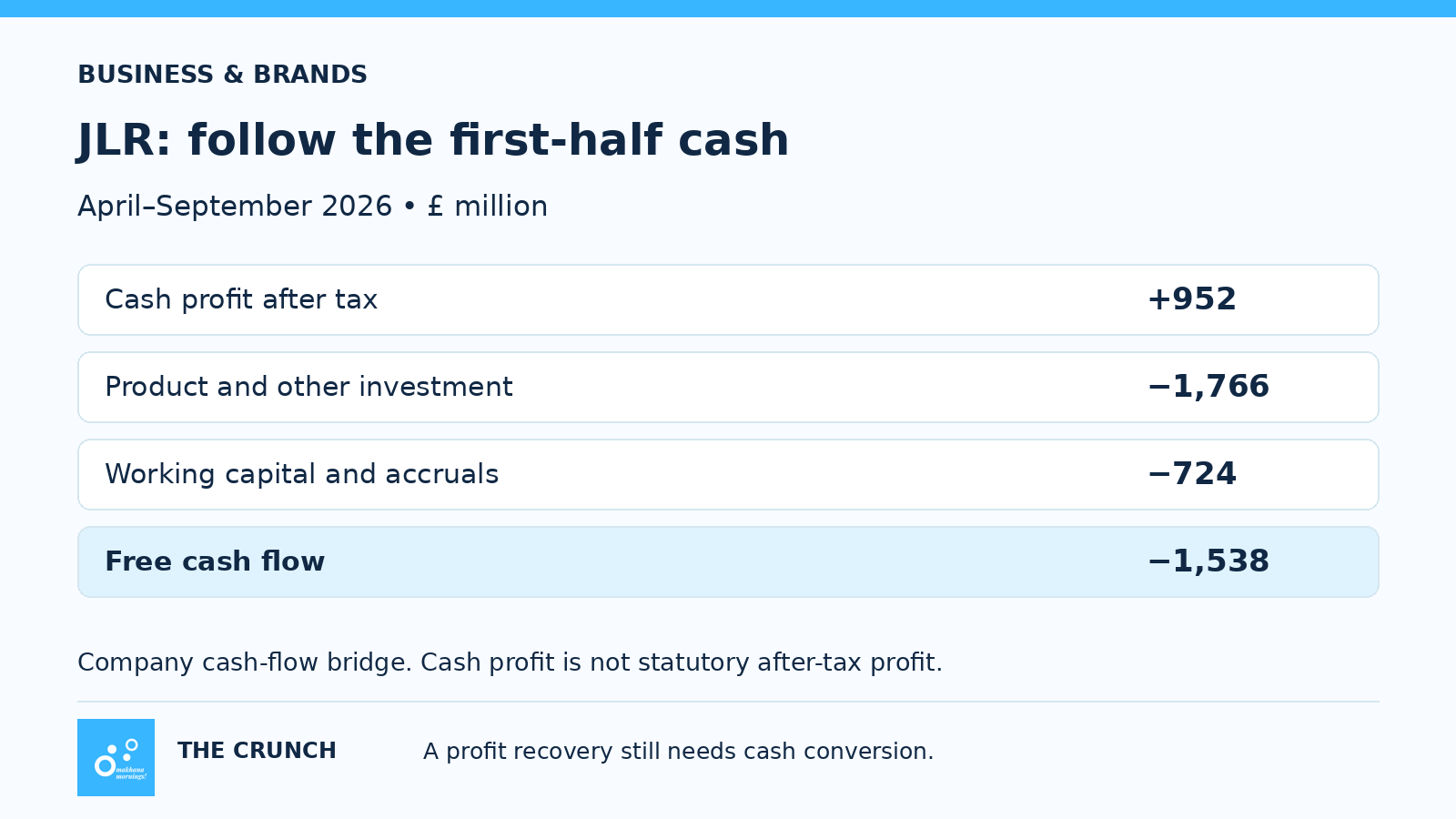
The first-half cash bridge makes the spending pressure clearer. JLR showed £952 million of cash profit after tax, followed by £1.766 billion of product and other investment and a £724 million outflow from working capital and accruals. The resulting free cash outflow was £1.538 billion.
Working capital includes money tied up in inventory and receivables, alongside changes in payments owed to suppliers. It is not interchangeable with an accounting expense. Equally, an asset write-down is not automatically a matching cash payment in that quarter.
This is why neither the adjusted profit number nor the statutory loss, read alone, explains the cash outcome.
Why This Matters In India
JLR sits within the Indian-listed Tata Motors Passenger Vehicles group. Its cash needs therefore matter even when the domestic vehicle business is performing differently. The group’s presentation showed positive domestic-business free cash flow of ₹1,945 crore in the first half; that does not make JLR’s separate cash outflow disappear.
Liquidity provides another important distinction. JLR reported £1.8 billion of cash and £6 billion of total liquidity at September-end. The larger figure includes financing facilities, not just cash already in the bank.
The Crunch
The next test is conversion: whether stronger trading, investment and working-capital management translate into cash. JLR’s results support a recovery story, but not the conclusion that its financial rebuilding is complete. Watch actual cash generation alongside the margin forecast, without treating either as a promise.



Leave your thoughts