
An online order can look like a successful sale before it becomes a cost. For a small seller, the important number is not only how many parcels leave the warehouse, but how much contribution remains after failed deliveries and customer returns.
Two journeys, different charges
A customer return happens after delivery. A return to origin, or RTO, can happen when a parcel never reaches the customer. A cancellation before dispatch is different again: no parcel has made a return trip. Combining these events into one percentage hides different operational problems and potentially different costs.
Meesho’s public supplier policy offers a concrete example. It says a seller is charged a fee for return shipping based on weight when a customer returns a product. An undelivered order converted to RTO does not attract an additional shipping fee. The policy also allows exceptional waivers of return fees and provides sellers with charge and compensation information.
That is one platform’s published policy, not a rule for every marketplace. And “no additional shipping fee” is not the same as saying an unsuccessful order has no economic cost.
Why the margin changes
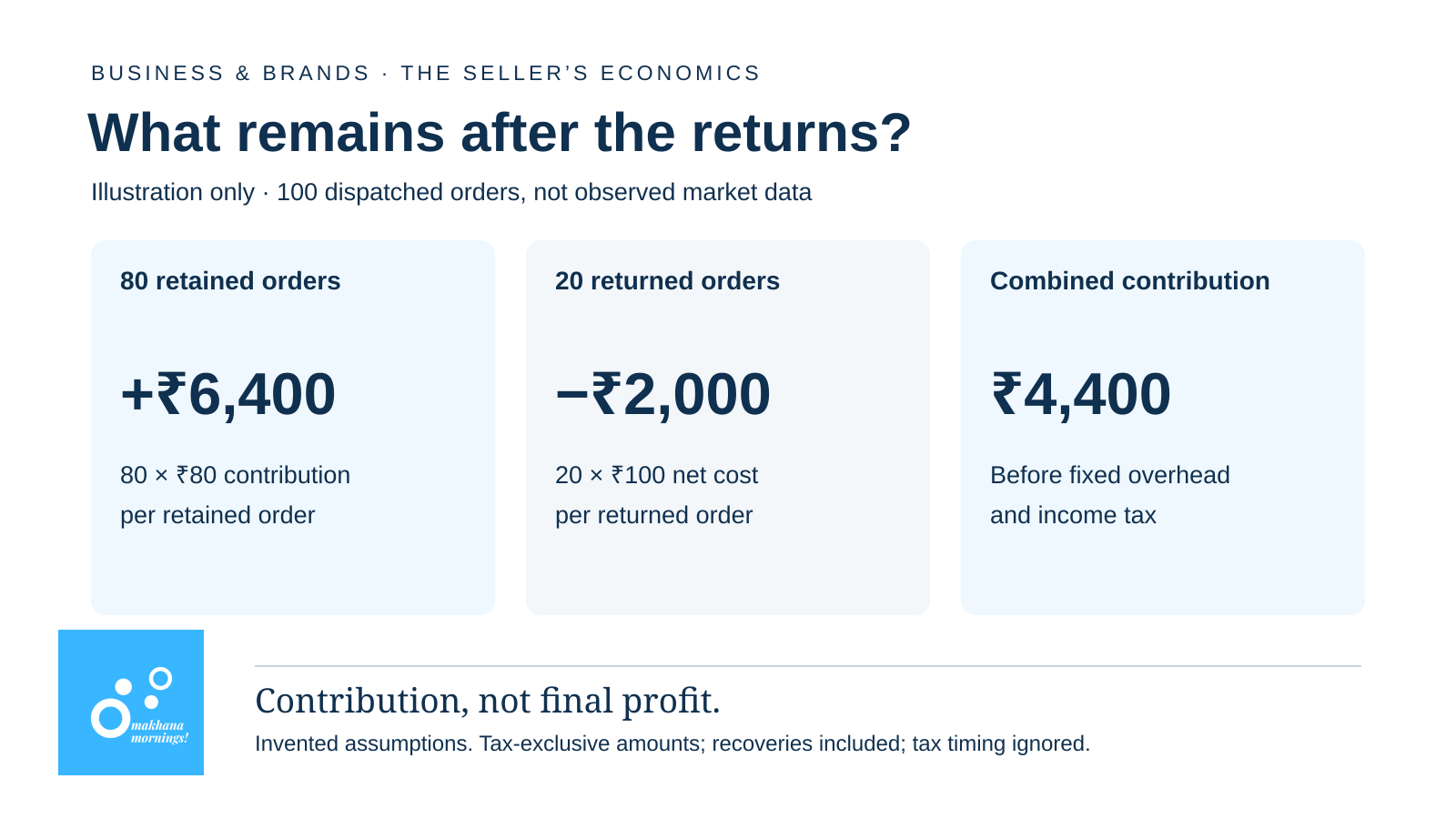
Consider a purely illustrative seller with 100 dispatched orders. Suppose each retained order contributes ₹80 after product cost and other variable costs, including ordinary fulfilment, while each returned order leaves ₹100 of unrecoverable variable cost after any recovery. If 20 orders return, the combined contribution is ₹4,400: ₹6,400 from the 80 retained orders, less ₹2,000 on the returns. With all 100 retained, it would have been ₹8,000.
These are invented assumptions, not measured Indian averages or a marketplace settlement forecast. The example is before fixed overhead and income tax; amounts consistently exclude tax and ignore tax timing. It measures contribution, not final profit. The outcome changes with charges, recoveries and whether the product can be sold again.
A returned item also has a timeline. A product that comes back in saleable condition is different from one requiring repair or a discount. Recovering stock after its main selling season can be different from recovering it while demand remains strong. A seller may also have cash committed to stock while awaiting its return or resale. Those differences need evidence for individual orders, not just a total return count.
Cost is not proof of misuse
A costly return does not establish customer fraud. Fit, product description, defects, delivery failure and permitted changes of mind are different explanations. Evidence that a seller loses money cannot, by itself, establish which one caused the loss.
The sharper question about the platform and the seller is contractual: who pays which charge, when can a seller seek compensation, and how quickly is the dispute resolved? The published policy identifies part of that allocation; actual settlement records would be needed to measure its effect.
The Crunch
Returns belong in the economics of a sale, not outside it. To understand the pressure on small online sellers, follow the contribution from retained orders and the net cost of unsuccessful orders separately. A big festive dispatch number cannot tell us how much the seller ultimately keeps.




Leave your thoughts