
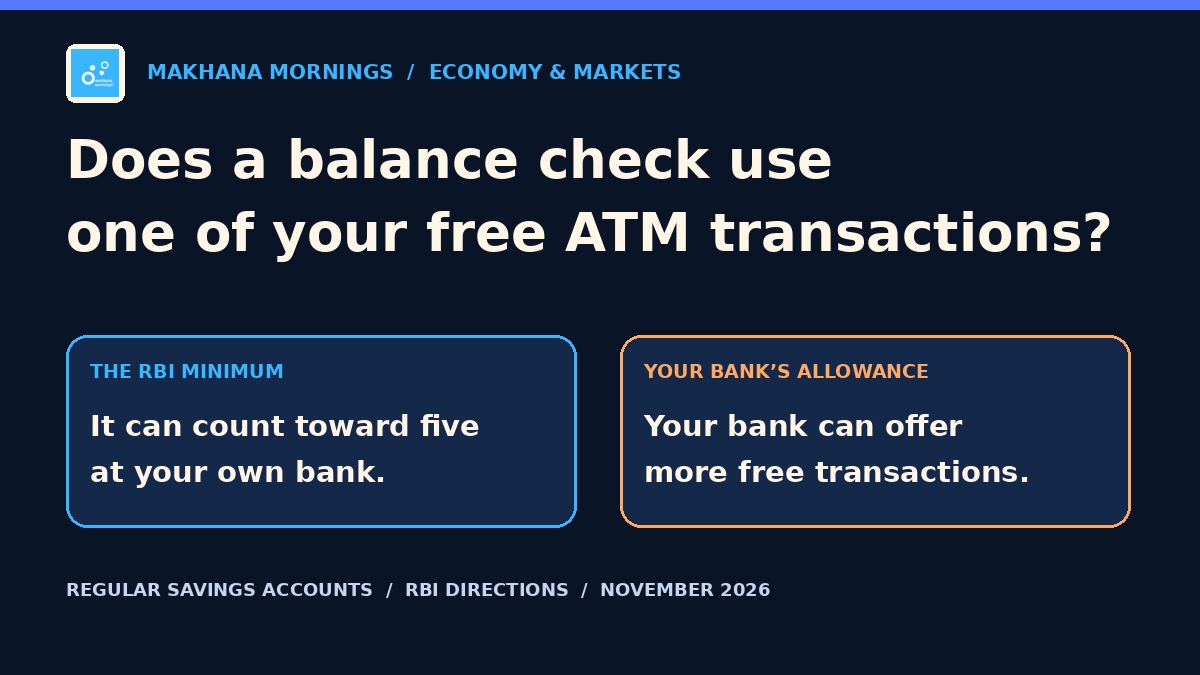
A balance check at your own bank’s ATM used to sit outside the free-transaction count in RBI guidance. The central bank’s November 27 directions now describe the minimum as five monthly transactions at your own bank’s ATMs, including both cash and non-cash activity. That change in wording matters even if your bank keeps a more generous allowance.
The RBI sets the minimum. Your bank can offer more.
Under the new directions, if a regular savings account comes with only the minimum allowance, three successful cash withdrawals and two successful balance checks at its own bank’s ATMs would use up the five free transactions. A bank with a more generous policy can allow more. Basic Savings Bank Deposit Accounts follow separate rules.
The ₹23 ceiling, plus applicable taxes, is not a new flat fee. It is the most a bank may charge per transaction beyond the allowance under these directions. The RBI also tells banks to have a way of warning customers about the free transactions they have used and the charges that may follow. It does not require an SMS for every withdrawal.
Visiting another bank’s ATM uses a separate allowance
At another bank’s ATM, the RBI prescribes three free monthly transactions in its six listed metro centres and five in other places. If you use both, the minimum framework does not add the two together. It caps their combined count at five. The direction also caps each cash withdrawal at another bank’s ATM at ₹10,000.
A failed attempt due to a technical problem or the ATM running out of cash does not use a free transaction or attract a fee. The useful number is not how many times you used the machine, but how many valid transactions counted under your bank’s allowance.




Leave your thoughts