
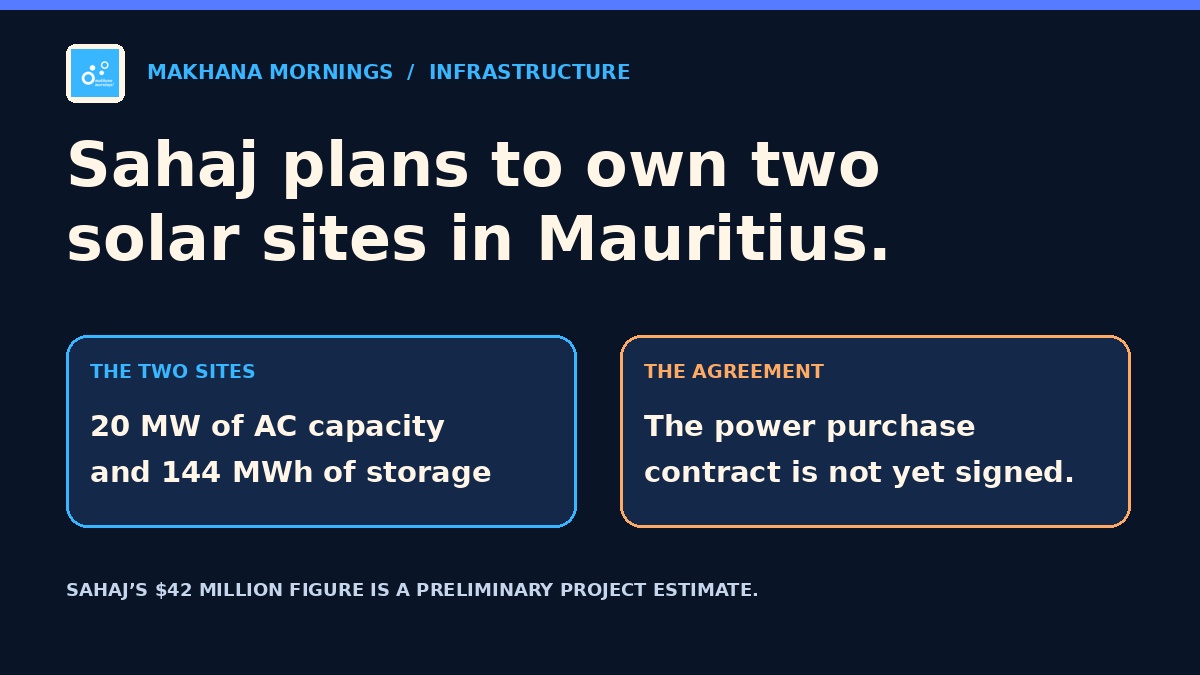
A solar developer can sell a set of panels and move on. Sahaj Solar’s plan in Mauritius is to remain the owner after construction and sell electricity to the island’s Central Electricity Board. The Ahmedabad-based company estimates the value of the two projects at $42 million. That is a project estimate, not a disclosed payment for equipment or a signed electricity revenue figure.
The headline number covers two proposed projects, not ten
The Central Electricity Board invited bids for power from ten 10 MW hybrid sites in a wider procurement. Sahaj’s 27 November exchange filings describe two sites for its own proposal. At each site the company lists 17 MW of solar panels measured on the direct-current side, a 10 MW alternating-current project rating and 72 MWh of battery storage. Across both sites that comes to 20 MW of alternating-current capacity and 144 MWh of storage.
The megawatts and the megawatt-hours measure different things
Megawatts tell you how much power the plant can deliver at a moment. Megawatt-hours tell you how much energy the battery can store. A battery can move some daytime solar generation to a time when the grid needs it, but it does not create additional electricity. The stated storage capacity alone does not tell you how long the battery can deliver at a particular rate, because the filing does not specify the battery’s discharge rating or usable energy.
The power purchase agreement is the next milestone
Sahaj’s initial filing calls the notice a letter of award; a press release it filed later the same day calls it a letter of intent. Both describe a power purchase agreement still to be executed, and the later release names the Central Electricity Board as the intended sole buyer for 25 years. Sahaj plans to develop, own and operate the sites through its wholly owned Mauritian subsidiary. Neither filing provides a signed agreement, the tariff, financing terms or a commissioning date.
That is the distinction to watch. A developer that keeps the assets needs to fund and build them before it can earn from supplying power. The $42 million estimate does not tell you what the utility will pay for a unit of electricity or when the first unit can be delivered.




Leave your thoughts