
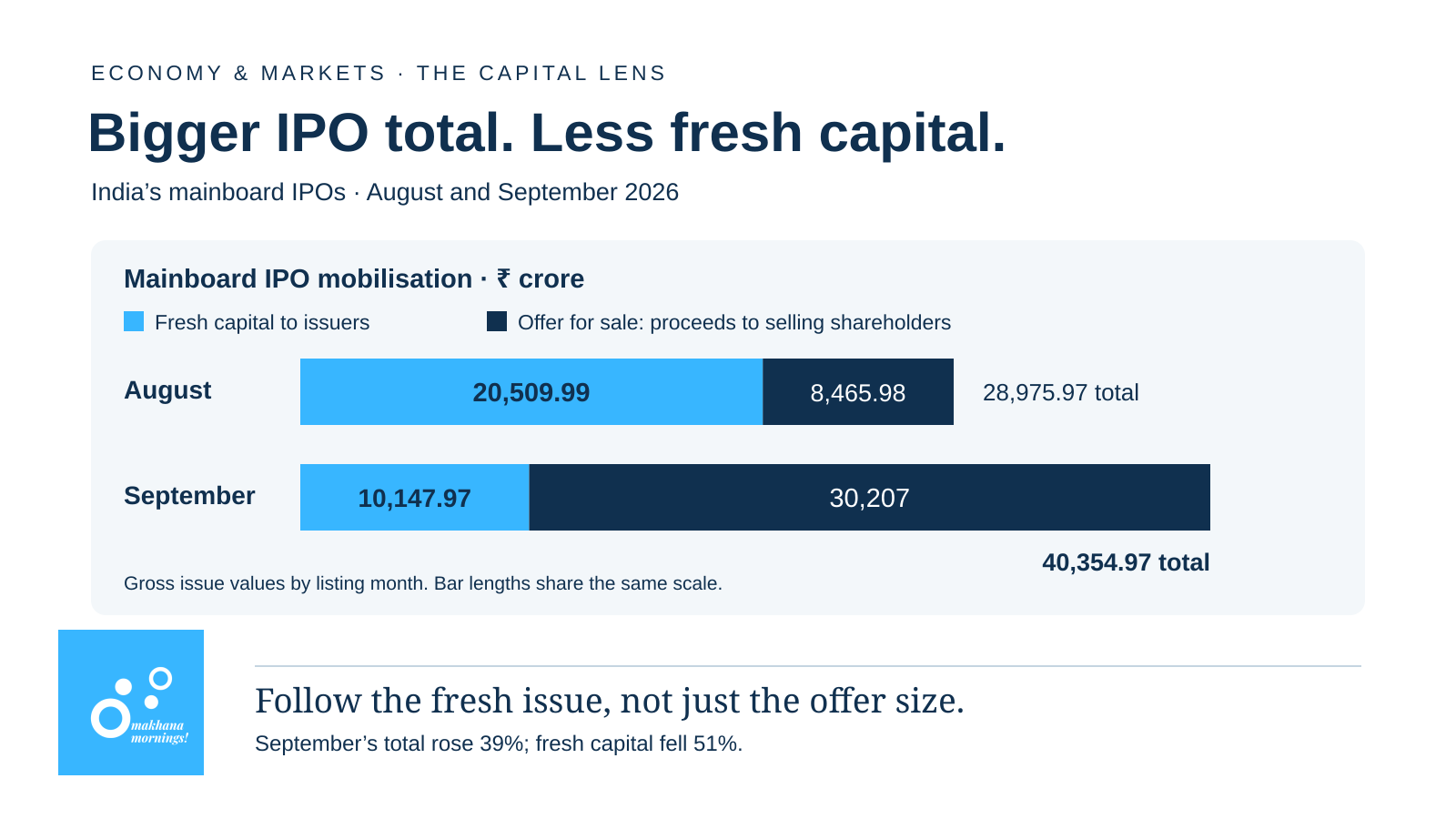
India’s mainboard IPO market mobilised ₹40,355 crore in September 2026. Only about one-quarter of that amount was fresh capital for the companies coming to market.
The distinction changes what the headline tells us. A busy listing market can help existing shareholders sell their stakes without delivering an equivalent increase in money available to the businesses themselves.
The Breakdown
September’s 32 mainboard IPOs mobilised ₹40,354.97 crore. Of that, ₹30,207 crore was the offer-for-sale component, or OFS. Fresh capital accounted for ₹10,147.97 crore.
An OFS sells shares held by existing owners. Its proceeds go to the selling shareholders rather than to the company. A fresh issue creates shares to raise money for the issuer. Both can be part of the same IPO, but they serve different purposes.
The contrast with August is striking. Total mainboard IPO mobilisation rose about 39%, from ₹28,975.97 crore. Yet its fresh-capital component fell about 51%, from ₹20,509.99 crore.
That is not a contradiction. September’s larger total had a much greater contribution from shareholder sales.
These are gross issue-value figures, calculated from the relevant shares and issue price. They are not measurements of net proceeds after expenses, cash already spent on expansion, or investment completed during the month. The monthly IPO classification follows listing dates, not the dates on which subscription windows opened.
Why This Matters
For Indian businesses, “a strong IPO market” can mean several things: access to new equity, an exit route for earlier investors, or a wider public shareholder base. A single mobilisation figure cannot tell us which function is dominating.
Fresh capital also should not automatically be labelled factory, technology or hiring expenditure. An issuer’s stated uses may include debt repayment, working capital or other purposes. Those uses need to be checked company by company.
Nor does a large OFS component establish that a listing is good or bad. It identifies the portion attributable to existing-share sales and where those proceeds go. Valuation, business performance and the reasons for a sale remain separate questions.
The Big Picture
September’s SME IPOs showed a different funding mix. Across 38 issues, they mobilised ₹1,683.83 crore, including ₹1,587.88 crore of fresh capital, about 94% of their total.
The SME pool was much smaller than the mainboard pool. Its different composition does not establish that SME listings are safer or that small businesses generally enjoy easier financing. It does show why combining both markets into one headline can obscure the kind of funding being raised.
Across mainboard and SME IPOs together, September’s mobilisation was ₹42,038.80 crore. Fresh capital contributed ₹11,735.85 crore; shareholder sales contributed the rest.
The Crunch
September was a bigger month for mainboard IPO mobilisation than August, but a smaller month for fresh capital raised through those IPOs. To understand what listings contribute to business funding, follow the fresh-issue component, not just the size of the offer.




Leave your thoughts