
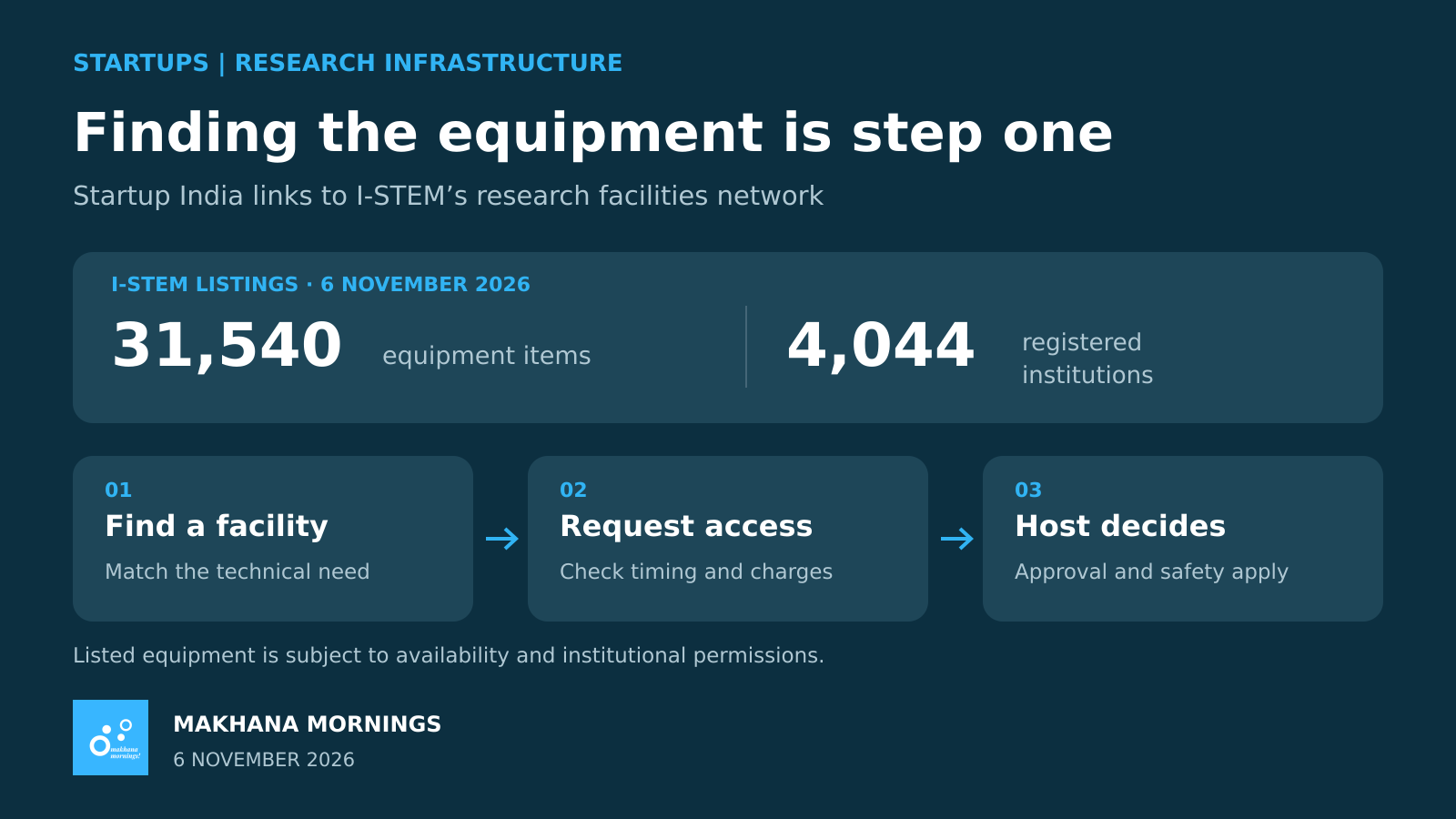
A startup looking for a specialised test may first need to find out which institution has the right equipment. A new link between the Startup India and I-STEM portals aims to make that search easier for DPIIT-recognised businesses.
The API integration launched on November 6 connects the startup platform with the Indian Science, Technology and Engineering Facilities Map. I-STEM listed 31,540 equipment items across 4,044 registered institutions on that date. Those figures describe the network’s listings; a founder must still request access to a suitable facility.
The Breakdown
The Office of the Principal Scientific Adviser and the Department for Promotion of Industry and Internal Trade have brought the two portals together. The integration is designed to help recognised startups find scientific equipment and facilities for research, prototyping, testing and technology validation.
Automated checks of DPIIT recognition status and links between the portals are intended to simplify onboarding. This addresses an administrative step in reaching the equipment network. Recognition does not settle whether a particular instrument or service is suitable for a startup’s project.
Single sign-on is proposed for subsequent phases. Founders should therefore treat a unified login as a planned addition, rather than assume the launch has already delivered that experience.
The institution still decides
Each host institution will continue to assess and approve individual requests. Its decision depends on technical suitability, availability, applicable charges, safety requirements and institutional permissions.
That leaves several practical questions for a founder: Can the facility perform the required work? Is capacity available within the project’s timetable? What will it charge, and what conditions must the startup meet before work begins? The integration can help identify a candidate facility, while those answers determine whether it can support the next development step.
The same distinction applies to the equipment count. Several items may sit within one institution, and a listed instrument may have its own schedule or restrictions. The 31,540 figure should not be read as an equal number of laboratories or immediately bookable slots.
A broader route into existing infrastructure
This integration reaches across the startup ecosystem, with particular relevance to deep-tech businesses that need specialised research infrastructure. It adds a discovery and onboarding route to equipment already held by institutions, rather than announcing 31,540 new purchases.
For an early-stage team, shared access can offer a way to carry out a test without buying and maintaining an expensive instrument itself. Whether that option makes sense depends on the actual service, price and timing. The launch does not quantify savings for an individual business.
The network will also need current listings and sustained participation from institutions. A useful search result should lead to reliable information about what a facility can do and how to request it. Keeping that information updated matters as equipment availability and institutional arrangements change.
The Crunch
The Startup India–I-STEM link can shorten the search for research infrastructure. Its practical value will become clearer as startups move from finding an instrument to obtaining approval and completing work. For now, founders have a wider route to explore, with the host institution’s terms still shaping the outcome.

Leave your thoughts