
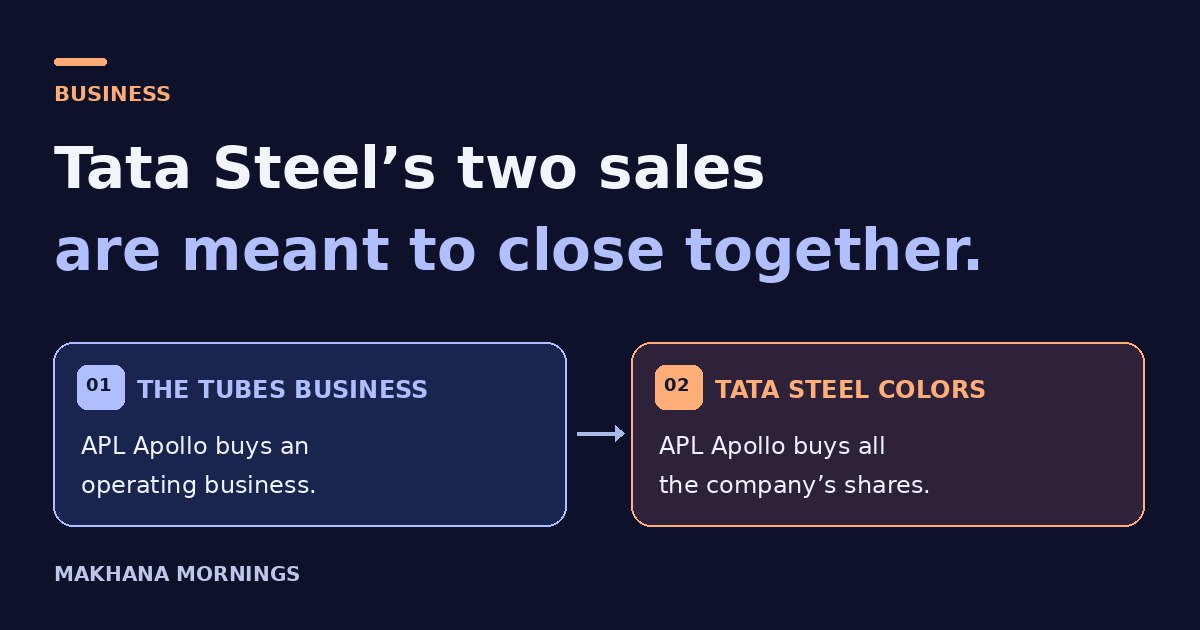
APL Apollo is not buying Tata Steel. It plans to buy two parts of the group, and the agreements are built to close together. That distinction matters for anyone trying to understand what the headline figure of up to ₹28,000 crore buys.
The companies disclosed the terms on 22 November. Tata Steel describes up to ₹11,700 crore in cash for its tubes business. APL Apollo lists ₹11,700 crore, payable at completion. The second transaction is ₹16,300 crore in cash for 100% of Tata Steel Colors, formerly Tata BlueScope Steel. No closing payment has been announced.
One agreement transfers a business. The other transfers shares.
The first deal covers Tata Steel’s tubes and pipes operations at Jamshedpur, Hosur, Khopoli and Sahibabad, alongside certain cold-rolling and coated-steel facilities at Khopoli. APL Apollo says the transfer covers specified assets, contracts, licences, employees and liabilities. A slump sale transfers an operating business for a lump sum rather than giving every asset a separate price in the agreement.
The second deal changes who owns a company. Tata Steel and its wholly owned downstream subsidiary each hold half of Tata Steel Colors. Both would sell their shares, with ₹8,150 crore payable to each seller. The coated-steel and building-products company would become wholly owned by APL Apollo if the deal closes.
What the deal changes for APL Apollo
APL Apollo already sells steel tubes and coated products. Buying the two operations would give it more production sites and products to sell through its network. The buyer points to wider distribution and scale as reasons for the deal. Whether it can actually serve more customers or make better use of the plants depends on what happens after closing.
The agreements are conditional on each other: the companies plan to close both at the same time. APL Apollo lists Competition Commission of India approval among the conditions, as well as shareholder approval for the share purchase. The agreements identify 31 March 2028 as the long-stop date, not a promise that closing will occur then.
The Crunch: The buyer would take over a tubes operation directly and gain control of a coated-steel company through its shares. Two contracts describe what moves, but neither is meant to close alone.


Leave your thoughts