
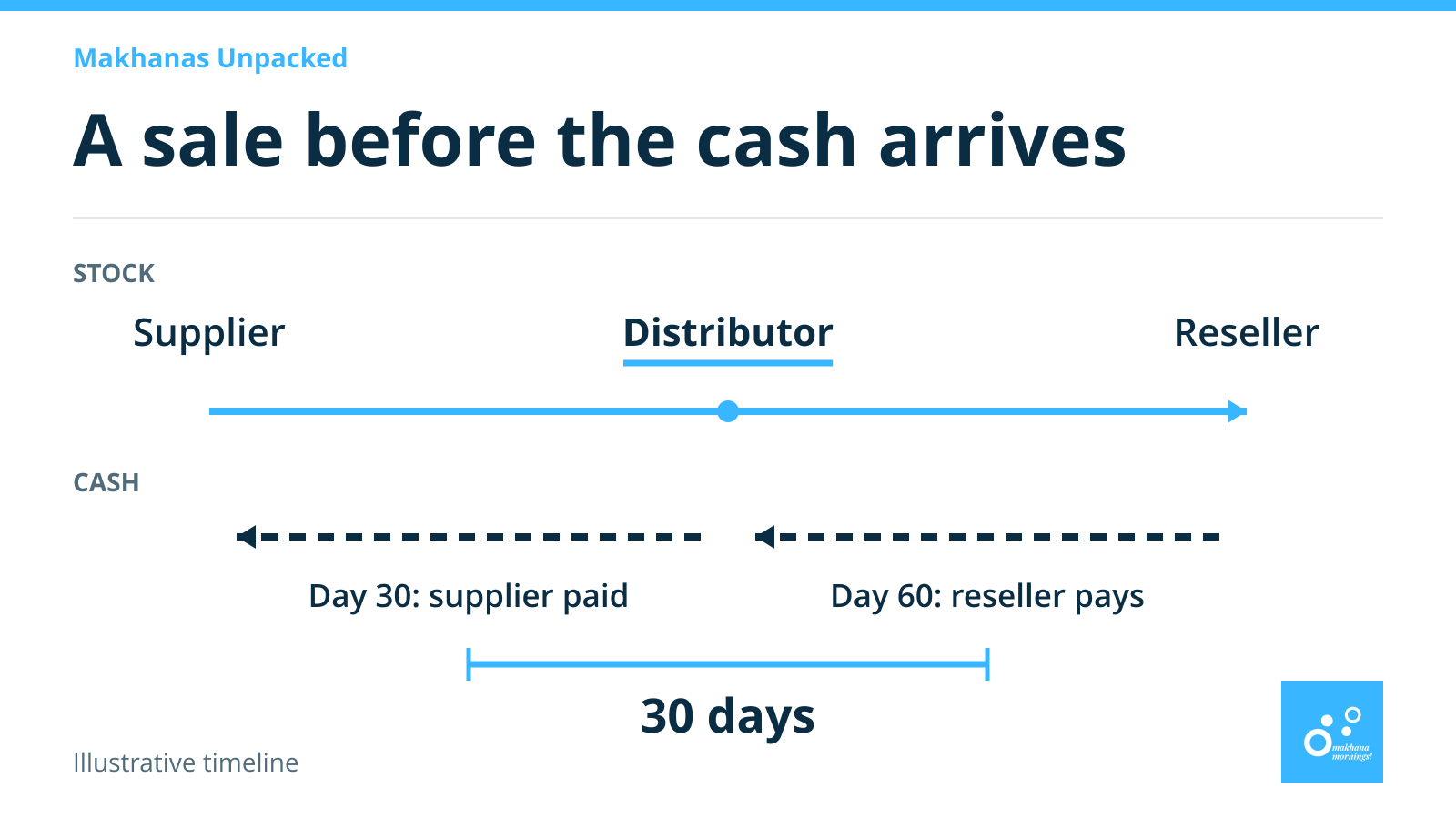
A shipment can leave the warehouse weeks before its payment arrives. In between, the distributor may already owe its supplier. That gap helps explain why moving more products can require more money, even when each sale earns a profit.
Redington offers a useful Indian example of the business around the box. Its published services include warehousing and returns handling, partner training, and channel finance arranged through banks and NBFCs. Those are company descriptions of available services, not proof that every customer receives the same terms or results.
The idea in eight frames
Swipe through the visual explanation, or use the arrow controls. The full story continues below.


Read the eight-frame text
SLIDE 1 / 8: Why does a profitable sale still need cash?
Follow one distributor’s ₹10 lakh order
Illustrative example, not company financial data.
Makhanas Unpacked
Big ideas. One bite at a time.
SLIDE 2 / 8: Who is buying from whom?
Physical stock: Supplier → Distributor → Reseller
Batch costs ₹10 lakh
Batch sells for ₹10.4 lakh
The reseller is the distributor’s customer. We follow the same batch throughout.
Makhanas Unpacked
Big ideas. One bite at a time.
SLIDE 3 / 8: Day 0: the distributor receives the stock
Stock: Supplier → Distributor
The whole batch
Supplier’s bill: ₹10 lakh
Payment due: Day 30
No cash leaves the distributor on Day 0.
Makhanas Unpacked
Big ideas. One bite at a time.
SLIDE 4 / 8: Day 20: the distributor delivers to the reseller
Stock: Distributor → Reseller
The whole batch
Reseller’s bill: ₹10.4 lakh
Payment due: Day 60
The stock has left the distributor. The reseller has not paid yet.
Makhanas Unpacked
Big ideas. One bite at a time.
SLIDE 5 / 8: Day 30: the distributor pays the supplier
Cash: Distributor → Supplier
₹10 lakh paid
Reseller: Still owes ₹10.4 lakh
The distributor uses its own cash or borrowing to make this payment.
Makhanas Unpacked
Big ideas. One bite at a time.
SLIDE 6 / 8: Day 30 to Day 60: cash is tied up
Day 30: supplier paid
Day 60: reseller pays
30 days
₹10 lakh funded for 30 days
The distributor has paid for the stock but has not collected the sale proceeds.
Makhanas Unpacked
Big ideas. One bite at a time.
SLIDE 7 / 8: Day 60: the reseller pays the distributor
Cash: Reseller → Distributor
₹10.4 lakh received
₹10 lakh restores the cash used for stock
₹40,000 remains before other costs
If the stock was funded with borrowing, that funding also needs repayment.
Makhanas Unpacked
Big ideas. One bite at a time.
SLIDE 8 / 8: Profit and cash needed are different numbers
₹40,000 gross profit
₹10.4 lakh selling price − ₹10 lakh stock cost
₹10 lakh temporary funding
Needed from Day 30 until Day 60
Simplified example. Freight, staff costs, interest, losses and tax excluded.
Read the full story at makhanamornings.com
Makhanas Unpacked
Big ideas. One bite at a time.
The Breakdown
Imagine a small technology distributor buying a batch of devices for ₹10 lakh and selling the entire batch to a reseller for ₹10.4 lakh. These are illustrative numbers, not Redington’s prices, margins or credit terms. Ignore tax, freight, staff costs, interest and losses initially so the timing stays visible.
The stock arrives on day 0. The reseller takes it on day 20 and agrees to pay 40 days later, on day 60. But the distributor must pay its supplier on day 30.
For 30 days, from day 30 to day 60, the distributor needs ₹10 lakh from its own cash or another funding source. The devices have already been delivered. The customer payment is still outstanding.
The batch earns ₹40,000 in gross profit before the excluded costs. That is a different calculation from the ₹10 lakh temporarily needed to settle the supplier’s bill. A profitable invoice cannot, by itself, pay that bill.
Growth changes the cash requirement
Now double the order while keeping the same dates and prices per device. Two identical batches cost ₹20 lakh and sell for ₹20.8 lakh. Gross profit becomes ₹80,000. The temporary funding requirement also doubles to ₹20 lakh.
There is no deterioration in this example. Customers pay exactly when promised. The larger cash requirement comes from doing more business under the same terms.
The cash operating cycle describes the time between paying suppliers and collecting sales proceeds. Inventory time and customer credit lengthen it, while supplier credit offsets part of it. In a real company, reported averages combine many transactions and may use different calculation conventions. Our single-batch timeline avoids treating an average as an exact invoice deadline.
The terms can matter as much as the order
Suppose the original reseller pays on day 75 instead of day 60. The ₹10 lakh now needs funding for 45 days. The selling price has not increased to compensate for that extra 15-day wait. Whether the delay reduces the eventual profit depends on financing and collection costs, which our example has deliberately left out.
A separate scenario shows the sensitivity to price. Reduce the original ₹10.4 lakh selling price by 2%, without changing the ₹10 lakh purchase cost. Revenue becomes ₹10.192 lakh and gross profit falls to ₹19,200. A modest discount has consumed more than half the original gross profit, before any other expense.
These examples are alternatives, not claims about a particular distributor’s customers or forecasts of its performance.
What the intermediary contributes
A brand and a local reseller could trade directly. The practical question is who would then do the work the intermediary handles, and on what terms. A reseller comparing offers needs to consider the purchase price alongside delivery, support and the payment date. The cheapest invoice may not describe the whole arrangement.
The supplier contract also matters. Global technology distributor TD SYNNEX describes arrangements including rebates, early-payment discounts and price protection, alongside customer-credit checks. Its FY2025 filing shows that procurement and credit management involve more than transporting products. Those arrangements are company-specific, not automatic protections for an Indian reseller.
For an Indian business buying through distribution, this makes a written comparison more useful than a general claim about scale. Which entity invoices the order? When is payment due? Who handles a faulty device or a return? Which promised service is included, and which carries a separate charge?
The Big Picture
Redington’s service offering illustrates why technology distribution can extend beyond a warehouse. The worked example explains a separate point: the distributor must manage the money between purchase and collection. Neither establishes an unbeatable competitive advantage or tells us what the company’s current shares are worth.
This differs from the question of how brands choose their stockist networks. Our explanation of Honasa and Tata Consumer’s distribution choices examines that structure. Here, the focus is the timing and economics of an individual distributor’s transaction.
The Crunch
A distributor needs to know both what remains after a sale and how much cash is required before the customer pays. More orders can improve the first number while increasing the second. The dates on the invoices are part of the business model.


Leave your thoughts