
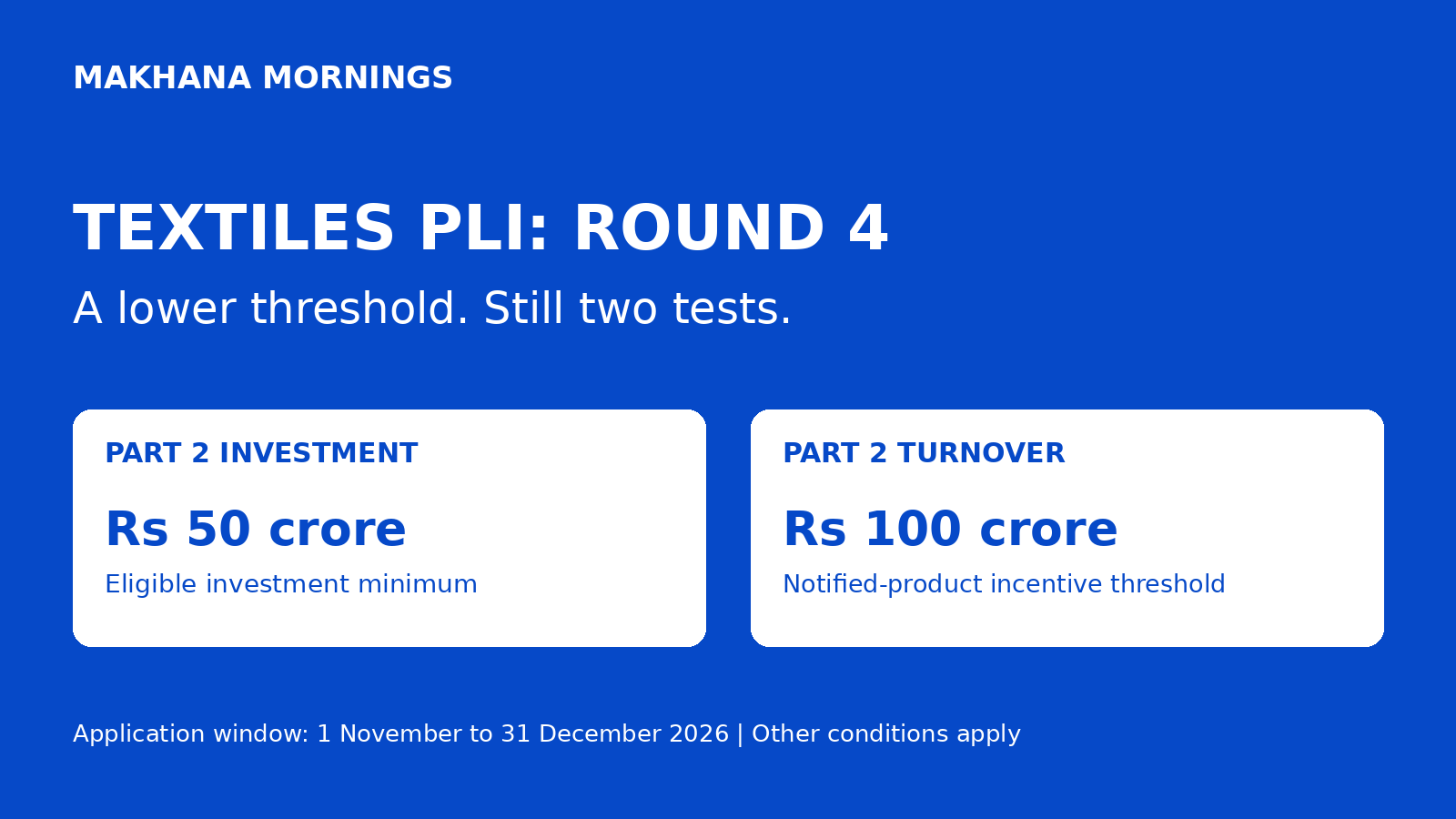
Textiles PLI has a lower turnover threshold, but it is not a blanket subsidy for small manufacturers. The useful question is whether a proposed project can meet the product, investment and performance conditions, not simply whether the business is called an MSME.
The Ministry of Textiles announced Round 4 on October 28, 2026, with applications scheduled from November 1 to December 31. This is an explanation of that existing window, not a new opening announced today. The change reduces Part 2’s minimum turnover criterion from ₹200 crore to ₹100 crore.
Investment and turnover are separate tests
The October 28 notification sets Part 2 at ₹50 crore of eligible investment and ₹100 crore of turnover from manufacturing and selling notified products. Part 1 requires ₹150 crore and ₹600 crore respectively. Both conditions must be met for incentives.
The ₹100 crore figure is therefore not a statement that any company with that much historical revenue automatically qualifies. The notification distinguishes willingness to make the qualifying investment for participation from achieving the required notified-product turnover for incentives.
For subsequent incentive years, the notification requires at least 10% turnover growth over the preceding year. Rates decline annually: Part 1 runs from 15% to 11%, and Part 2 from 11% to 7%, over five performance years. Eligible sales must pass through normal banking channels.
Only specified products and costs count
The portal’s fresh-applicant FAQ limits coverage to notified man-made-fibre apparel, MMF fabrics and technical textiles. A manufacturer needs to check its product against the notified list; a general textile or MSME description is not enough.
The FAQ includes new plant and machinery, factory buildings, associated utilities and qualifying R&D expenditure capped at 10% of project cost. It excludes land, administrative buildings and used machinery. It also requires project details, manufacturing-location documents and company authorisation records. Fresh applicants pay a ₹50,000 registration fee and may apply under only one part.
The extension is not an immediate cash payment
Under the notification’s timetable, FY2026–27 and FY2027–28 are the gestation period. Performance begins in FY2028–29, with the first claim year in FY2029–30. FY2032–33 is the last performance year and FY2033–34 the last claim year for Round 4.
That distinction matters to project planning. An incentive linked to later performance is not cash available today to buy machinery. A viable investment plan still needs financing, customers and the ability to meet the scheme’s conditions.
Migration has a consequential trade-off
The official migration FAQ says moving from Rounds 1–3 is optional. Participants that have submitted, claimed or received incentives are ineligible; a pending claim is not a clean slate.
Eligible participants must withdraw their earlier application or approval and submit a fresh Round 4 application. The FAQ says withdrawal is final and the old approval cannot be restored. It warns that withdrawing without filing in time leaves the applicant outside the scheme. Existing investment can also need depreciation adjustments. This is a decision to check with the scheme’s project management agency before acting, not merely a deadline reminder.
What this explanation does not establish
The notification says detailed operational guidelines incorporating the changes will follow. We verified it and the official Round 4 FAQs, but did not locate a newer consolidated guideline. The portal homepage was unavailable during this check, although its hosted documents were retrievable. This article summarises key published conditions, not every compliance requirement or an eligibility ruling for an individual applicant.
Applicants should verify the latest product list and instructions through the official PLI portal and project management agency before committing funds or withdrawing an approval.
For the wider policy question, see our separate analysis of PLI investment, jobs and local suppliers. Opening participation and proving outcomes are different tests.


Leave your thoughts