
ACME Solar’s latest Bikaner battery update is a reminder to keep the label beside the number. Installed storage, commissioned discharge capacity and the full project’s planned configuration are not interchangeable measures.
What changed
In its 17 November exchange filing, ACME says subsidiary ACME Greentech Seventh commissioned another 52.32 MW/209.28 MWh of battery discharge capacity that day. The project is at Kelan in Rajasthan’s Bikaner district.
The company specifies 19 November 2026 as the commercial-operation date for this addition. As of this report on 18 November, that date is still ahead, rather than a completed commercial milestone.
Three figures to keep separate
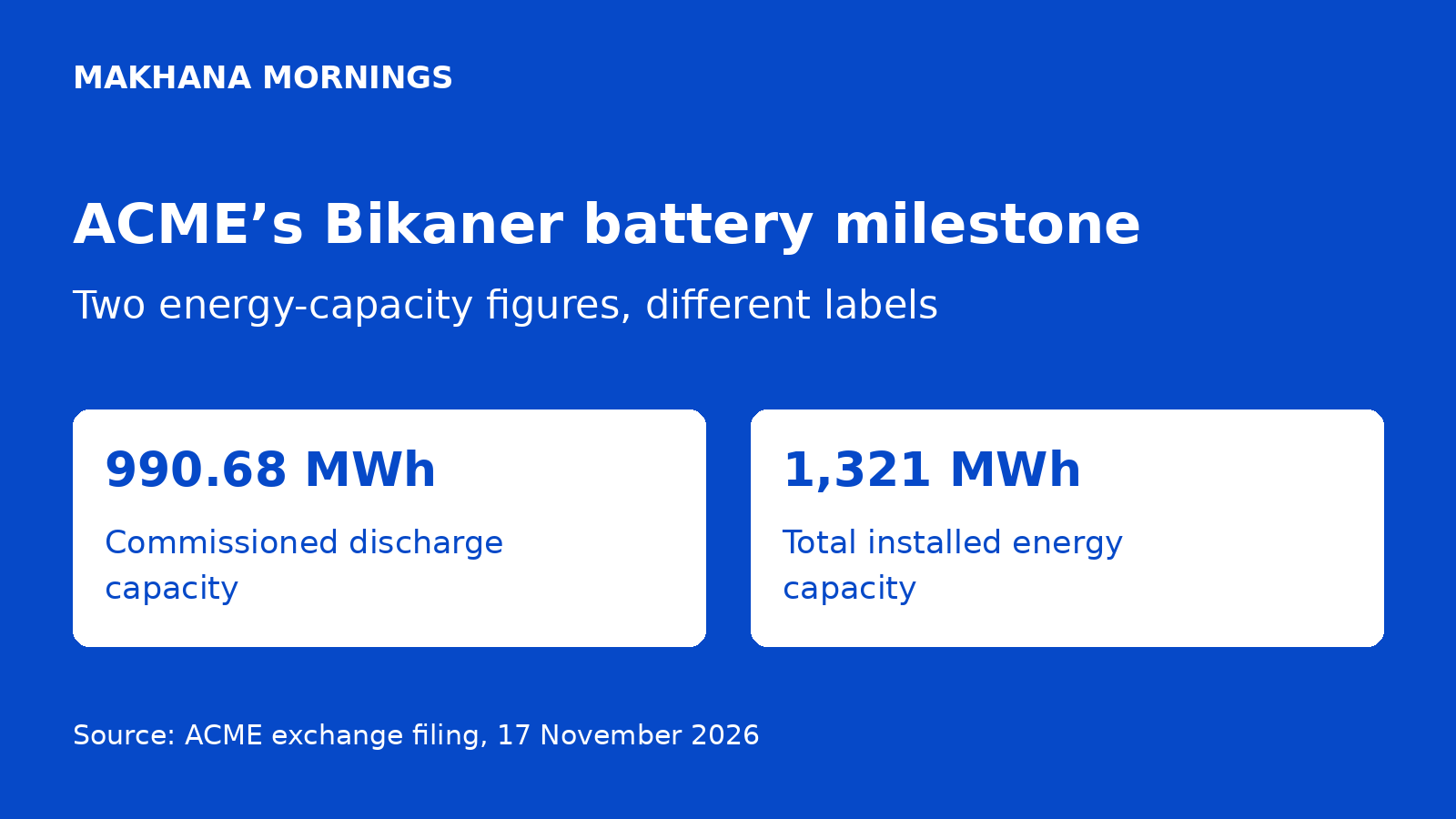
The filing puts cumulative commissioned battery discharge capacity at 247.67 MW/990.68 MWh. It separately states total installed capacity of 247.67 MW/1,321 MWh. The full firm-and-dispatchable renewable project’s battery discharge configuration is 300 MW/1,200 MWh.
ACME says the project has a power-purchase agreement with SJVN. This is a different project from the Morena solar-and-storage PPA previously covered by Makhana Mornings.
Our reading: capacity needs a definition
MW measures power, while MWh measures a quantity of energy. A storage headline needs both, along with an explanation of which capacity is being described. A larger installed-energy number should not automatically be substituted for the company’s stated discharge-energy capacity.
Nor does the ratio between these two figures establish round-trip efficiency. That would require appropriate charging and discharging measurements and a defined test boundary, not simply two capacity labels.
For a power buyer, the commercial question is when contracted supply can be delivered and on what terms. For readers of the announcement, the immediate discipline is simpler: distinguish the latest addition from the cumulative position and the still-larger full-project configuration.
What this update does not establish
The filing is a commissioning update, not an operating-performance report. It does not quantify electricity actually dispatched, receipts or profit from this addition. Those outcomes require further evidence after operation begins.




Leave your thoughts