
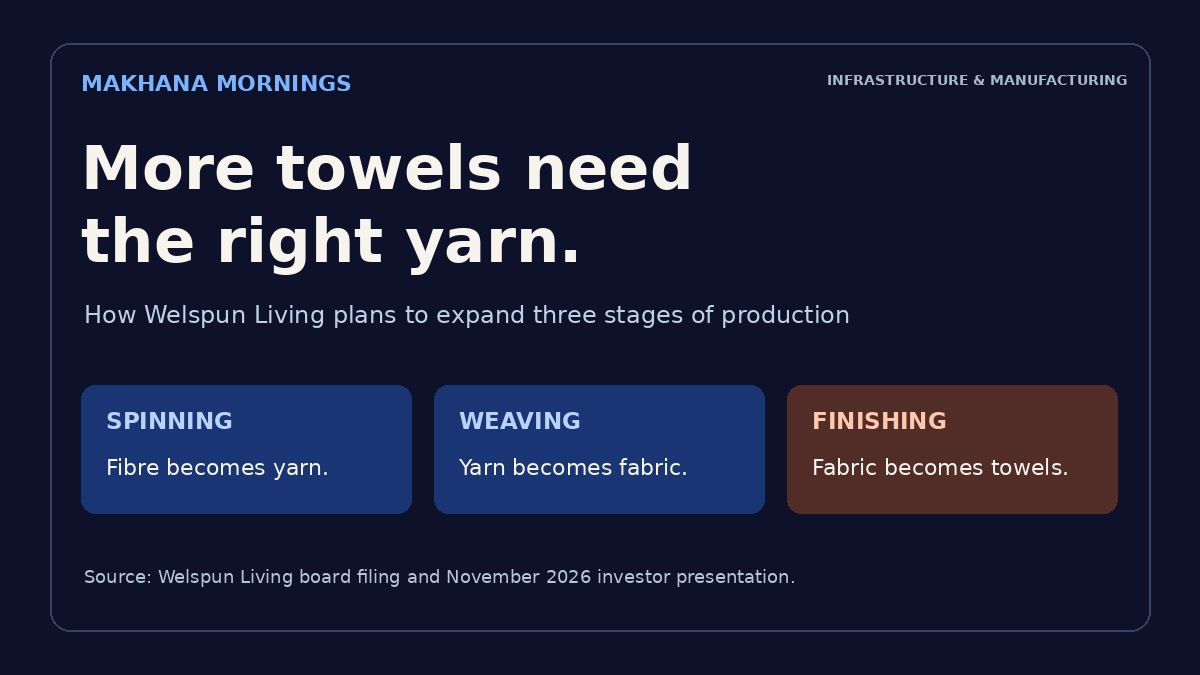
Welspun Living wants to make more towels. In its 23 November investor presentation, the home-textile maker set out why it also wants to make more of the yarn and fabric that go into them. Its board approved spending of up to ₹3,200 crore through wholly owned Welspun Home Solutions.
Three capacity figures measure different stages
The plan adds about 29,000 tonnes a year of terry towel capacity. It also adds about 31,000 tonnes of annual yarn capacity and 15,000 tonnes of annual weaving capacity, alongside a research and development centre.
Spinning turns fibre into yarn. Weaving turns yarn into fabric. A finished towel still has to be processed, cut and sewn. Adding the three capacity figures would count different stages as if all their output were finished towels. The figures also do not show how much yarn or fabric will go into towels rather than other products.
More control over inputs can help with repeat orders
Think of a retailer asking for another batch of a towel already on its shelves. Extra finishing capacity helps only if the right fabric is available. Making more yarn and fabric in-house gives Welspun more control over production schedules and specifications. Management expects shorter lead times and less reliance on outside suppliers. Those benefits still depend on how reliably the new lines run.
The trade-off is that the company takes on more of the work and the fixed costs. Its existing towel capacity was 83% utilised as of 30 September, according to the board filing. That is a snapshot across the group, not a measure of spare capacity in every yarn type, fabric width or towel line.
The timeline and financing are still plans
The company targets adding the capacity by 31 December 2028. The approved financing allows up to ₹800 crore of investment by the parent and up to ₹2,400 crore in borrowing by the subsidiary from banks and financial institutions, backed by a parent guarantee. Those are ceilings, not amounts already drawn.
The next test is whether spinning, weaving and towel production come online in the right sequence. More output gives Welspun room to take orders. Getting the right material to the next machine on time is what can make those orders easier to deliver.

Leave your thoughts