
A Kerala exporter can have an order ready to ship and still need to bring an empty container from Kochi to Kottayam before loading it. A rubber shipment for tyre maker MRF shows another way to get that box: use one that has just been emptied by an importer. It sounds like a shorter trip. Whether it actually is depends on where the box is emptied and who would have moved it otherwise.
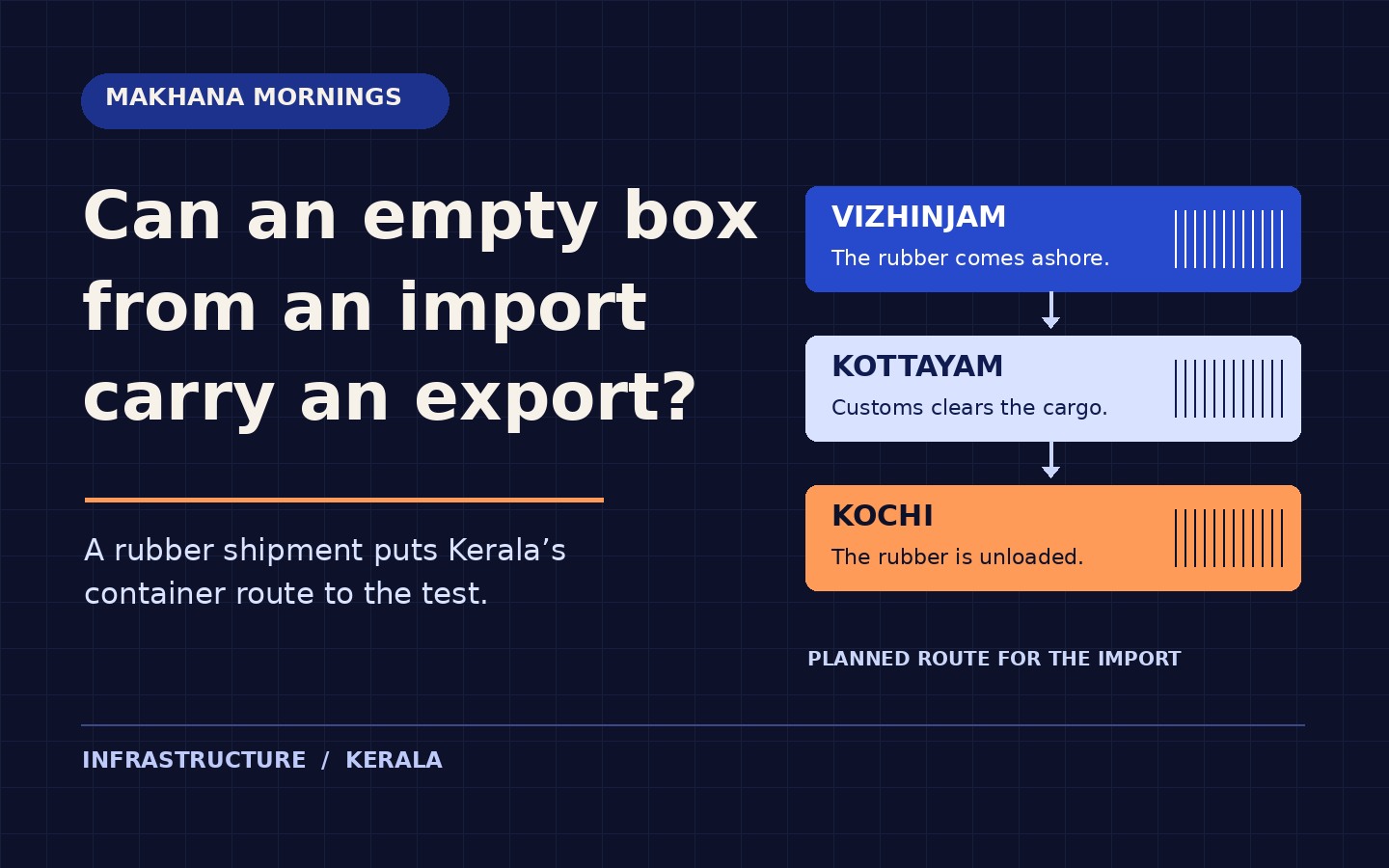
Kerala announced that about 1,500 tonnes of natural rubber from Africa would move in 60 containers from Vizhinjam through Kottayam’s inland container depot. Trade reporting on 23 November said the containers had been discharged at Vizhinjam and were expected at Kottayam that day. Customs clearance, delivery to MRF and any export reuse were not yet confirmed.
The rubber and the container have different journeys
The plan is to take the loaded containers by road from Vizhinjam to Kottayam, where customs can inspect them and release the cargo. The same trucks would then take the containers to MRF’s warehouse in Kochi. That is where the rubber delivery ends.
The box need not end its journey there. Under the arrangement described by Kerala, the empty containers could return to Kottayam’s yard and be made available to exporters. A local business with a shipment ready could then secure a box at the depot where it plans to load the cargo.
A box available in Kottayam can help even if it still travels empty
Kochi to Kottayam is still a road leg if a container is emptied in Kochi and sent back. If that return replaces another trip to fetch a box, the arrangement can avoid handling or a separate move. If it simply shifts an existing move from the exporter to the importer or carrier, the main gain for the exporter may be knowing that a box will be available nearby.
A spare container is not automatically a usable one. The exporter needs the right size and condition, authorisation from the carrier or container owner, and a return or loading window that fits the booking. If those do not line up, the box can sit empty while the exporter still has to find another one.
The useful comparison is the time and cost of getting a box ready to load
The shipment is an opportunity to test the arrangement, not proof of savings. To judge it, ask how long the import took from discharge to release, where the box was emptied, who paid to move it after unloading, and whether a specific exporter loaded it on time. That last step is what turns a possible second use into a real one.


Leave your thoughts