
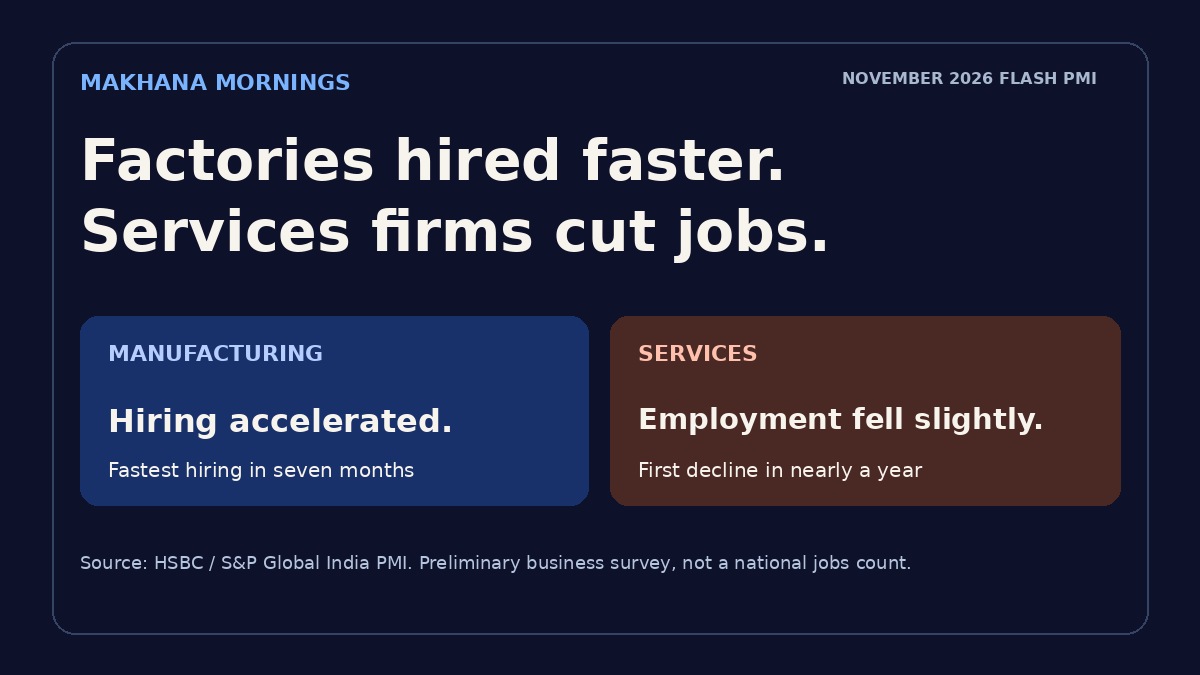
India’s November business survey found a split between the people making goods and the firms selling services. Manufacturers stepped up hiring, while services firms reduced staffing even as their business activity continued to grow. The combined activity index barely moved.
Factory hiring accelerated while services employment fell
In the preliminary HSBC survey compiled by S&P Global, the composite output index moved from 56.2 in October’s final reading to 56.3 in November’s early reading. The headline manufacturing PMI rose from 54.7 to 56.0, with stronger orders and production. The factory output index rose from 57.0 to 58.3. The services activity index moved the other way, from 55.8 to 55.3.
Hiring diverged more sharply. Manufacturers added staff at their quickest pace in seven months, while services firms reported a slight decline in employment, their first in nearly a year. Employment across the two survey panels edged up overall. The services activity index was still above 50, the survey’s dividing line between expansion and contraction compared with the previous month.
How the survey combines factory and services activity
The manufacturing PMI blends measures such as new orders, production and employment. The services headline tracks business activity directly. To calculate the composite, S&P Global uses the factory output index and the services activity index, weighting them by sector size. Averaging the two published sector headlines will not get you 56.3.
The indexes track the direction of change reported by businesses, not the number of jobs created or the percentage change in output. November’s reading is preliminary and may change as more companies respond.
What the hiring split can tell you
If you want to understand how business growth is translating into employment, follow the staffing numbers as well as orders and activity. A firm can handle more work with fewer people for a month. The survey identifies that divergence; it does not tell us whether services firms changed their staffing because of costs, productivity or a different mix of work.
For the national labour market, look to the household survey. It put the unemployment rate for people aged 15 and over at 4.9% in October. That result covers a different month and population. It cannot settle what happened to national unemployment when surveyed services firms reduced staffing in November.



Leave your thoughts