
A solar farm can produce plenty of electricity at noon and none at midnight. A utility that needs more power after dark is buying something different from daytime generation: delivery at the hours it asks for.
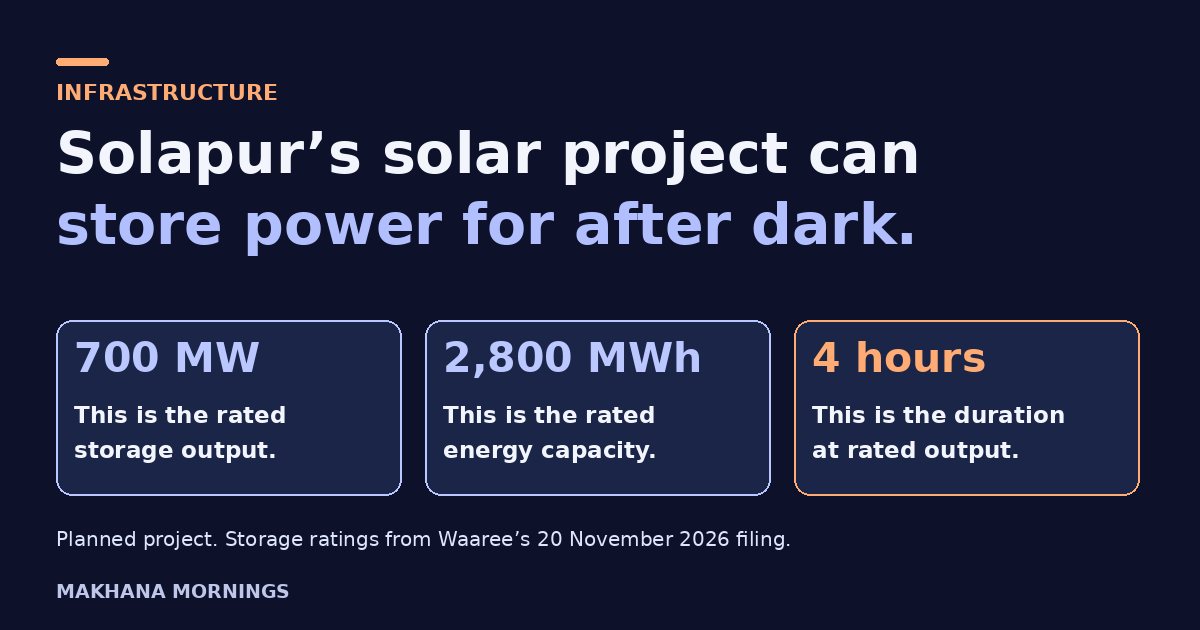
On 20 November, Waaree Forever Energies signed a power purchase agreement with the Solar Energy Corporation of India (SECI). The proposed project in Solapur, Maharashtra, combines 700 megawatts of solar capacity with storage rated at 700 megawatts and 2,800 megawatt-hours. The signing moves the project from an August award to a contract. It does not mean the project has started supplying power.
Megawatts tell you how fast. Megawatt-hours tell you how much.
The storage rating of 700 MW describes how much power the system can deliver at a given moment. The 2,800 MWh describes how much energy it can store at its rated capacity. Divide 2,800 MWh by 700 MW and you get four hours at the rated output. That describes a fully charged system on paper, not its actual output through the night. Nor does adding the two 700 MW figures give you 1,400 MW of solar capacity.
The buyer gets to pick the hours
In the SECI tender that awarded Waaree the project, the buyer chooses four hours each day within the non-solar window. The hours need not form a single four-hour block. This lets the buyer ask for power when it needs it instead of taking whatever the panels happen to generate. The tender sets out consequences for falling short of what was scheduled.
SECI’s auction result lists Waaree’s winning bid at ₹5.99 per kilowatt-hour for 700 MW. Two other winners in the same tender, NTPC Renewable Energy and ACME Solar, won 500 MW and 300 MW respectively at ₹6.00 per kilowatt-hour. Those are auction prices for assured peak supply, not household electricity rates or a comparison with the price of solar generation alone.
The next test is whether the project can deliver on schedule
Waaree’s August filing says the agreement runs for 25 years from the scheduled start of supply, not from signing. The November notice does not give that start date. Watch for commissioning and, once the project operates, how often it supplies the contracted energy in the hours requested. The first tells you the equipment is ready; the second tells you whether the buyer is getting what it paid for.

Leave your thoughts