
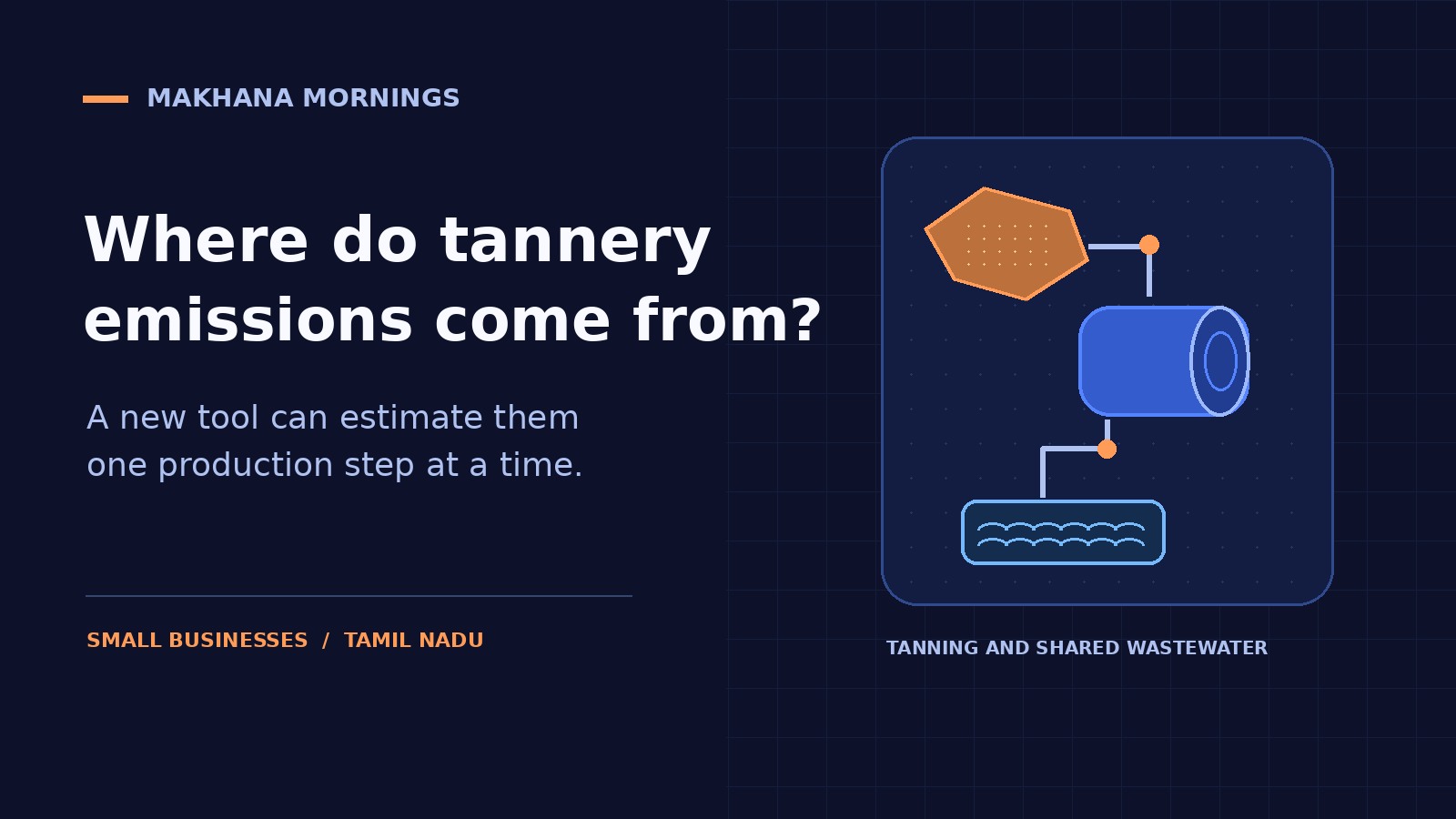
A tannery’s electricity bill can tell it how much power it bought. It cannot, on its own, tell the owner whether the biggest opportunity to cut greenhouse gas emissions is in the tanning drums, the finishing line or the plant that treats the wastewater.
On 20 November, the Central Leather Research Institute (CSIR-CLRI) exchanged technology-transfer agreements for its CLI-Mate software with four manufacturers: Sai Chamois, KAR Leathers and Vaigai Leathers in Dindigul, and VRS Leathers in Chennai. The tool estimates emissions at different steps of leather production and can also assess waste treatment. The agreements do not show that the firms have completed an assessment or cut emissions.
The tool separates emissions by stage
The software takes in production data such as raw materials, chemicals used, fuel and electricity, water and waste. It converts those inputs into estimates in carbon dioxide equivalent, a common unit for the warming impact of different greenhouse gases. A tannery can then see how estimates differ across preparation, tanning and finishing instead of treating the factory as one number.
Consider a tannery deciding between a more efficient finishing machine and changes to how it heats water. If its records show that heating accounts for a larger share of emissions, it has a reason to investigate the boiler first. That is an example of how the estimates could guide a decision, not a finding about any of the four firms.
Wastewater treatment is part of the picture
In Dindigul, a separate agreement exchanged on 11 November covers the common effluent treatment plant run by TALCO-DINTEC. The plant treats wastewater from the leather cluster. It uses energy to provide a service that benefits several factories, even though the work does not happen inside any one tannery’s gate. Measuring that facility separately makes the boundary visible; sharing its emissions across suppliers would still require an allocation method that avoids double counting.
The institute lists an annual licence of ₹15,000 plus GST for leather units that process under two tonnes a day, and ₹25,000 plus GST for those above two tonnes, shared treatment plants and other eligible facilities. The licence gives access to software and support, not a verification certificate. A useful assessment still needs sound records and clear boundaries.
The first useful result is a better decision
The test is whether the estimates help a factory choose what to measure more closely or change first. To tell whether an intervention worked, the business would then need to compare like-for-like production periods and check that the emissions did not simply move to a different supplier or part of the process.

Leave your thoughts