
A company can have oil left underground and still decide not to drill another well. If its contract ends before the well earns back what it cost to drill, leaving the oil where it is may make more sense. India’s revised rules for certain older oil and gas contracts address that mismatch.
Two notifications dated 10 November cover separate groups: seven blocks awarded before India’s New Exploration Licensing Policy, and 22 named small and medium fields, including Ravva and Kharsang. Eligible operators can seek extensions for as long as production remains commercially viable, in periods of up to 30 years each. Neither notification grants an extension to any individual operator.
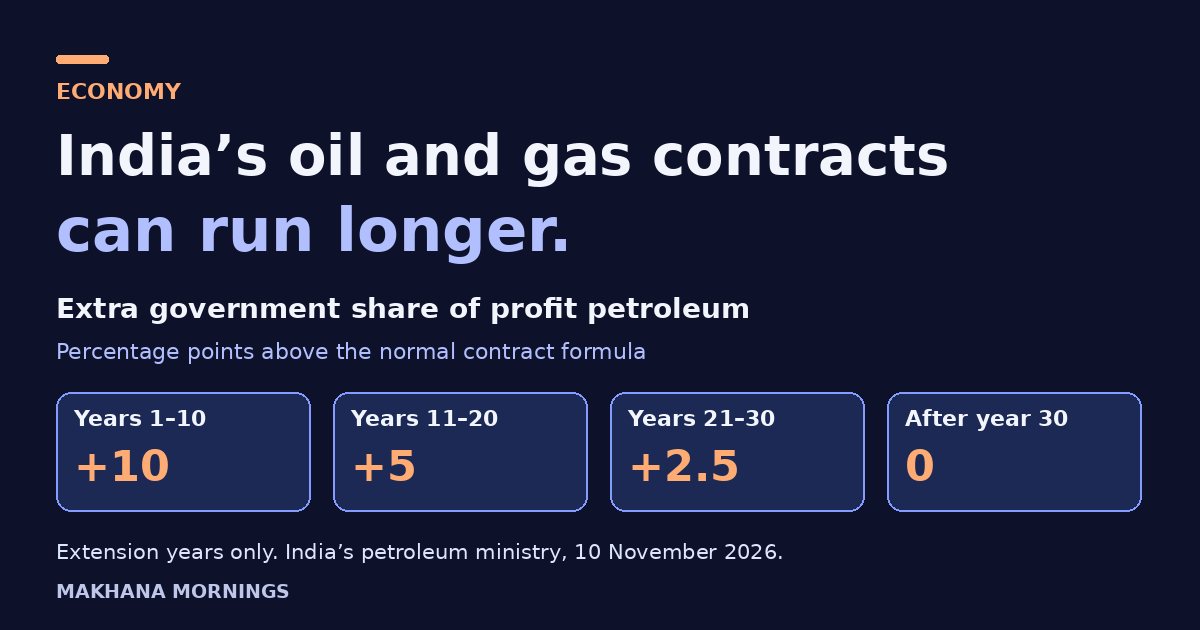
The government’s additional share falls over time
Under a production-sharing contract, the government and the contractor divide what the contract calls profit petroleum: the part of production, or its value, remaining after eligible costs are recovered under the contract. It is not the same as total sales or the operator’s accounting profit.
For the first ten years of an extension, the government gets 10 percentage points above its normal contractual share of profit petroleum. The addition falls to five points in years 11 to 20, then to 2.5 points in years 21 to 30. If a contract is extended beyond year 30, the normal formula applies without an addition.
If the normal formula would give the government 20% in year five of an extension, it would get 30% that year, not 22%. The normal share can itself change from year to year, so the schedule tells you the addition, not the government’s final share.
An operator has to show what more time would buy
For the 22 named fields, an application needs an independent audit of recoverable reserves and a revised development plan. That plan compares expected production with no change to the previously approved work against expected production if the proposed work goes ahead. The operator has to spell out what it would do and what that would cost.
That comparison matters. If a field would produce much the same amount without new work, an extension may do little to bring additional oil or gas to market. If a new well or better recovery can lift output enough to cover its costs, a longer contract gives that investment more time to pay back.
An extension is only the first milestone
Look for three separate developments: an approved extension, a funded work programme and evidence that production actually rose above the field’s expected path without the new work. The rules make the first possible. They do not, on their own, deliver the third.



Leave your thoughts