
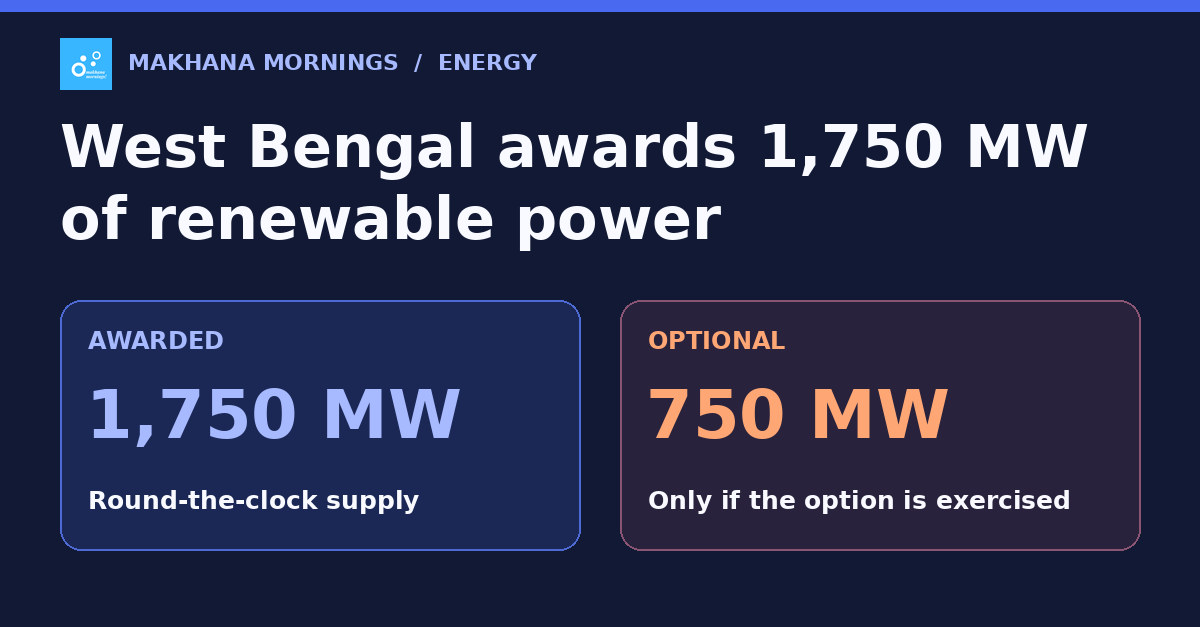
West Bengal’s state power distributor has awarded a 25-year deal for 1,750 megawatts (MW) of round-the-clock renewable power to Powerpulse Trading Solutions, a subsidiary of Adani Energy Solutions. The award includes an option for another 750 MW. That puts the potential total at 2,500 MW, but the extra capacity is not part of the base award.
The base award and the option have different start dates
Adani Energy Solutions says Powerpulse won the award through a competitive auction. The West Bengal State Electricity Distribution Company is scheduled to start receiving the initial 1,750 MW on 1 July 2028. If the distributor exercises the option, the additional 750 MW is scheduled to start on 1 April 2029. Neither date means power is being delivered now.
The distributor is buying power when it needs it
The award is for a supply commitment, not an announcement that Powerpulse will build a single 1,750 MW plant. A solar farm produces when sunlight is available; a distributor also has to serve customers after dark. Pairing different sources of generation with stored energy is one way to meet a delivery schedule that extends beyond any one plant’s generating hours.
Adani Energy Solutions says Powerpulse has arranged access to around 4.6 gigawatts of solar and wind capacity and around 3.5 gigawatt-hours of battery storage across its wider business. The announcement does not say how much of that capacity is reserved for this order. It also does not disclose the purchase price or the full delivery terms.
What to watch before supply starts
The first test is whether Powerpulse can deliver the base 1,750 MW on the agreed schedule. The second is a separate decision: whether West Bengal takes the additional 750 MW. The number that matters today is the supply awarded, not the maximum the deal could reach.


Leave your thoughts