
The factory can be the product
A chemical company does not always have to invent the customer’s molecule to win the customer’s business. It can become the organisation that works out how to make that molecule reliably, or builds and runs the factory that produces it. That changes what is being sold: not just material, but a manufacturing capability.
Indian producers have built versions of this model through different routes. Navin Fluorine added research and custom manufacturing to its fluorochemical base. Aarti Industries now offers a connected research, pilot and production service. These are specific business histories, not proof that every product called a specialty chemical commands a premium.
The idea in nine frames
Follow the visual explanation, or continue below for the full story. All nine frames can be read in order.
Swipe through the visual summary, or use the arrow controls. The full explanation continues below.


Read the nine frame text
Frame 1 of 9
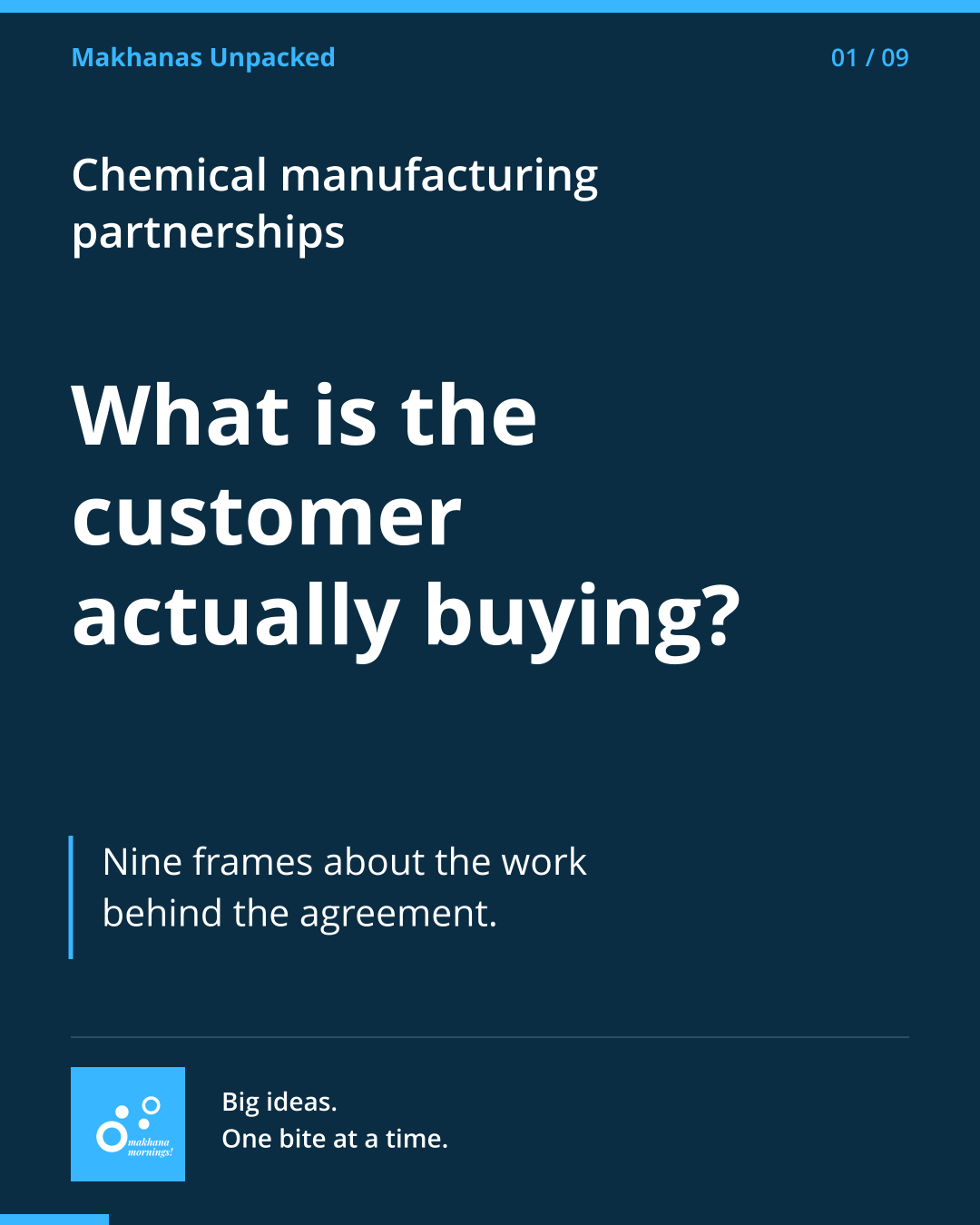
Chemical manufacturing partnerships
What is the customer actually buying?
Nine frames about the work behind the agreement.
Frame 2 of 9
Capability building
Navin Fluorine
2009
Research laboratories
Pilot plant
Contract development
Beyond production
Frame 3 of 9
A connected service
Aarti Industries
Process design
Pilot work
Commercial production
An offering, not a delivery guarantee.
Frame 4 of 9
The delivery test
Navin Fluorine
April 2026 report
European customer agreement
Validation completed
Commercial supplies started
A new plant still needs process checks.
Frame 5 of 9
Different responsibilities
October 2026
Customer
Proprietary technology
Aarti
Construction
Operations
Planned facility
Subject to approvals
Frame 6 of 9
Named customer
2025 agreement
Chemours
Opteon cooling fluid
Navin Fluorine
Manufacturing
Adoption needs separate evidence.
Frame 7 of 9
Cancelled contract
Aarti
Historical example
Fees received
Other customers
Gradual ramp
Frame 8 of 9
Who carries which responsibility?
Funding
Who pays for the facility?
Technology
Who controls the process?
Demand
What happens if orders change?
Frame 9 of 9
The evidence test
Which part is a promise?
Which part is evidence?
Look at the work and the obligations.
Build the missing steps
Navin’s history begins with fluorochemicals, including refrigerant gases, in 1967. In 2009 it established a dedicated contract development and manufacturing business, with a pilot plant and research laboratories at Dewas. In 2011 it took a controlling stake in Manchester Organics; the acquisition was completed in 2015. The company describes the move as a way to deepen complex fluorination expertise.
There is a later operating milestone, not just an investment plan. Navin’s April 2026 presentation reported completed validation and the start of commercial supplies from a new manufacturing facility under a European customer agreement. Validation means the manufacturing process has passed the required checks; it is a separate step from building the plant.
Aarti offers route design: working out how to make the chemical. Its services include process development, pilot work, technology transfer and commercial production, alongside quality improvement and process safety studies. The offering includes developing the production process and transferring it into operation.
The customer can keep the technology
Aarti’s agreement announced on 13 October 2026 illustrates a different division of work. The unnamed customer supplies proprietary process technology; Aarti is to establish and operate a dedicated Indian manufacturing facility. The arrangement runs for more than ten years. Commercial operations are expected in the 2028 to 2029 financial year, subject to approvals. It is an announced project, not a factory already delivering those future sales.
That distinction explains why outsourcing manufacturing need not mean outsourcing ownership of the invention. One party can retain the technology while the other contributes engineering, construction and operations. The commercial question becomes how the two parties divide investment, execution responsibility and demand risk, not simply who has the chemical formula.
A named customer shows the connection
There is also evidence from the buyer’s side. In May 2025, Chemours announced an agreement for Navin Fluorine to manufacture its proprietary Opteon two phase immersion cooling fluid. The intended application was cooling advanced data centre equipment. That is a named customer selecting an Indian manufacturing partner for its own product, rather than an Indian producer merely announcing ambitions in a fashionable market.
The agreement establishes the relationship. It does not, by itself, establish widespread adoption, realised revenue or a particular saving for data centre operators. Those are separate questions. Keeping them separate lets the business mechanism remain visible without turning a customer announcement into an unsupported success claim.
A contract does not remove the market
Aarti’s report for the 2022 to 2023 financial year records an earlier contract for a herbicide intermediate cancelled by its customer because of challenges related to demand. Aarti received eligible shortfall and termination fees, and said the plant had begun supplying other customers. The same report described a gradual ramp up. This historical example shows why contract protections and alternative uses for an asset belong inside the business model.
The lesson is not that agreements lasting many years are worthless. They can assign consequences when plans change. But compensation is different from recurring product demand, and a replacement customer is different from instant full utilisation. A dedicated asset makes the relationship concrete; it also makes the cost of a changed plan concrete.
The Crunch
The route into a customer’s supply chain is built through choices: add the research capability, connect development with manufacturing, agree who owns the technology, and decide who carries the risk when demand changes. The Indian opportunity in these examples is not simply “more chemicals”. It is doing a larger, clearly defined part of the customer’s work.
For manufacturers and their customers, that is a more useful lens than the specialty label alone. Look at the work being performed and the obligations being accepted. A signed partnership is evidence of a relationship; a functioning plant and repeat business are evidence of what that relationship eventually delivers.



Leave your thoughts