
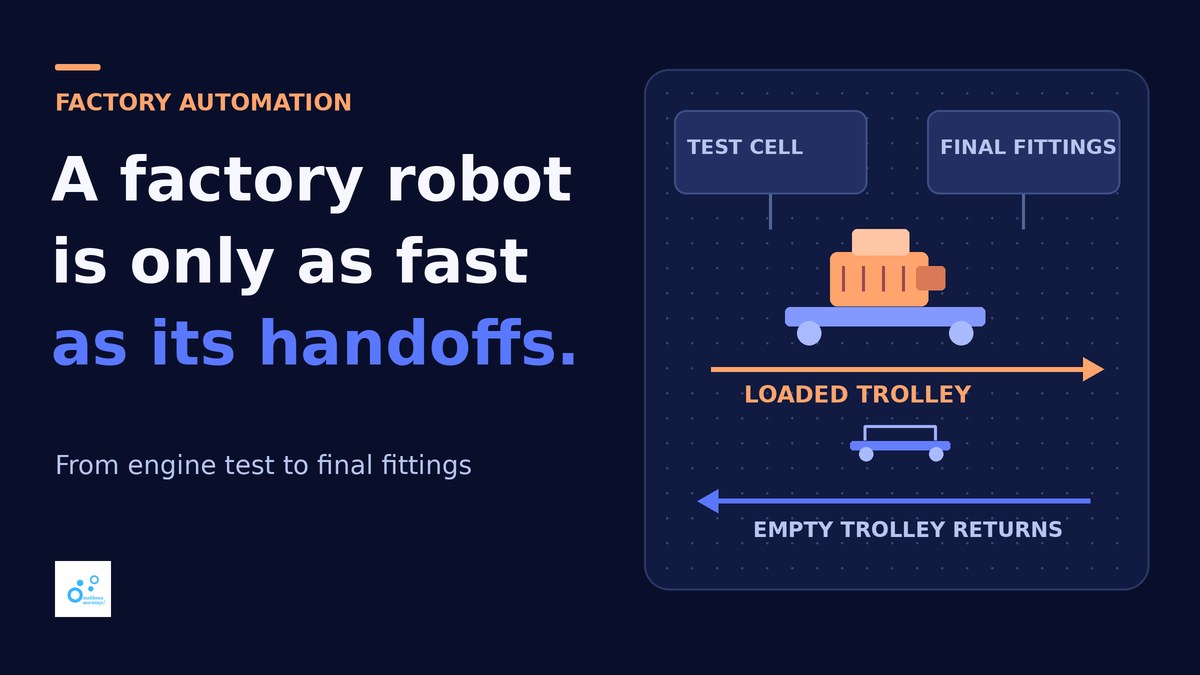
A tested engine can leave a workstation exactly on time and the next one can still be delayed. All it takes is for the empty trolley to be somewhere else.
That is the useful detail in a project robotics supplier Botsync describes at Ashok Leyland. The company, headquartered in Singapore with an office and experience centre in Bengaluru, announced an $11 million round led by IvyCap Ventures on 18 November. The funding is new. The factory example shows an older and more enduring problem: getting equipment, materials and people ready for each other.
The empty trolley was part of the job
According to Botsync’s case study, operators at Ashok Leyland used to push engine trolleys from a test cell to a dressing area, where engines receive their final fittings. The new setup kept a decision with the operator: a person confirmed on a call panel that an engine was ready. Software then assigned a mobile robot to collect the loaded trolley and sent the fleet a parallel instruction to bring an empty trolley back to the pickup point.
The two moves serve different purposes. One delivers the finished work to the next team. The other makes it possible for the first team to keep working. Measuring only the loaded trip would miss half the job. Botsync’s case describes the workflow; it does not independently establish what another factory would save.
A faster trip will not always make the line faster
Imagine the robot takes two minutes to cross the floor, but the trolley pickup often waits six minutes for a signal. A faster robot saves time on the shorter part of the journey. A better signal may save more. If the destination is full, neither change helps unless the next team can clear a spot. Those numbers are illustrative, not Ashok Leyland’s results.
That is where a small pilot can tell a plant more than a catalogue. Track the time from ‘engine ready’ to pickup, how often an empty trolley is available when needed, and how often the receiving station cannot take the load. Watch those measures during a busy shift, not only during the demonstration. The answers tell you whether to change the route, the signal, the trolley supply or the work at the next station.
The Crunch
Before you buy a faster robot, find out what each workstation is waiting for. The most useful test is whether the next team can start on time.


Leave your thoughts