
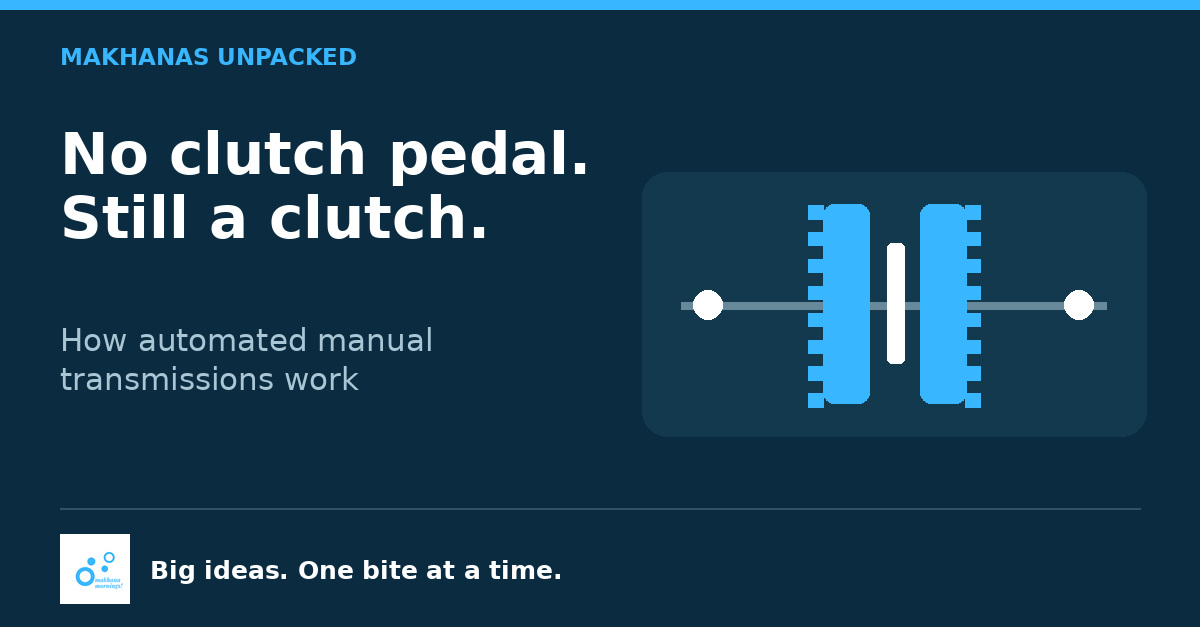
A car with an automated manual transmission (AMT) has two pedals, but there is still a clutch between the engine and the gearbox. The difference is who operates it. That explains both the convenience of an AMT in everyday driving and why its first few gear changes can feel unlike those in another automatic.


The gearbox is still a manual underneath
A manual gearbox uses fixed gear ratios. To change gears, the driver usually presses the clutch pedal, moves the gear lever and releases the pedal. In an AMT, a controller and actuators handle those jobs. The clutch briefly separates the engine from the gearbox, the system selects another gear, and the clutch reconnects the two. The driver still uses the accelerator and brake, but no longer has to coordinate a clutch pedal with the gear lever.
Pulling away from a stop is a different job. The clutch has to engage progressively while the car starts to move. Once the car is moving, you may instead notice a brief pause in acceleration as the gearbox changes gear. How noticeable either feels depends on the car and how the system is calibrated. Hyundai’s Grand i10 NIOS manual, for example, describes a dry single clutch and says shifts can be more noticeable than in a conventional torque-converter automatic.


Why Indian carmakers offer it
An AMT gives a manufacturer a way to offer two-pedal driving using a manual-style gearbox. That doesn’t make it a universal substitute for other automatics. It gives the carmaker another option when deciding which combinations of engine, fuel and transmission to sell.
In September 2026, Maruti Suzuki introduced five-speed Auto Gear Shift versions of the S-CNG Swift, Dzire and Baleno. AGS is Maruti’s name for the AMT in those models. The practical change was that buyers could choose automatic shifting on those CNG variants, not that every CNG car or every Maruti automatic would use the same gearbox.


What to notice on a test drive
Try the exact variant you’re considering. Notice how it pulls away from rest, how it feels when traffic slows to a crawl, and what happens through the first few shifts under gentle acceleration. Those are different tests. A short drive that stays at a steady speed may tell you less than a few minutes of ordinary stop-start driving.


The useful distinction is this: “automatic” tells you what you don’t have to do. “AMT” tells you how the car does it for you.
Read more from Makhanas Unpacked, including what goes into making and qualifying a specialised component.



Leave your thoughts